Chapter 5 of 5
Syllabus
Molecular Basis of Inheritance — Syllabus
Punjab Board · Class 12 · Biology
What Molecular Basis of Inheritance covers in Punjab Board Class 12 Biology: 4 topics, for the 2026-27 session.
45 questions33 flashcards5 concepts
Interactive on Super Tutor
Studying Molecular Basis of Inheritance? Get the full interactive chapter.
Quizzes, flashcards, AI doubt-solver and a step-by-step study plan — built for syllabus and more.
Free trial, no card needed.
Super Tutor
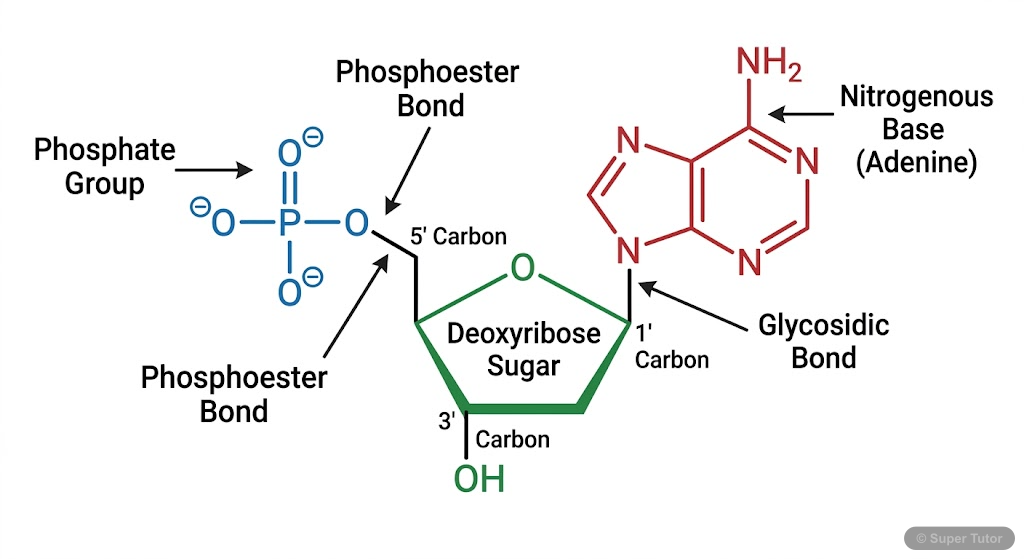
One of 22 illustrations for Molecular Basis of Inheritance in Super Tutor — alongside flashcards, concept maps and practice questions.
4 Topics · Punjab Board Class 12 Biology · 2026-27
Topics in Molecular Basis of Inheritance
1
Structure of DNA
- DNA (Deoxyribonucleic Acid) is a long polymer of deoxyribonucleotides.
- Each nucleotide has three components: a nitrogenous base, a pentose sugar (deoxyribose), and a phosphate group.
- Nitrogenous bases: Purines (Adenine, Guanine) and Pyrimidines (Cytosine, Thymine). Uracil replaces Thymine in RNA.
2
Packaging of DNA in the Nucleus
- Total length of DNA in a human cell (~2.2 metres) must fit into a nucleus of ~10⁻⁶ m — this requires extraordinary packaging.
- In prokaryotes (e.g., E. coli): DNA is organised in 'nucleoid' region with the help of positively charged proteins. DNA forms large loops held by these proteins.
- In eukaryotes: DNA is packaged around histone proteins.
3
Search for Genetic Material – Key Experiments
- DNA was first identified in the nucleus by Friedrich Miescher in 1869 and called 'Nuclein'.
- GRIFFITH'S EXPERIMENT (1928): Used Streptococcus pneumoniae (pneumococcus). S-strain (smooth, virulent, has polysaccharide coat) kills mice; R-strain (rough, non-virulent, no coat) does not kill mice.
- Heat-killed S-strain does not kill mice. BUT mixture of heat-killed S + live R kills mice — and live S bacteria were recovered from dead mice.
4
Properties of Genetic Material and RNA World
- Criteria for a molecule to be genetic material: (1) Ability to replicate, (2) Chemical and structural stability, (3) Ability to mutate slowly for evolution, (4) Ability to express as 'Mendelian Charac
- Both DNA and RNA can replicate (due to complementarity), but only DNA satisfies all four criteria optimally.
- RNA is less stable because of the reactive 2'-OH group at every nucleotide. DNA lacks this group, making it more stable.
Key Concepts
DNA is a polymer of deoxyribonucleotidesThe journey to identify DNA asWhile both DNA and RNA canHuman DNA would stretch approximately 2DNA replication is the process by
Work through every topic in Molecular Basis of Inheritance with notes and quizzes
Start This ChapterFrequently Asked Questions
What are the important topics in Molecular Basis of Inheritance for Punjab Board Class 12 Biology?
Key topics in Molecular Basis of Inheritance include Structure of DNA, Packaging of DNA in the Nucleus, Search for Genetic Material – Key Experiments, Properties of Genetic Material and RNA World. Study these first, then practise questions on each for the Punjab Board Class 12 board exam.
How should I revise Molecular Basis of Inheritance for the Punjab Board Class 12 board exam?
Learn the core ideas first, then work through the 45 practice questions on Molecular Basis of Inheritance. Revise definitions regularly and use flashcards for quick recall before the exam.
Sources & Official References
Content is aligned to the official syllabus. Refer to the board website for the latest curriculum.
More resources for Molecular Basis of Inheritance
For serious students
Get the full Molecular Basis of Inheritance chapter — start free.
Quizzes, flashcards, an AI doubt solver and a study plan for Punjab Board Class 12 Biology. Free to start, no card needed.