Structure of the Atom — Practice Quiz
Punjab Board · Class 9 · Science
Try a 4-question quiz on Structure of the Atom for Punjab Board Class 9 Science: tap an answer to check it and see why.
Interactive on Super Tutor
Studying Structure of the Atom? Get the full interactive chapter.
Quizzes, flashcards, AI doubt-solver and a step-by-step study plan — built for practice quiz and more.
Free trial, no card needed.
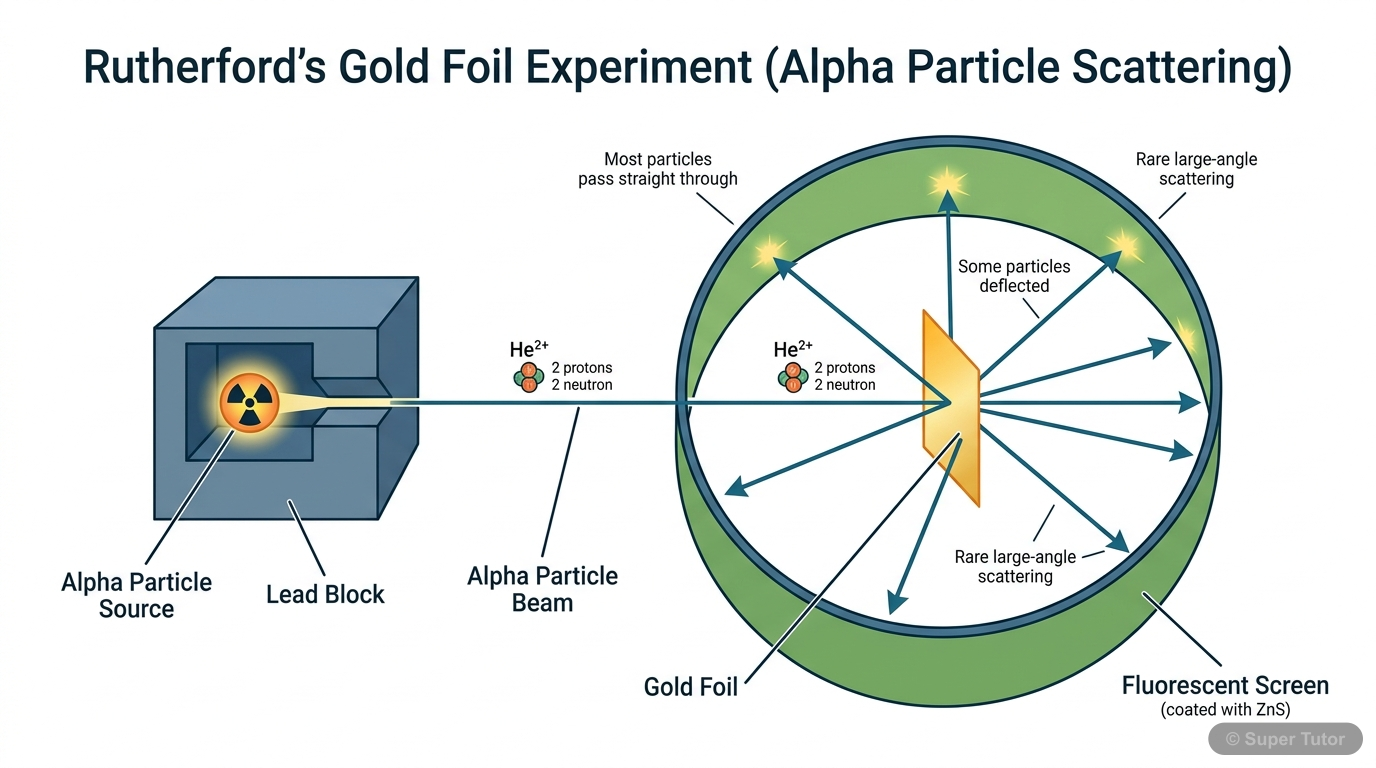
One of 4 illustrations for Structure of the Atom in Super Tutor — alongside flashcards, concept maps and practice questions.
Quick Quiz: Structure of the Atom
0/4Tap an answer to check it instantly. No sign-up needed for these 4.
Rutherford's alpha-particle scattering experiment used a gold foil that was about 1000 atoms thick. In this experiment, approximately 1 out of every 12000 alpha particles was deflected by 180°. What is the BEST conclusion that can be drawn from the fact that MOST alpha particles passed straight through the foil?
A neutral atom has 17 electrons. Using the Bohr-Bury scheme, what is the correct electron distribution in its shells and what is its valency?
Which of the following is the MAIN drawback of Rutherford's nuclear model of the atom?
The element Phosphorus (P) has an atomic number of 15. What is the electron distribution in its shells and what are its POSSIBLE valencies?
Sample Questions
An element X has mass number 23 and atomic number 11. Another element Y has mass number 23 and atomic number 12. What is the relationship between X and Y, and how many neutrons does each have?
Show answer
X and Y are isobars; X has 12 neutrons, Y has 11 neutrons.
Step 1: Isotopes have the SAME atomic number but DIFFERENT mass numbers. Isobars have DIFFERENT atomic numbers but the SAME mass number. Step 2: X has atomic number 11 and Y has atomic number 12 — different atomic numbers. Both have mass number 23 — same mass number. Step 3: Therefore, X and Y are ISOBARS (same mass number, different atomic numbers). Step 4: Number of neutrons = Mass number − Atomic number. For X: neutrons = 23 − 11 = 12. Step 5: For Y: neutrons = 23 − 12 = 11. So X (Sodium, Na) has 12 neutrons and Y (Magnesium, Mg) has 11 neutrons. Options A and D are wrong because these elem
Chlorine naturally exists in two isotopic forms: Cl-35 (mass 35 u) occurring 75% of the time and Cl-37 (mass 37 u) occurring 25% of the time. What is the average atomic mass of chlorine?
Show answer
35.5 u
Step 1: To find average atomic mass, multiply each isotope's mass by its percentage abundance (as a fraction) and add them. Step 2: For Cl-35: mass × fraction = 35 × (75/100) = 35 × 0.75 = 26.25 u. Step 3: For Cl-37: mass × fraction = 37 × (25/100) = 37 × 0.25 = 9.25 u. Step 4: Average atomic mass = 26.25 + 9.25 = 35.5 u. Step 5: This is why the periodic table shows chlorine's atomic mass as 35.5 u — it is a weighted average, not a whole number. No single atom has a mass of 35.5 u, but a bulk sample of chlorine will behave as if each atom has this average mass. Option A (36 u) would be the sim
How did J.J. Thomson's model of the atom explain electrical neutrality, and why was this model ultimately rejected?
Show answer
Thomson proposed electrons are embedded in a positive sphere with equal and opposite charges; rejected because Rutherford's experiment showed the positive charge is concentrated in a tiny nucleus, not spread throughout.
Step 1: Thomson's model (also called the 'plum pudding' or 'watermelon' model) proposed that the atom is a sphere of uniform positive charge with electrons embedded in it like seeds in a watermelon. Step 2: Since the negative charge of electrons exactly equals the positive charge of the sphere, the atom as a whole is electrically neutral — this explained neutrality. Step 3: However, Rutherford's alpha-particle scattering experiment showed that most alpha particles passed straight through AND a very small fraction bounced back almost completely. Step 4: If positive charge were spread uniformly
The maximum number of electrons that can be accommodated in the M-shell of an atom is calculated using the formula 2n². For n=3, this gives 18. But according to the Bohr-Bury rules, what is the MAXIMUM number of electrons actually allowed in the outermost shell of ANY atom, regardless of the shell's
Show answer
8
Step 1: The formula 2n² gives the THEORETICAL maximum for each shell: K=2, L=8, M=18, N=32. Step 2: However, the Bohr-Bury rules include a special restriction: the outermost (valence) shell of any atom can hold a MAXIMUM of only 8 electrons, regardless of what 2n² gives for that shell. Step 3: For example, even though the M-shell can theoretically hold 18 electrons, if M is the outermost shell, it will hold no more than 8 electrons. Step 4: This rule is the basis of the 'octet rule' — atoms with 8 electrons in their outermost shell are chemically stable (like noble gases). Step 5: This maximum
+41 more questions on Structure of the Atom (Punjab Board Class 9 Science)
Practise AllFrequently Asked Questions
What are the important topics in Structure of the Atom for Punjab Board Class 9 Science?
How many practice questions are there for Structure of the Atom?
Sources & Official References
Content is aligned to the official syllabus. Refer to the board website for the latest curriculum.
More resources for Structure of the Atom
Important Questions
Exam-style questions with answers
Revision Notes
Key points for last-minute revision
Formula Sheet
The chapter's formulas in one place
Chapter Summary
Understand the chapter at a glance
Concept Maps
See how topics connect
Flashcards
Quick-fire cards for active recall
Syllabus
What topics to cover
For serious students
Get the full Structure of the Atom chapter — start free.
Quizzes, flashcards, an AI doubt solver and a study plan for Punjab Board Class 9 Science. Free to start, no card needed.