Structure of the Atom — Chapter Summary
Punjab Board · Class 9 · Science
Summary of Structure of the Atom for Punjab Board Class 9 Science. Key concepts: Atoms consist of three, J and Ernest Rutherford fired fast.
Interactive on Super Tutor
Studying Structure of the Atom? Get the full interactive chapter.
Quizzes, flashcards, AI doubt-solver and a step-by-step study plan — built for chapter summary and more.
Free trial, no card needed.
One of 4 illustrations for Structure of the Atom in Super Tutor — alongside flashcards, concept maps and practice questions.
Overview
The Structure of the Atom is a fundamental chapter that explains how atoms are not indivisible units as Dalton proposed, but rather consist of smaller subatomic particles arranged in specific patterns. This chapter explores the discovery of electrons, protons, and neutrons, and presents several mode
Key Concepts
Atoms consist of three fundamental subatomic
Atoms consist of three fundamental subatomic particles. Protons are positively charged particles found in the nucleus with a charge of +1 and mass of
J
J.J. Thomson proposed that atoms consist of a positively charged sphere with electrons embedded throughout it, like currants in a Christmas pudding or
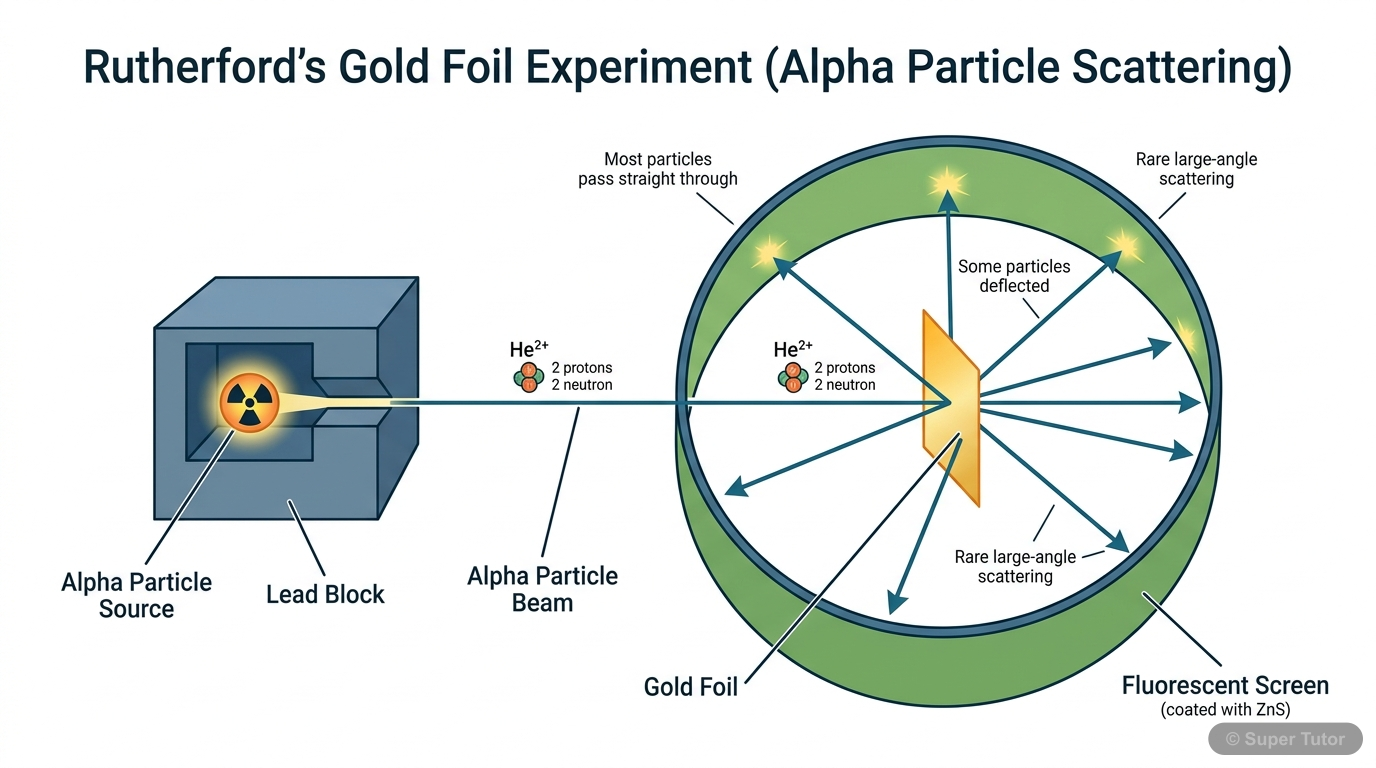
Ernest Rutherford fired fast
Ernest Rutherford fired fast-moving alpha particles (helium ions with mass 4 u) at a thin gold foil. Most particles passed straight through, some were
Based on his scattering experiment
Based on his scattering experiment, Rutherford proposed that atoms have a small, positively charged nucleus at the center containing most of the atom'
Niels Bohr proposed that electrons occupy
Niels Bohr proposed that electrons occupy only certain special orbits called discrete orbits or energy levels (K, L, M, N shells or n = 1, 2, 3, 4...)
Learning Objectives
- Understand that atoms contain charged particles and are not indivisible
- Learn about the three main subatomic particles: electrons, protons, and neutrons
- Compare and evaluate different atomic models proposed by Thomson, Rutherford, and Bohr
- Understand the concept of energy levels or electron shells in atoms
- Learn how electrons are distributed in different shells using the Bohr-Bury scheme
Frequently Asked Questions
What are the important topics in Structure of the Atom for Punjab Board Class 9 Science?
How should I revise Structure of the Atom for Class 9 exams?
Sources & Official References
Content is aligned to the official syllabus. Refer to the board website for the latest curriculum.
More resources for Structure of the Atom
For serious students
Get the full Structure of the Atom chapter — start free.
Quizzes, flashcards, an AI doubt solver and a study plan for Punjab Board Class 9 Science. Free to start, no card needed.