Matter in Our Surroundings — Practice Quiz
Punjab Board · Class 9 · Science
Try a 4-question quiz on Matter in Our Surroundings for Punjab Board Class 9 Science: tap an answer to check it and see why.
Interactive on Super Tutor
Studying Matter in Our Surroundings? Get the full interactive chapter.
Quizzes, flashcards, AI doubt-solver and a step-by-step study plan — built for practice quiz and more.
Free trial, no card needed.
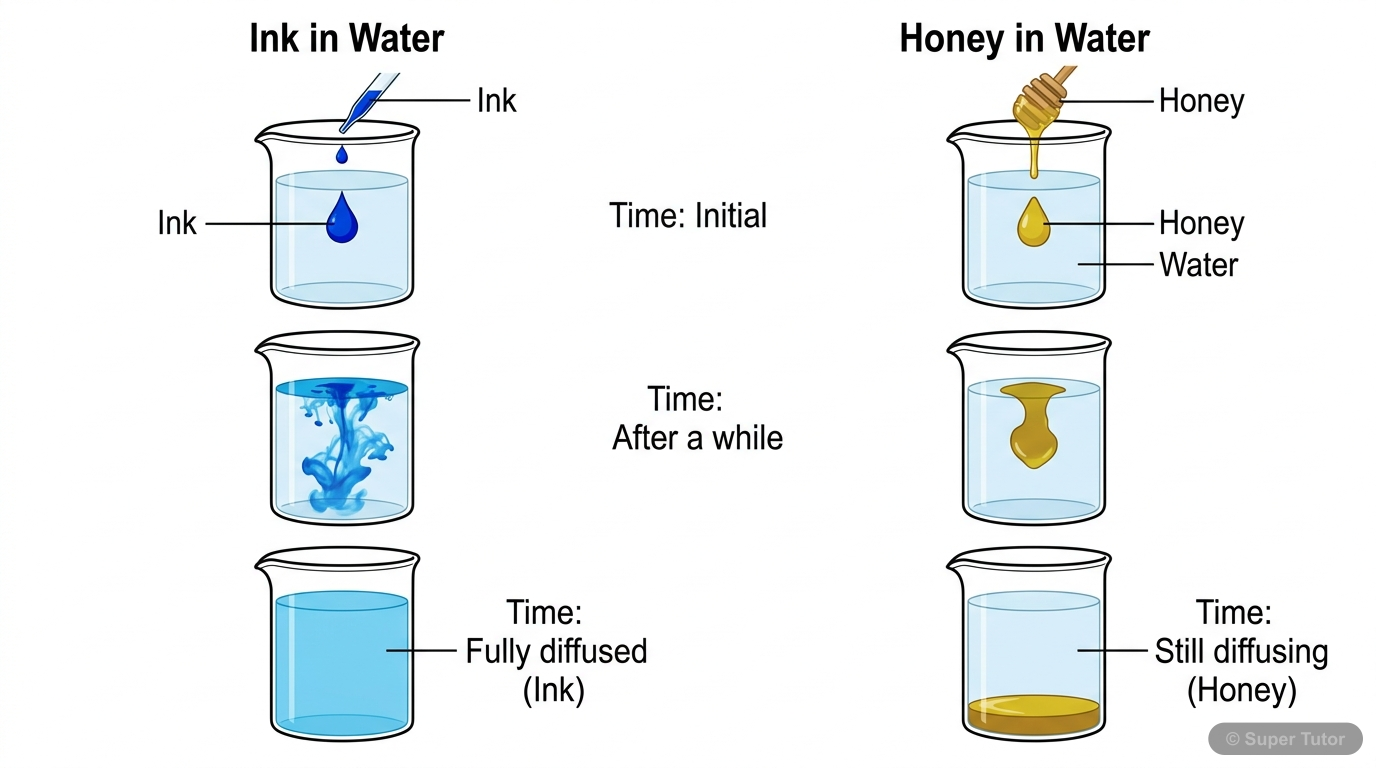
One of 2 illustrations for Matter in Our Surroundings in Super Tutor — alongside flashcards, concept maps and practice questions.
Quick Quiz: Matter in Our Surroundings
0/4Tap an answer to check it instantly. No sign-up needed for these 4.
Which of the following is NOT an example of matter?
When sugar is dissolved in water, the level of water does not rise significantly. What does this observation tell us about particles of matter?
The spreading of the smell of food from the kitchen to other rooms is an example of which property of matter?
What happens to the rate of diffusion when temperature is increased?
Sample Questions
Which state of matter has a definite shape and a definite volume?
Show answer
Solid
Step 1: Let us recall the properties of each state of matter. Step 2: Solids have a fixed/definite shape and a definite volume. Their particles are tightly packed and held strongly together, so they resist changes in shape. Step 3: Liquids have a definite volume but NO definite shape — they take the shape of the container they are kept in. Step 4: Gases have neither a definite shape nor a definite volume — they fill up any container completely. Step 5: Therefore, only solids have both a definite shape AND a definite volume.
Which of the following correctly describes a liquid?
Show answer
No definite shape but definite volume
Step 1: When you pour water from a glass into a bowl, the water takes the shape of the bowl. This means liquids do NOT have a definite shape. Step 2: However, if you measure 50 mL of water and pour it into different containers, it remains 50 mL. This means liquids DO have a definite volume. Step 3: So the correct description of a liquid is: no definite shape but definite volume. Step 4: Solids have both definite shape and volume. Gases have neither. This makes liquids unique — they can flow (they are fluids) but their volume stays fixed.
In which state of matter are the particles most closely packed with maximum force of attraction?
Show answer
Solid
Step 1: The force of attraction between particles holds them together and determines how closely they are packed. Step 2: In solids, particles are very closely packed and the force of attraction between them is maximum. This is why solids are rigid and hard to compress. Step 3: In liquids, the force of attraction is intermediate — particles are close but can slide over each other. Step 4: In gases, the force of attraction is minimum — particles are far apart and move freely and randomly. Step 5: So the correct order of force of attraction is: Solid > Liquid > Gas.
What is the melting point of ice?
Show answer
0°C (273 K)
Step 1: The melting point is the minimum temperature at which a solid melts to become a liquid at atmospheric pressure. Step 2: For ice (solid water), this temperature is 0°C, which is equal to 273.15 K (approximately 273 K). Step 3: The boiling point of water is 100°C (373 K) — this is when water changes to steam, not when ice melts. Step 4: At exactly 0°C, ice starts melting. The temperature stays at 0°C until ALL the ice has melted — this is because the heat is used up as latent heat of fusion to break the bonds between particles. Step 5: So the melting point of ice = 0°C = 273 K.
+41 more questions on Matter in Our Surroundings (Punjab Board Class 9 Science)
Practise AllFrequently Asked Questions
What are the important topics in Matter in Our Surroundings for Punjab Board Class 9 Science?
How many practice questions are there for Matter in Our Surroundings?
Sources & Official References
Content is aligned to the official syllabus. Refer to the board website for the latest curriculum.
More resources for Matter in Our Surroundings
Important Questions
Exam-style questions with answers
Revision Notes
Key points for last-minute revision
Formula Sheet
The chapter's formulas in one place
Chapter Summary
Understand the chapter at a glance
Concept Maps
See how topics connect
Flashcards
Quick-fire cards for active recall
Syllabus
What topics to cover
For serious students
Get the full Matter in Our Surroundings chapter — start free.
Quizzes, flashcards, an AI doubt solver and a study plan for Punjab Board Class 9 Science. Free to start, no card needed.