Chapter 11 of 13
NCERT Solutions

Electricity

Rajasthan Board · Class 10 · Science

NCERT Solutions for Electricity — Rajasthan Board Class 10 Science.

58 questions20 flashcards5 concepts

Interactive on Super Tutor

Studying Electricity? Get the full interactive chapter.

Quizzes, flashcards, AI doubt-solver and a step-by-step study plan — built for ncert solutions and more.

1,000+ Class 10 students started this chapter today

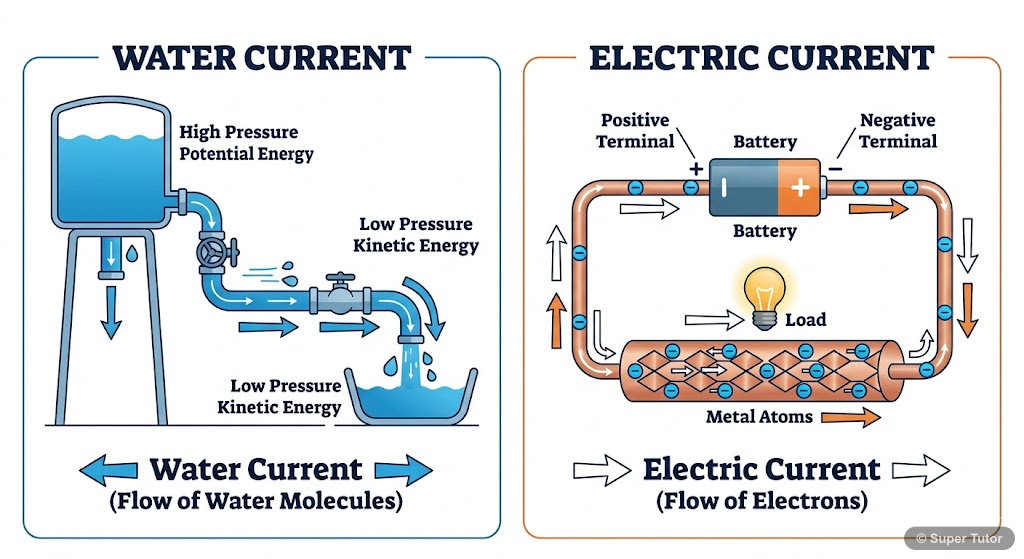
An illustration comparing the flow of water in a pipe to the flow of electric charge (current) in a conductor, highlighting the concept of 'current'.
Super Tutor

Super Tutor has 19+ illustrations like this for Electricity alone — flashcards, concept maps, and step-by-step visuals.

See them all
20 Questions Solved · 2 Sections

QUESTIONS (In-text)

1What determines the rate at which energy is delivered by a current?Show solution
The rate at which energy is delivered by a current is determined by the electric power.

Electric power is given by:
P=V×IP = V \times I
where VV is the potential difference (voltage) and II is the electric current.

It can also be expressed as:
P=I2R=V2RP = I^2 R = \frac{V^2}{R}

Thus, the power (i.e., the rate of energy delivery) depends on both the potential difference across the circuit and the current flowing through it.
2An electric motor takes 5 A from a 220 V line. Determine the power of the motor and the energy consumed in 2 h.Show solution
Given:
- Current, I=5AI = 5\,\text{A}
- Voltage, V=220VV = 220\,\text{V}
- Time, t=2h=2×3600=7200st = 2\,\text{h} = 2 \times 3600 = 7200\,\text{s}

Formula used:
P=V×IP = V \times I
W=P×tW = P \times t

Step 1: Calculate Power
P=220V×5A=1100W=1.1kWP = 220\,\text{V} \times 5\,\text{A} = 1100\,\text{W} = 1.1\,\text{kW}

Step 2: Calculate Energy consumed
W=P×t=1100W×7200s=7,920,000J=7.92×10⁶JW = P \times t = 1100\,\text{W} \times 7200\,\text{s} = 7,920,000\,\text{J} = 7.92 \times 10^6\,\text{J}

Alternatively in kWh:
W=1.1kW×2h=2.2kWhW = 1.1\,\text{kW} \times 2\,\text{h} = 2.2\,\text{kWh}

Result:
- Power of the motor =1100W= 1100\,\text{W}
- Energy consumed in 2 h =7.92×10⁶J= 7.92 \times 10^6\,\text{J} (or 2.2kWh2.2\,\text{kWh})

EXERCISES

1A piece of wire of resistance R is cut into five equal parts. These parts are then connected in parallel. If the equivalent resistance of this combination is R', then the ratio R/R' is:
(a) 1/25 (b) 1/5 (c) 5 (d) 25
Show solution
Correct option: (d) 25

Justification:

When the wire of resistance RR is cut into 5 equal parts, the resistance of each part is:
r=R5r = \frac{R}{5}

When these 5 equal resistors are connected in parallel, the equivalent resistance RR' is:
1R=1r+1r+1r+1r+1r=5r\frac{1}{R'} = \frac{1}{r} + \frac{1}{r} + \frac{1}{r} + \frac{1}{r} + \frac{1}{r} = \frac{5}{r}
R=r5=R/55=R25R' = \frac{r}{5} = \frac{R/5}{5} = \frac{R}{25}

Therefore:
RR=RR/25=25\frac{R}{R'} = \frac{R}{R/25} = 25
2Which of the following terms does not represent electrical power in a circuit?
(a) I²R (b) IR² (c) VI (d) V²/R
Show solution
Correct option: (b) IR2IR^2

Justification:

Electrical power is given by P=VI=I2R=V2RP = VI = I^2R = \dfrac{V^2}{R}.

The expression IR2IR^2 has units of A×Ω2\text{A} \times \Omega^2, which does not simplify to watts (W). Hence IR2IR^2 does not represent electrical power.
3An electric bulb is rated 220 V and 100 W. When it is operated on 110 V, the power consumed will be:
(a) 100 W (b) 75 W (c) 50 W (d) 25 W
Show solution
Correct option: (d) 25 W

Justification:

The resistance of the bulb (assumed constant):
R=V2P=(220)2100=484ΩR = \frac{V^2}{P} = \frac{(220)^2}{100} = 484\,\Omega

Power consumed at 110 V:
P=V2R=(110)2484=12100484=25WP' = \frac{V'^2}{R} = \frac{(110)^2}{484} = \frac{12100}{484} = 25\,\text{W}
4Two conducting wires of the same material and of equal lengths and equal diameters are first connected in series and then parallel in a circuit across the same potential difference. The ratio of heat produced in series and parallel combinations would be:
(a) 1:2 (b) 2:1 (c) 1:4 (d) 4:1
Show solution
Correct option: (c) 1:4

Justification:

Let the resistance of each wire be RR.

- In series: Rs=R+R=2RR_s = R + R = 2R
- In parallel: Rp=R×RR+R=R2R_p = \dfrac{R \times R}{R + R} = \dfrac{R}{2}

Heat produced =V2Req×t= \dfrac{V^2}{R_{eq}} \times t (at same potential difference VV and time tt):

Hs=V22R×t,Hp=V2R/2×t=2V2R×tH_s = \frac{V^2}{2R} \times t, \quad H_p = \frac{V^2}{R/2} \times t = \frac{2V^2}{R} \times t

HsHp=V2/(2R)2V2/R=14\frac{H_s}{H_p} = \frac{V^2/(2R)}{2V^2/R} = \frac{1}{4}

So the ratio is 1:41:4.
5How is a voltmeter connected in the circuit to measure the potential difference between two points?Show solution
A voltmeter is always connected in parallel across the two points between which the potential difference is to be measured.

Reason: A voltmeter has very high resistance so that it draws negligible current from the circuit and does not disturb the original potential difference across those two points.
6A copper wire has diameter 0.5 mm and resistivity of 1.6 × 10⁻⁸ Ω m. What will be the length of this wire to make its resistance 10 Ω? How much does the resistance change if the diameter is doubled?Show solution
Given:
- Diameter, d=0.5mm=0.5×10³md = 0.5\,\text{mm} = 0.5 \times 10^{-3}\,\text{m}
- Radius, r=0.25×10³mr = 0.25 \times 10^{-3}\,\text{m}
- Resistivity, ρ=1.6×10⁸Ωm\rho = 1.6 \times 10^{-8}\,\Omega\text{m}
- Resistance, R=10ΩR = 10\,\Omega

Step 1: Find the area of cross-section
A=πr2=π×(0.25×10³)2=π×6.25×10⁸m2A = \pi r^2 = \pi \times (0.25 \times 10^{-3})^2 = \pi \times 6.25 \times 10^{-8}\,\text{m}^2
A=1.964×10⁷m2A = 1.964 \times 10^{-7}\,\text{m}^2

Step 2: Find the length using R=ρlAR = \rho \dfrac{l}{A}
l=R×Aρ=10×1.964×1071.6×108l = \frac{R \times A}{\rho} = \frac{10 \times 1.964 \times 10^{-7}}{1.6 \times 10^{-8}}
l=1.964×1061.6×108=122.7m122.7ml = \frac{1.964 \times 10^{-6}}{1.6 \times 10^{-8}} = 122.7\,\text{m} \approx 122.7\,\text{m}

Step 3: Effect of doubling the diameter

If diameter is doubled, new diameter d=2dd' = 2d, so new radius r=2rr' = 2r.
A=π(2r)2=4πr2=4AA' = \pi (2r)^2 = 4\pi r^2 = 4A

New resistance:
R=ρlA=ρl4A=R4=104=2.5ΩR' = \rho \frac{l}{A'} = \rho \frac{l}{4A} = \frac{R}{4} = \frac{10}{4} = 2.5\,\Omega

Result:
- Length of wire required =122.7m= 122.7\,\text{m}
- When diameter is doubled, resistance becomes 2.5Ω2.5\,\Omega (i.e., it reduces to one-fourth of the original value).
7The values of current I flowing in a given resistor for the corresponding values of potential difference V across the resistor are given below:
| I (amperes) | 0.5 | 1.0 | 2.0 | 3.0 | 4.0 |
| V (volts) | 1.6 | 3.4 | 6.7 | 10.2 | 13.2 |
Plot a graph between V and I and calculate the resistance of that resistor.
Show solution
Given data:

| II (A) | 0.5 | 1.0 | 2.0 | 3.0 | 4.0 |
|---------|-----|-----|-----|------|------|
| VV (V) | 1.6 | 3.4 | 6.7 | 10.2 | 13.2 |

Graph: Plot VV on the y-axis and II on the x-axis. The points approximately lie on a straight line passing through (or near) the origin, confirming Ohm's law.

Calculating Resistance:

The resistance is the slope of the VVII graph:
R=ΔVΔIR = \frac{\Delta V}{\Delta I}

Using two well-separated points, e.g., (I=0.5A,V=1.6V)(I = 0.5\,\text{A},\, V = 1.6\,\text{V}) and (I=4.0A,V=13.2V)(I = 4.0\,\text{A},\, V = 13.2\,\text{V}):
R=13.21.64.00.5=11.63.53.31ΩR = \frac{13.2 - 1.6}{4.0 - 0.5} = \frac{11.6}{3.5} \approx 3.31\,\Omega

We can also verify with individual readings:
- R=1.6/0.5=3.2ΩR = 1.6/0.5 = 3.2\,\Omega
- R=3.4/1.0=3.4ΩR = 3.4/1.0 = 3.4\,\Omega
- R=6.7/2.0=3.35ΩR = 6.7/2.0 = 3.35\,\Omega
- R=10.2/3.0=3.4ΩR = 10.2/3.0 = 3.4\,\Omega
- R=13.2/4.0=3.3ΩR = 13.2/4.0 = 3.3\,\Omega

Average (from graph slope) 3.4Ω\approx 3.4\,\Omega

The resistance of the resistor is approximately 3.4Ω\mathbf{3.4\,\Omega}.
8When a 12 V battery is connected across an unknown resistor, there is a current of 2.5 mA in the circuit. Find the value of the resistance of the resistor.Show solution
Given:
- Voltage, V=12VV = 12\,\text{V}
- Current, I=2.5mA=2.5×10³AI = 2.5\,\text{mA} = 2.5 \times 10^{-3}\,\text{A}

Using Ohm's Law:
R=VI=122.5×103=120.0025=4800ΩR = \frac{V}{I} = \frac{12}{2.5 \times 10^{-3}} = \frac{12}{0.0025} = 4800\,\Omega

The resistance of the resistor is 4800Ω4800\,\Omega (or 4.8kΩ4.8\,\text{k}\Omega).
9A battery of 9 V is connected in series with resistors of 0.2 Ω, 0.3 Ω, 0.4 Ω, 0.5 Ω and 12 Ω, respectively. How much current would flow through the 12 Ω resistor?Show solution
Given:
- EMF of battery, V=9VV = 9\,\text{V}
- Resistors in series: 0.2Ω,  0.3Ω,  0.4Ω,  0.5Ω,  12Ω0.2\,\Omega,\; 0.3\,\Omega,\; 0.4\,\Omega,\; 0.5\,\Omega,\; 12\,\Omega

Step 1: Find total resistance in series
Rtotal=0.2+0.3+0.4+0.5+12=13.4ΩR_{total} = 0.2 + 0.3 + 0.4 + 0.5 + 12 = 13.4\,\Omega

Step 2: Find current using Ohm's Law

In a series circuit, the same current flows through all resistors:
I=VRtotal=913.40.671AI = \frac{V}{R_{total}} = \frac{9}{13.4} \approx 0.671\,\text{A}

The current through the 12Ω12\,\Omega resistor is approximately 0.67A0.67\,\text{A}.
10How many 176 Ω resistors (in parallel) are required to carry 5 A on a 220 V line?Show solution
Given:
- Each resistor, R=176ΩR = 176\,\Omega
- Total current, I=5AI = 5\,\text{A}
- Voltage, V=220VV = 220\,\text{V}

Step 1: Find the required equivalent resistance
Req=VI=2205=44ΩR_{eq} = \frac{V}{I} = \frac{220}{5} = 44\,\Omega

Step 2: Find number of resistors in parallel

For nn resistors of resistance RR each in parallel:
Req=RnR_{eq} = \frac{R}{n}
n=RReq=17644=4n = \frac{R}{R_{eq}} = \frac{176}{44} = 4

4 resistors of 176Ω176\,\Omega connected in parallel are required.
11Show how you would connect three resistors, each of resistance 6 Ω, so that the combination has a resistance of (i) 9 Ω, (ii) 4 Ω.Show solution
Each resistor has resistance R=6ΩR = 6\,\Omega.

(i) To get 9Ω9\,\Omega:

Connect two resistors in parallel, and then connect the third resistor in series with this parallel combination.

- Parallel combination of two 6Ω6\,\Omega resistors:
Rp=6×66+6=3612=3ΩR_p = \frac{6 \times 6}{6 + 6} = \frac{36}{12} = 3\,\Omega

- Series with the third resistor:
Rtotal=3+6=9ΩR_{total} = 3 + 6 = 9\,\Omega \checkmark

(ii) To get 4Ω4\,\Omega:

Connect two resistors in series, and then connect the third resistor in parallel with this series combination.

- Series combination of two 6Ω6\,\Omega resistors:
Rs=6+6=12ΩR_s = 6 + 6 = 12\,\Omega

- Parallel with the third resistor:
Rtotal=12×612+6=7218=4ΩR_{total} = \frac{12 \times 6}{12 + 6} = \frac{72}{18} = 4\,\Omega \checkmark
12Several electric bulbs designed to be used on a 220 V electric supply line, are rated 10 W. How many lamps can be connected in parallel with each other across the two wires of 220 V line if the maximum allowable current is 5 A?Show solution
Given:
- Voltage of supply, V=220VV = 220\,\text{V}
- Power rating of each bulb, P=10WP = 10\,\text{W}
- Maximum allowable current, Imax=5AI_{max} = 5\,\text{A}

Step 1: Find current drawn by each bulb
Ibulb=PV=10220=122AI_{bulb} = \frac{P}{V} = \frac{10}{220} = \frac{1}{22}\,\text{A}

Step 2: Find number of bulbs

In parallel, total current = n×Ibulbn \times I_{bulb}
n=ImaxIbulb=51/22=5×22=110n = \frac{I_{max}}{I_{bulb}} = \frac{5}{1/22} = 5 \times 22 = 110

110 lamps can be connected in parallel.
13A hot plate of an electric oven connected to a 220 V line has two resistance coils A and B, each of 24 Ω resistance, which may be used separately, in series, or in parallel. What are the currents in the three cases?Show solution
Given:
- Voltage, V=220VV = 220\,\text{V}
- Resistance of each coil: RA=RB=24ΩR_A = R_B = 24\,\Omega

Case 1: Used separately (only one coil)
I=VR=220249.17AI = \frac{V}{R} = \frac{220}{24} \approx 9.17\,\text{A}

Case 2: Connected in series
Rs=RA+RB=24+24=48ΩR_s = R_A + R_B = 24 + 24 = 48\,\Omega
Is=VRs=220484.58AI_s = \frac{V}{R_s} = \frac{220}{48} \approx 4.58\,\text{A}

Case 3: Connected in parallel
Rp=RA×RBRA+RB=24×2424+24=57648=12ΩR_p = \frac{R_A \times R_B}{R_A + R_B} = \frac{24 \times 24}{24 + 24} = \frac{576}{48} = 12\,\Omega
Ip=VRp=2201218.33AI_p = \frac{V}{R_p} = \frac{220}{12} \approx 18.33\,\text{A}

Summary:
- Separately: 9.17A\approx 9.17\,\text{A}
- In series: 4.58A\approx 4.58\,\text{A}
- In parallel: 18.33A\approx 18.33\,\text{A}
14Compare the power used in the 2 Ω resistor in each of the following circuits: (i) a 6 V battery in series with 1 Ω and 2 Ω resistors, and (ii) a 4 V battery in parallel with 12 Ω and 2 Ω resistors.Show solution
Case (i): 6 V battery in series with 1 Ω and 2 Ω

Total resistance:
Rtotal=1+2=3ΩR_{total} = 1 + 2 = 3\,\Omega

Current through circuit (same through both resistors in series):
I=VRtotal=63=2AI = \frac{V}{R_{total}} = \frac{6}{3} = 2\,\text{A}

Power used in 2Ω2\,\Omega resistor:
P1=I2×R=(2)2×2=4×2=8WP_1 = I^2 \times R = (2)^2 \times 2 = 4 \times 2 = 8\,\text{W}

Case (ii): 4 V battery in parallel with 12 Ω and 2 Ω

In a parallel circuit, the voltage across each resistor equals the battery voltage.

Voltage across 2Ω2\,\Omega resistor =4V= 4\,\text{V}

Power used in 2Ω2\,\Omega resistor:
P2=V2R=(4)22=162=8WP_2 = \frac{V^2}{R} = \frac{(4)^2}{2} = \frac{16}{2} = 8\,\text{W}

Comparison:
P1P2=88=1\frac{P_1}{P_2} = \frac{8}{8} = 1

The power used in the 2Ω2\,\Omega resistor is equal (8 W each) in both circuits.
15Two lamps, one rated 100 W at 220 V, and the other 60 W at 220 V, are connected in parallel to electric mains supply. What current is drawn from the line if the supply voltage is 220 V?Show solution
Given:
- Lamp 1: P1=100WP_1 = 100\,\text{W} at 220V220\,\text{V}
- Lamp 2: P2=60WP_2 = 60\,\text{W} at 220V220\,\text{V}
- Supply voltage, V=220VV = 220\,\text{V}

Current drawn by each lamp:
I1=P1V=100220=511AI_1 = \frac{P_1}{V} = \frac{100}{220} = \frac{5}{11}\,\text{A}
I2=P2V=60220=311AI_2 = \frac{P_2}{V} = \frac{60}{220} = \frac{3}{11}\,\text{A}

Total current drawn from the line (parallel connection):
I=I1+I2=511+311=8110.727AI = I_1 + I_2 = \frac{5}{11} + \frac{3}{11} = \frac{8}{11} \approx 0.727\,\text{A}

The current drawn from the line is approximately 0.73A0.73\,\text{A}.
16Which uses more energy, a 250 W TV set in 1 hr, or a 1200 W toaster in 10 minutes?Show solution
Energy consumed by TV set:
ETV=P×t=250W×1h=250WhE_{TV} = P \times t = 250\,\text{W} \times 1\,\text{h} = 250\,\text{Wh}
=250×3600J=9×10⁵J= 250 \times 3600\,\text{J} = 9 \times 10^5\,\text{J}

Energy consumed by toaster:
t=10min=1060h=16ht = 10\,\text{min} = \frac{10}{60}\,\text{h} = \frac{1}{6}\,\text{h}
Etoaster=1200W×16h=200WhE_{toaster} = 1200\,\text{W} \times \frac{1}{6}\,\text{h} = 200\,\text{Wh}
=200×3600J=7.2×10⁵J= 200 \times 3600\,\text{J} = 7.2 \times 10^5\,\text{J}

Comparison:
E_{TV} = 9 \times 10^5\,\text{J} > E_{toaster} = 7.2 \times 10^5\,\text{J}

The 250 W TV set used for 1 hour consumes more energy (9×1059 \times 10^5 J) than the 1200 W toaster used for 10 minutes (7.2×1057.2 \times 10^5 J).
17An electric heater of resistance 44 Ω draws 5 A from the service mains for 2 hours. Calculate the rate at which heat is developed in the heater.Show solution
Given:
- Resistance, R=44ΩR = 44\,\Omega
- Current, I=5AI = 5\,\text{A}
- Time, t=2ht = 2\,\text{h} (not needed for rate)

The rate at which heat is developed = Power dissipated:
P=I2R=(5)2×44=25×44=1100WP = I^2 R = (5)^2 \times 44 = 25 \times 44 = 1100\,\text{W}

The rate at which heat is developed in the heater is 1100W1100\,\text{W} (or 1.1kW1.1\,\text{kW}).
18Explain the following:
(a) Why is tungsten used almost exclusively for filament of electric lamps?
(b) Why are the conductors of electric heating devices, such as bread-toasters and electric irons, made of an alloy rather than a pure metal?
(c) Why is the series arrangement not used for domestic circuits?
(d) How does the resistance of a wire vary with its area of cross-section?
(e) Why are copper and aluminium wires usually employed for electricity transmission?
Show solution
(a) Tungsten for filament of electric lamps:

Tungsten is used almost exclusively for filaments because:
1. It has a very high melting point (3380°C3380°\text{C}), so it can be heated to very high temperatures (around 2500°C2500°\text{C}) without melting.
2. It has high resistivity, which allows it to produce a large amount of heat and light.
3. It does not oxidise readily at high temperatures (especially in an inert gas atmosphere inside the bulb).

---

(b) Alloys for heating devices instead of pure metals:

Alloys are preferred over pure metals in heating devices because:
1. Alloys have higher resistivity than pure metals, so they produce more heat for the same current.
2. Alloys do not oxidise (burn) easily at high temperatures, making them more durable.
3. They have a high melting point, so they can withstand the high temperatures generated during operation.

*(Example: Nichrome is used in toasters and electric irons.)*

---

(c) Series arrangement not used for domestic circuits:

Series arrangement is not used in domestic circuits because:
1. In series, if one appliance fails or is switched off, the circuit breaks and all other appliances stop working.
2. All appliances in series get the same current, but different appliances require different currents for proper operation.
3. The voltage gets divided among all appliances, so each appliance does not get the required voltage for proper functioning.
4. We cannot independently control individual appliances.

---

(d) Resistance of a wire and its area of cross-section:

The resistance of a wire is given by:
R=ρlAR = \rho \frac{l}{A}
where AA is the area of cross-section.

Resistance is inversely proportional to the area of cross-section:
R1AR \propto \frac{1}{A}

This means: as the area of cross-section increases, the resistance decreases, and vice versa. A thicker wire offers less resistance because more electrons can flow through it simultaneously.

---

(e) Copper and aluminium for electricity transmission:

Copper and aluminium are used for electricity transmission because:
1. Both have very low resistivity (copper: 1.7×10⁸Ωm1.7 \times 10^{-8}\,\Omega\text{m}; aluminium: 2.8×10⁸Ωm2.8 \times 10^{-8}\,\Omega\text{m}), so they are excellent conductors and energy loss during transmission is minimal.
2. They are good conductors of electricity, allowing large currents to flow with minimal heating.
3. They are ductile (can be drawn into thin wires) and relatively inexpensive and abundant.
4. Aluminium is also lightweight, making it suitable for overhead transmission lines.

Stuck on a step?

Ask Super Tutor AI to explain any solution on this page in a simpler way — free, 24x7.

Ask a Doubt Free

Frequently Asked Questions

What are the important topics in Electricity for Rajasthan Board Class 10 Science?
Key topics in Electricity include Electricity Chapter Concept Overview, Electricity Chapter Overview, Electricity Chapter Concept Map. These are the concepts Rajasthan Board Class 10 examiners draw on most — study them first, then practise related questions.
How to score full marks in Electricity — Rajasthan Board Class 10 Science?
Understand the core concepts first, then work through the 58 practice questions available for this chapter. Revise formulas and definitions regularly, and use flashcards for quick recall before the exam.
Where can I get free NCERT Solutions for Electricity Class 10 Science?
This page has free step-by-step NCERT Solutions for every exercise question in Electricity (Rajasthan Board Class 10 Science) — written the way examiners award marks: given, formula, working, answer.

Sources & Official References

Content is aligned to the official syllabus. Refer to the board website for the latest curriculum.

For serious students

Get the full Electricity chapter — for free.

Quizzes, flashcards, AI doubt-solver and a step-by-step study plan for Rajasthan Board Class 10 Science.