How do Organisms Reproduce? — NCERT Solutions
Rajasthan Board · Class 10 · Science
NCERT Solutions for How do Organisms Reproduce?, Rajasthan Board Class 10 Science: 22 textbook questions solved step by step.
Interactive on Super Tutor
Studying How do Organisms Reproduce?? Get the full interactive chapter.
Quizzes, flashcards, AI doubt-solver and a step-by-step study plan — built for NCERT solutions and more.
Free trial, no card needed.
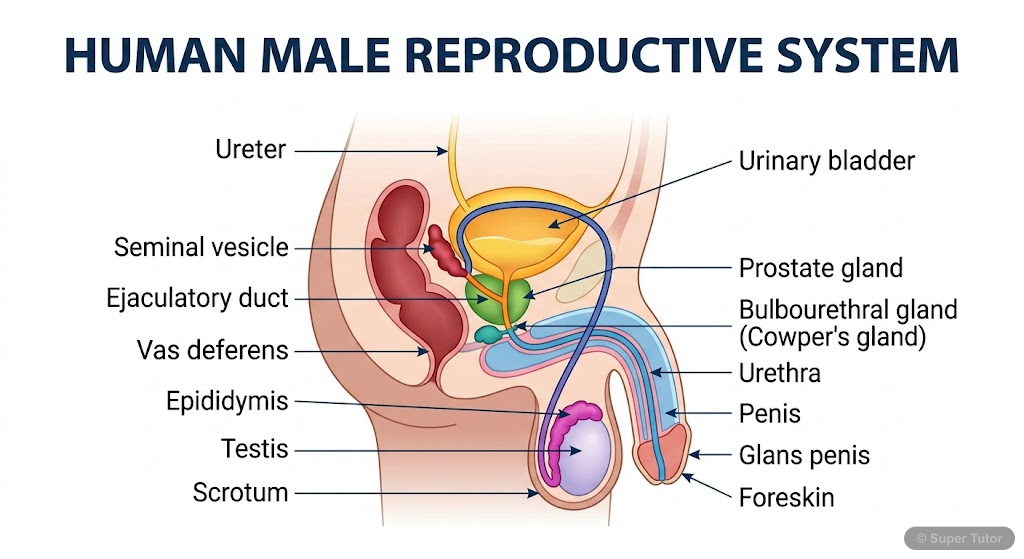
One of 20 illustrations for How do Organisms Reproduce? in Super Tutor — alongside flashcards, concept maps and practice questions.
The first 11 solutions are open to read. The other 11 are free with a Super Tutor account.
Questions
1What is the importance of DNA copying in reproduction?Show solution
DNA copying is important because it passes the hereditary information from parents to the next generation. It also helps make new cells with the same basic body design. Small variations may occur during copying, and these variations are the basis of evolution and help species survive changing conditions.
2Why is variation beneficial to the species but not necessarily for the individual?Show solution
Variation is beneficial to the species because if conditions change, at least some individuals may survive and reproduce. But variation is not always beneficial to an individual because some changes may be harmful and the individual may die or fail to function properly.
Questions
1How does binary fission differ from multiple fission?Show solution
In binary fission, one unicellular organism splits into two daughter cells. In multiple fission, the parent cell divides at the same time to form many daughter cells at once, as in Plasmodium.
2How will an organism be benefited if it reproduces through spores?Show solution
An organism reproducing through spores is benefited because spores have thick protective walls, so they can survive unfavorable conditions and remain dormant until they reach a moist surface. They are also produced in large numbers, helping the species spread widely.
3Can you think of reasons why more complex organisms cannot give rise to new individuals through regeneration?Show solution
More complex organisms cannot give rise to new individuals through regeneration because their bodies have specialised tissues, organs, and organ systems arranged in a fixed way. Simple cell-by-cell regrowth would not rebuild this complex organisation properly, so regeneration is not a practical normal mode of reproduction for them.
4Why is vegetative propagation practised for growing some types of plants?Show solution
Vegetative propagation is practised because it allows plants like banana, orange, rose and jasmine to be multiplied easily, quickly, and in disease-free conditions. It also helps plants that have lost the capacity to produce seeds, and the new plants are genetically similar to the parent and retain its desirable characteristics.
QUESTIONS (In-text)
1How is the process of pollination different from fertilisation?Show solution
Pollination vs Fertilisation:
| Feature | Pollination | Fertilisation |
|---|---|---|
| Definition | Transfer of pollen grains from the anther (male part) to the stigma (female part) of a flower. | Fusion of the male gamete (from pollen) with the female gamete (egg cell/ovule) to form a zygote. |
| Nature | A physical/mechanical process. | A biological/chemical process. |
| Where it occurs | On the surface of the stigma. | Inside the ovule (in the ovary). |
| Agents involved | Wind, water, insects, birds, etc. | No external agent; pollen tube carries male gamete to the ovule. |
| Result | Pollen grain lands on stigma. | Formation of a zygote, which develops into an embryo. |
In summary: Pollination is a prerequisite for fertilisation. Pollination brings the pollen to the stigma, after which the pollen tube grows down to the ovule and fertilisation takes place.
2What is the role of the seminal vesicles and the prostate gland?Show solution
Given: The seminal vesicles and prostate gland are accessory glands of the male reproductive system.
Role:
- Seminal Vesicles: They secrete a fluid that is rich in fructose (sugar), proteins, and other substances. This fluid:
- Provides nutrition (energy) to the sperms.
- Forms a major part of the semen.
- Helps in the motility (movement) of sperms.
- Prostate Gland: It secretes a milky, slightly alkaline fluid that:
- Forms a part of the semen.
- Neutralises the acidity of the urethra and the female vaginal tract, thereby protecting the sperms and maintaining their motility.
- Provides nutrients to the sperms.
Conclusion: Both glands add their secretions to the sperms to form semen, which nourishes the sperms and facilitates their transport.
3What are the changes seen in girls at the time of puberty?Show solution
Given: Puberty is the period of sexual maturation.
Changes seen in girls at puberty:
- Increase in height — sudden growth spurt occurs.
- Development of breasts — breast size increases.
- Growth of pubic hair — hair grows in the pubic region and armpits.
- Widening of hips — the pelvis broadens.
- Onset of menstruation — the menstrual cycle begins (menarche).
- Skin becomes oily — may lead to acne.
- Development of ovaries and uterus — the female reproductive organs mature.
- Emotional and psychological changes — mood swings, increased self-awareness.
Conclusion: These changes are brought about by the secretion of female sex hormones (oestrogen and progesterone) and prepare the girl's body for reproduction.
4How does the embryo get nourishment inside the mother's body?Show solution
Given: After fertilisation, the zygote implants itself in the wall of the uterus and develops into an embryo.
Concept: The embryo gets nourishment through a special structure called the placenta.
Explanation:
- The embryo gets embedded in the wall of the uterus (endometrium).
- A disc-like special tissue called the placenta develops between the uterine wall and the embryo.
- The placenta contains villi (finger-like projections) on the embryo's side, which provide a large surface area for the exchange of materials.
- On the mother's side, there are blood spaces surrounding the villi.
- Through the placenta:
- Glucose, oxygen, and nutrients pass from the mother's blood to the embryo.
- Carbon dioxide and metabolic waste products pass from the embryo's blood to the mother's blood for elimination.
- The placenta is connected to the embryo via the umbilical cord.
Conclusion: The placenta acts as the interface between the mother and the embryo, supplying all necessary nutrients and removing waste products.
5If a woman is using a copper-T, will it help in protecting her from sexually transmitted diseases?Show solution
Answer: No, — a copper-T will not protect a woman from sexually transmitted diseases (STDs).
Reason:
- A copper-T is an Intra-Uterine Device (IUD) that works as a contraceptive by preventing the implantation of the fertilised egg in the uterus, or by affecting sperm motility.
- It is a mechanical/chemical barrier placed inside the uterus and does not prevent the entry of pathogens (bacteria, viruses) that cause STDs such as HIV/AIDS, gonorrhoea, syphilis, etc.
- STDs are transmitted through sexual contact involving the exchange of body fluids, and a copper-T provides no protection against this.
What actually protects against STDs: The use of condoms (male or female) is the only contraceptive method that also provides protection against STDs, as it acts as a physical barrier preventing contact with infected body fluids.
Exercises
(a) Amoeba.
(b) Yeast.
(c) Plasmodium.
(d) Leishmania.
Free with a Super Tutor account
(a) Ovary
(b) Uterus
(c) Vas deferens
(d) Fallopian tube
Free with a Super Tutor account
(a) sepals.
(b) ovules.
(c) pistil.
(d) pollen grains.
Free with a Super Tutor account
Free with a Super Tutor account
Free with a Super Tutor account
Free with a Super Tutor account
Free with a Super Tutor account
Free with a Super Tutor account
Free with a Super Tutor account
Free with a Super Tutor account
Free with a Super Tutor account
11 more solved questions in How do Organisms Reproduce?
They are free with a Super Tutor account, along with practice quizzes and flashcards for this chapter. Free to start, no card needed.
Frequently Asked Questions
What are the important topics in How do Organisms Reproduce? for Rajasthan Board Class 10 Science?
Are these NCERT Solutions for How do Organisms Reproduce? free?
How should I revise How do Organisms Reproduce? for the Rajasthan Board Class 10 board exam?
Sources & Official References
Content is aligned to the official syllabus. Refer to the board website for the latest curriculum.
More resources for How do Organisms Reproduce?
Practice Quiz
Test yourself with a quick quiz
Important Questions
Exam-style questions with answers
Revision Notes
Key points for last-minute revision
Chapter Summary
Understand the chapter at a glance
Concept Maps
See how topics connect
Study Plan
Step-by-step plan for this chapter
Flashcards
Quick-fire cards for active recall
Syllabus
What topics to cover
For serious students
Get the full How do Organisms Reproduce? chapter — start free.
Quizzes, flashcards, an AI doubt solver and a study plan for Rajasthan Board Class 10 Science. Free to start, no card needed.