Light - Reflection and Refraction — NCERT Solutions
Rajasthan Board · Class 10 · Science
NCERT Solutions for Light - Reflection and Refraction, Rajasthan Board Class 10 Science: 25 textbook questions solved step by step.
Interactive on Super Tutor
Studying Light - Reflection and Refraction? Get the full interactive chapter.
Quizzes, flashcards, AI doubt-solver and a step-by-step study plan — built for NCERT solutions and more.
Free trial, no card needed.
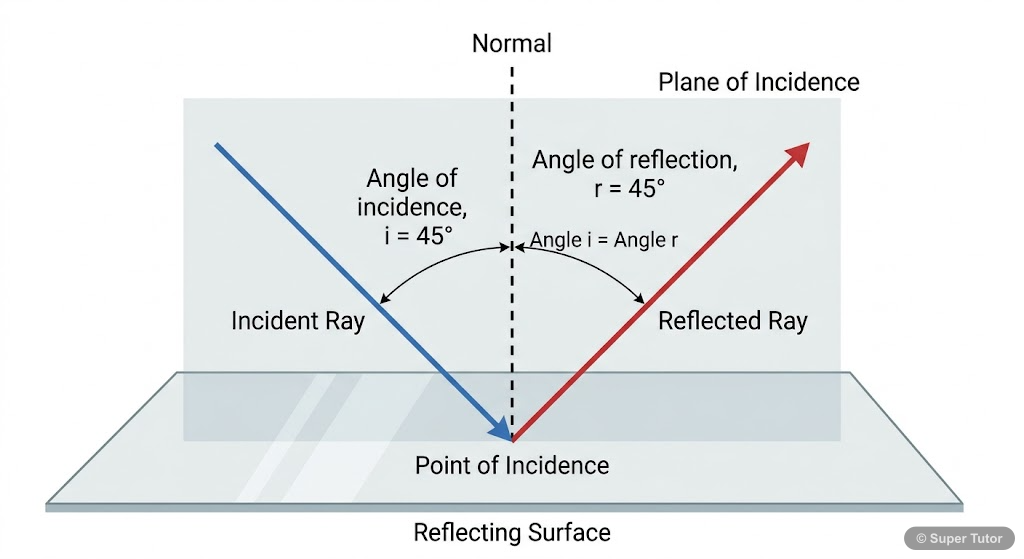
Learn better with visuals Super Tutor pairs illustrations like this with notes and quizzes for Light - Reflection and Refraction.
The first 13 solutions are open to read. The other 12 are free with a Super Tutor account.
Questions
1A ray of light travelling in air enters obliquely into water. Does the light ray bend towards the normal or away from the normal? Why?Show solution
When light travels from air to water, it goes from a rarer medium to a denser medium. Therefore, it bends towards the normal because its speed decreases in water.
2Light enters from air to glass having refractive index 1.50. What is the speed of light in the glass? The speed of light in vacuum is 3 × 10⁸ m s⁻¹.Show solution
Refractive index,
Given and ,
3Find out, from Table 9.3, the medium having highest optical density. Also find the medium with lowest optical density.Show solution
From Table 9.3, the highest refractive index is for diamond (), so it has the highest optical density.
The lowest refractive index is for air (), so it has the lowest optical density.
4You are given kerosene, turpentine and water. In which of these does the light travel fastest? Use the information given in Table 9.3.Show solution
Light travels fastest in the medium with the lowest refractive index.
From Table 9.3:
- water:
- kerosene:
- turpentine oil:
So light travels fastest in water.
5The refractive index of diamond is 2.42. What is the meaning of this statement?Show solution
The statement means
So the speed of light in diamond is
That is, light travels 2.42 times slower in diamond than in vacuum.
Intext Questions (Before Exercises)
1Define 1 dioptre of power of a lens.Show solution
Definition: 1 dioptre is the power of a lens whose focal length is 1 metre.
Explanation:
The power of a lens is defined as the reciprocal of its focal length in metres:
When ,
Thus, 1 dioptre (1 D) is the power of a lens of focal length 1 metre. Its SI unit is .
2A convex lens forms a real and inverted image of a needle at a distance of 50 cm from it. Where is the needle placed in front of the convex lens if the image is equal to the size of the object? Also, find the power of the lens.Show solution
Given:
- Image distance, (real and inverted, so positive by sign convention)
- Image size = Object size, so magnification (real and inverted image of same size)
Step 1: Find object distance using magnification.
So the needle is placed 50 cm in front of the lens (i.e., at the centre of curvature / at ).
Step 2: Find focal length using lens formula.
Step 3: Find power of the lens.
Result: The needle is placed 50 cm in front of the convex lens (at twice the focal length), and the power of the lens is .
3Find the power of a concave lens of focal length 2 m.Show solution
Given:
- Focal length of concave lens, (negative for concave lens)
Formula:
Calculation:
Result: The power of the concave lens is .
Exercises
1Which one of the following materials cannot be used to make a lens?
(a) Water
(b) Glass
(c) Plastic
(d) ClayShow solution
Correct Answer: (d) Clay
Justification: A lens works on the principle of refraction of light. For refraction to occur, the material must be transparent (light must pass through it). Clay is an opaque material — light cannot pass through it — so it cannot be used to make a lens. Water, glass, and plastic are all transparent and can be used to make lenses.
2The image formed by a concave mirror is observed to be virtual, erect and larger than the object. Where should be the position of the object?
(a) Between the principal focus and the centre of curvature
(b) At the centre of curvature
(c) Beyond the centre of curvature
(d) Between the pole of the mirror and its principal focus.Show solution
Correct Answer: (d) Between the pole of the mirror and its principal focus.
Justification: A concave mirror produces a virtual, erect, and magnified image only when the object is placed between the pole (P) and the principal focus (F) of the mirror. In all other positions, a concave mirror forms a real and inverted image.
3Where should an object be placed in front of a convex lens to get a real image of the size of the object?
(a) At the principal focus of the lens
(b) At twice the focal length
(c) At infinity
(d) Between the optical centre of the lens and its principal focus.Show solution
Correct Answer: (b) At twice the focal length.
Justification: When an object is placed at (twice the focal length) in front of a convex lens, the image is formed at on the other side. The image is real, inverted, and of the same size as the object (magnification ). This is the only position where image size equals object size for a convex lens.
4A spherical mirror and a thin spherical lens have each a focal length of −15 cm. The mirror and the lens are likely to be
(a) both concave.
(b) both convex.
(c) the mirror is concave and the lens is convex.
(d) the mirror is convex, but the lens is concave.Show solution
Correct Answer: (a) both concave.
Justification: By the New Cartesian Sign Convention:
- A concave mirror has a negative focal length (focus is in front of the mirror, on the same side as the object).
- A concave lens (diverging lens) also has a negative focal length.
Since both have (negative), both the mirror and the lens are concave.
5No matter how far you stand from a mirror, your image appears erect. The mirror is likely to be
(a) only plane.
(b) only concave.
(c) only convex.
(d) either plane or convex.Show solution
Correct Answer: (d) either plane or convex.
Justification:
- A plane mirror always forms a virtual, erect image regardless of the distance of the object.
- A convex mirror always forms a virtual, erect (and diminished) image for any position of the object.
- A concave mirror forms an erect image only when the object is between the pole and focus; beyond that it forms inverted images.
Therefore, the mirror is either plane or convex.
(a) A convex lens of focal length 50 cm.
(b) A concave lens of focal length 50 cm.
(c) A convex lens of focal length 5 cm.
(d) A concave lens of focal length 5 cm.
Free with a Super Tutor account
Free with a Super Tutor account
(a) Headlights of a car.
(b) Side/rear-view mirror of a vehicle.
(c) Solar furnace.
Support your answer with reason.
Free with a Super Tutor account
Free with a Super Tutor account
Free with a Super Tutor account
Free with a Super Tutor account
Free with a Super Tutor account
Free with a Super Tutor account
Free with a Super Tutor account
Free with a Super Tutor account
Free with a Super Tutor account
Free with a Super Tutor account
12 more solved questions in Light - Reflection and Refraction
They are free with a Super Tutor account, along with practice quizzes and flashcards for this chapter. Free to start, no card needed.
Frequently Asked Questions
What are the important topics in Light - Reflection and Refraction for Rajasthan Board Class 10 Science?
Are these NCERT Solutions for Light - Reflection and Refraction free?
How should I revise Light - Reflection and Refraction for the Rajasthan Board Class 10 board exam?
Sources & Official References
Content is aligned to the official syllabus. Refer to the board website for the latest curriculum.
More resources for Light - Reflection and Refraction
Practice Quiz
Test yourself with a quick quiz
Important Questions
Exam-style questions with answers
Revision Notes
Key points for last-minute revision
Formula Sheet
The chapter's formulas in one place
Chapter Summary
Understand the chapter at a glance
Concept Maps
See how topics connect
Study Plan
Step-by-step plan for this chapter
Flashcards
Quick-fire cards for active recall
Syllabus
What topics to cover
For serious students
Get the full Light - Reflection and Refraction chapter — start free.
Quizzes, flashcards, an AI doubt solver and a study plan for Rajasthan Board Class 10 Science. Free to start, no card needed.