Numbers and Sequences — Chapter Summary
Tamil Nadu Board · Class 10 · Mathematics
Summary of Numbers and Sequences for Tamil Nadu Board Class 10 Mathematics. Part of the Tamil Nadu Board Class 10 Mathematics syllabus.
Interactive on Super Tutor
Studying Numbers and Sequences? Get the full interactive chapter.
Quizzes, flashcards, AI doubt-solver and a step-by-step study plan — built for chapter summary and more.
Free trial, no card needed.
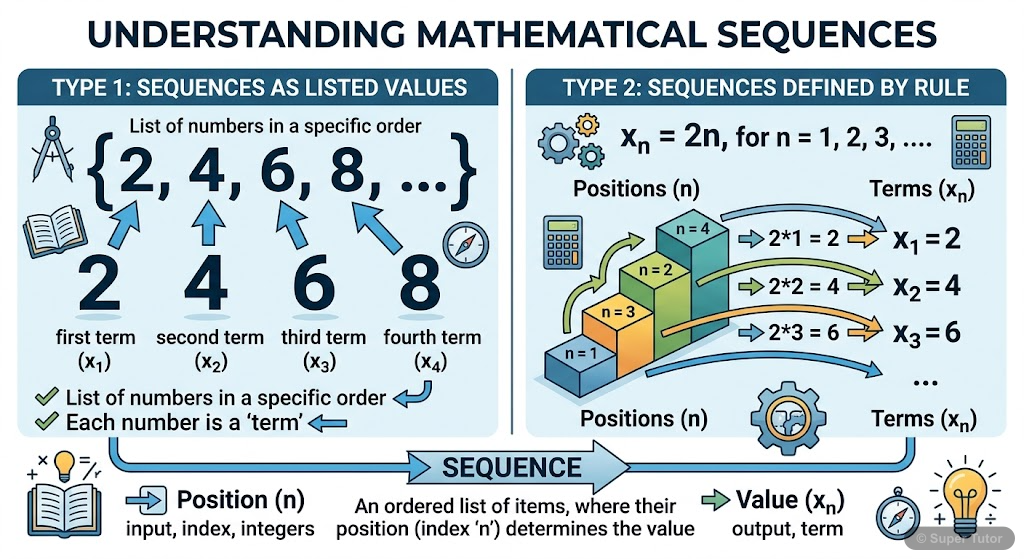
Learn better with visuals Super Tutor pairs illustrations like this with notes and quizzes for Numbers and Sequences.
Overview
Numbers and Sequences is a fundamental chapter in 10th grade mathematics that explores the properties of numbers, their divisibility patterns, and organized arrangements of numbers called sequences. This chapter builds upon your understanding of basic arithmetic and introduces you to important conce
Key Concepts
For any two positive integers
For any two positive integers a and b, there exist unique integers q and r such that a = bq + r, where 0 ≤ r < b. Here, a is the dividend, b is the di
This is a step
This is a step-by-step method to find the Highest Common Factor (HCF) of two positive integers. The algorithm repeatedly applies the division lemma: d
Every positive integer greater than 1
Every positive integer greater than 1 can be expressed as a product of prime numbers in exactly one way (ignoring the order of factors). For example,
Two integers a and b
Two integers a and b are congruent modulo n (written as a ≡ b (mod n)) if they leave the same remainder when divided by n, or equivalently, if a - b i
If a ≡ b (mod m)
If a ≡ b (mod m) and c ≡ d (mod m), then: (a + c) ≡ (b + d) (mod m); (a - c) ≡ (b - d) (mod m); (a × c) ≡ (b × d) (mod m). These properties allow us t
Learning Objectives
- Understand and apply Euclid's Division Lemma and Division Algorithm to find HCF and solve real-world problems
- Learn the Fundamental Theorem of Arithmetic and use prime factorization in problem-solving
- Master congruence modulo n and modular arithmetic operations
- Define sequences as functions and identify different types of sequences
- Understand Arithmetic Progressions and find nth terms and sums
Frequently Asked Questions
What are the important topics in Numbers and Sequences for Tamil Nadu Board Class 10 Mathematics?
How should I revise Numbers and Sequences for the Tamil Nadu Board Class 10 board exam?
Sources & Official References
Content is aligned to the official syllabus. Refer to the board website for the latest curriculum.
More resources for Numbers and Sequences
For serious students
Get the full Numbers and Sequences chapter — start free.
Quizzes, flashcards, an AI doubt solver and a study plan for Tamil Nadu Board Class 10 Mathematics. Free to start, no card needed.