Applications of Matrices and Determinants — Chapter Summary
Tamil Nadu Board · Class 12 · Mathematics
Summary of Applications of Matrices and Determinants for Tamil Nadu Board Class 12 Mathematics. Part of the Tamil Nadu Board Class 12 Mathematics syllabus.
Interactive on Super Tutor
Studying Applications of Matrices and Determinants? Get the full interactive chapter.
Quizzes, flashcards, AI doubt-solver and a step-by-step study plan — built for chapter summary and more.
Free trial, no card needed.
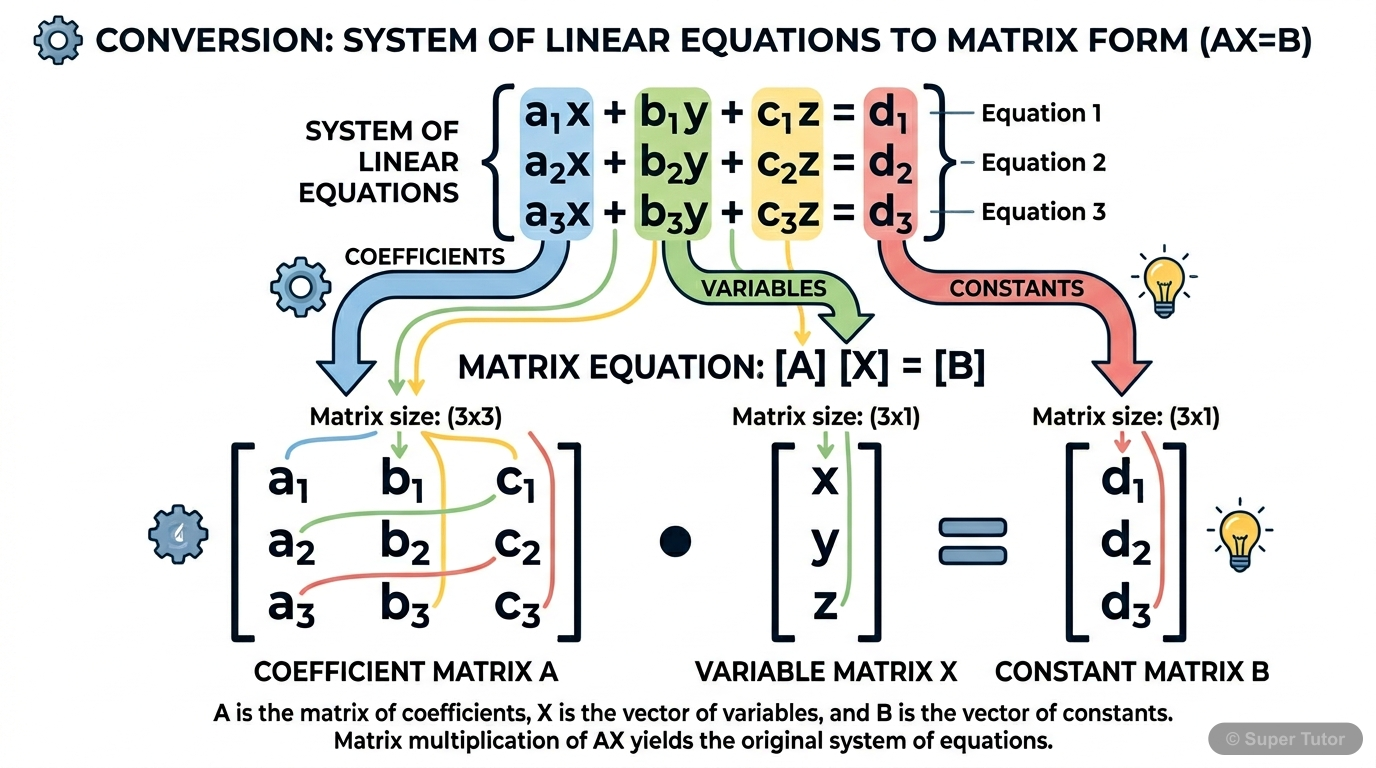
An illustration from Super Tutor's Applications of Matrices and Determinants chapter — alongside flashcards, concept maps and practice questions.
Overview
Matrices and determinants are fundamental mathematical tools used to solve systems of linear equations and model real-world problems. This chapter explores how these algebraic structures are applied to solve practical problems in engineering, physics, chemistry, and computer graphics. Understanding
Key Concepts
The adjoint (or adjugate) of
The adjoint (or adjugate) of a square matrix A is defined as the transpose of the matrix of cofactors. For a 3×3 matrix, if we replace each element aᵢ
A square matrix A has
A square matrix A has an inverse A⁻¹ if and only if it is non-singular (|A| ≠ 0). The inverse is given by: A⁻¹ = (1/|A|) × adj A. This inverse satisfi
Elementary transformations include
Elementary transformations include: (1) Interchanging any two rows/columns (Rᵢ ↔ Rⱼ), (2) Multiplying a row/column by a non-zero scalar (Rᵢ → λRᵢ), an
A matrix is in row
A matrix is in row-echelon form when: (1) all zero rows appear below non-zero rows, (2) the first non-zero element (pivot) in each row is to the right
By the Rouché
By the Rouché-Capelli theorem, a system AX = B is consistent (has at least one solution) if and only if rank(A) = rank([A|B]), where [A|B] is the augm
Learning Objectives
- Understand the concept of adjoint matrix and its properties
- Learn to find the inverse of a non-singular square matrix using the adjoint method
- Apply elementary row and column transformations to solve problems
- Master the rank method to determine consistency of linear systems
- Solve systems of linear equations using matrix inversion, Cramer's rule, and Gaussian elimination
Frequently Asked Questions
What are the important topics in Applications of Matrices and Determinants for Tamil Nadu Board Class 12 Mathematics?
How should I revise Applications of Matrices and Determinants for the Tamil Nadu Board Class 12 board exam?
Sources & Official References
Content is aligned to the official syllabus. Refer to the board website for the latest curriculum.
More resources for Applications of Matrices and Determinants
For serious students
Get the full Applications of Matrices and Determinants chapter — start free.
Quizzes, flashcards, an AI doubt solver and a study plan for Tamil Nadu Board Class 12 Mathematics. Free to start, no card needed.