Ordinary Differential Equations — Chapter Summary
Tamil Nadu Board · Class 12 · Mathematics
Summary of Ordinary Differential Equations for Tamil Nadu Board Class 12 Mathematics. Part of the Tamil Nadu Board Class 12 Mathematics syllabus.
Interactive on Super Tutor
Studying Ordinary Differential Equations? Get the full interactive chapter.
Quizzes, flashcards, AI doubt-solver and a step-by-step study plan — built for chapter summary and more.
Free trial, no card needed.
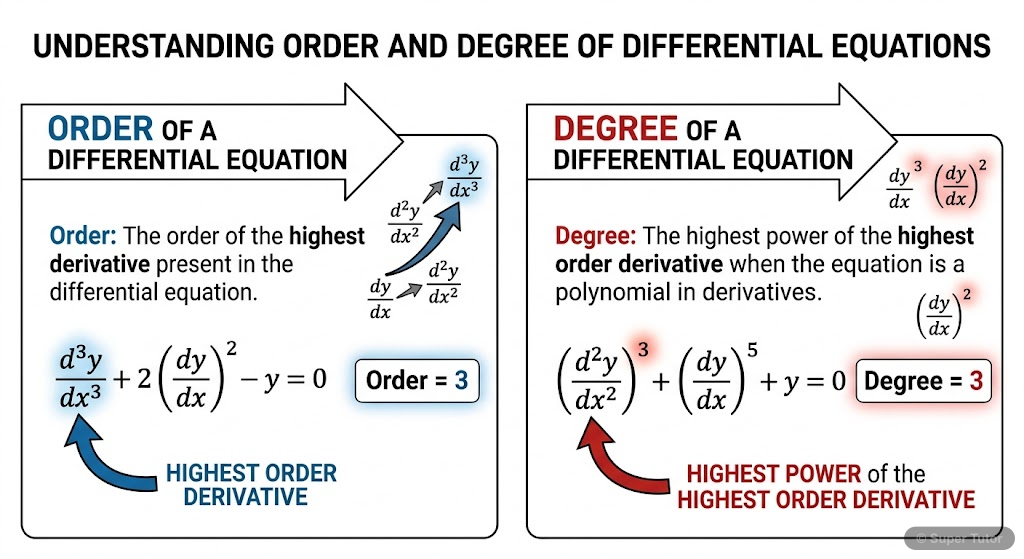
An illustration from Super Tutor's Ordinary Differential Equations chapter — alongside flashcards, concept maps and practice questions.
Overview
Ordinary Differential Equations (ODEs) are fundamental mathematical tools that describe how quantities change over time or space. They arise naturally in physics, chemistry, biology, engineering, and economics when we model real-world phenomena involving rates of change. From predicting population g
Key Concepts
A differential equation is any equation
A differential equation is any equation containing at least one derivative of an unknown function. For example, dy/dx = 2x, d²y/dx² + y = 0, and dy/dx
The order is the highest derivative
The order is the highest derivative present in the equation. In dy/dx = sin(x), the order is 1 (first derivative). In d²y/dx² + 3(dy/dx) + 5y = 0, the
The degree is the highest power
The degree is the highest power of the highest-order derivative when the equation is expressed as a polynomial. For (d³y/dx³)² - 3(d²y/dx²) + 5(dy/dx)
A linear differential equation has
A linear differential equation has the form: aₙ(x)y⁽ⁿ⁾ + aₙ₋₁(x)y⁽ⁿ⁻¹⁾ + ... + a₁(x)y' + a₀(x)y = g(x). The dependent variable y and its derivatives a
A linear differential equation is homogeneous
A linear differential equation is homogeneous if the right side equals zero (g(x) = 0), otherwise it's non-homogeneous. For example, d²y/dx² + 3dy/dx
Learning Objectives
- Classify differential equations based on order, degree, and type (linear/nonlinear, homogeneous/non-homogeneous)
- Construct differential equations from given families of curves by eliminating arbitrary constants
- Determine the order and degree of differential equations and understand when degree is undefined
- Master the method of separation of variables for solving first-order differential equations
- Apply substitution methods to transform complex equations into solvable forms
Frequently Asked Questions
What are the important topics in Ordinary Differential Equations for Tamil Nadu Board Class 12 Mathematics?
How should I revise Ordinary Differential Equations for the Tamil Nadu Board Class 12 board exam?
Sources & Official References
Content is aligned to the official syllabus. Refer to the board website for the latest curriculum.
More resources for Ordinary Differential Equations
For serious students
Get the full Ordinary Differential Equations chapter — start free.
Quizzes, flashcards, an AI doubt solver and a study plan for Tamil Nadu Board Class 12 Mathematics. Free to start, no card needed.