Applications of Matrices and Determinants — Practice Quiz
Tamil Nadu Board · Class 12 · Mathematics
Try a 4-question quiz on Applications of Matrices and Determinants for Tamil Nadu Board Class 12 Mathematics: tap an answer to check it and see why.
Interactive on Super Tutor
Studying Applications of Matrices and Determinants? Get the full interactive chapter.
Quizzes, flashcards, AI doubt-solver and a step-by-step study plan — built for practice quiz and more.
Free trial, no card needed.
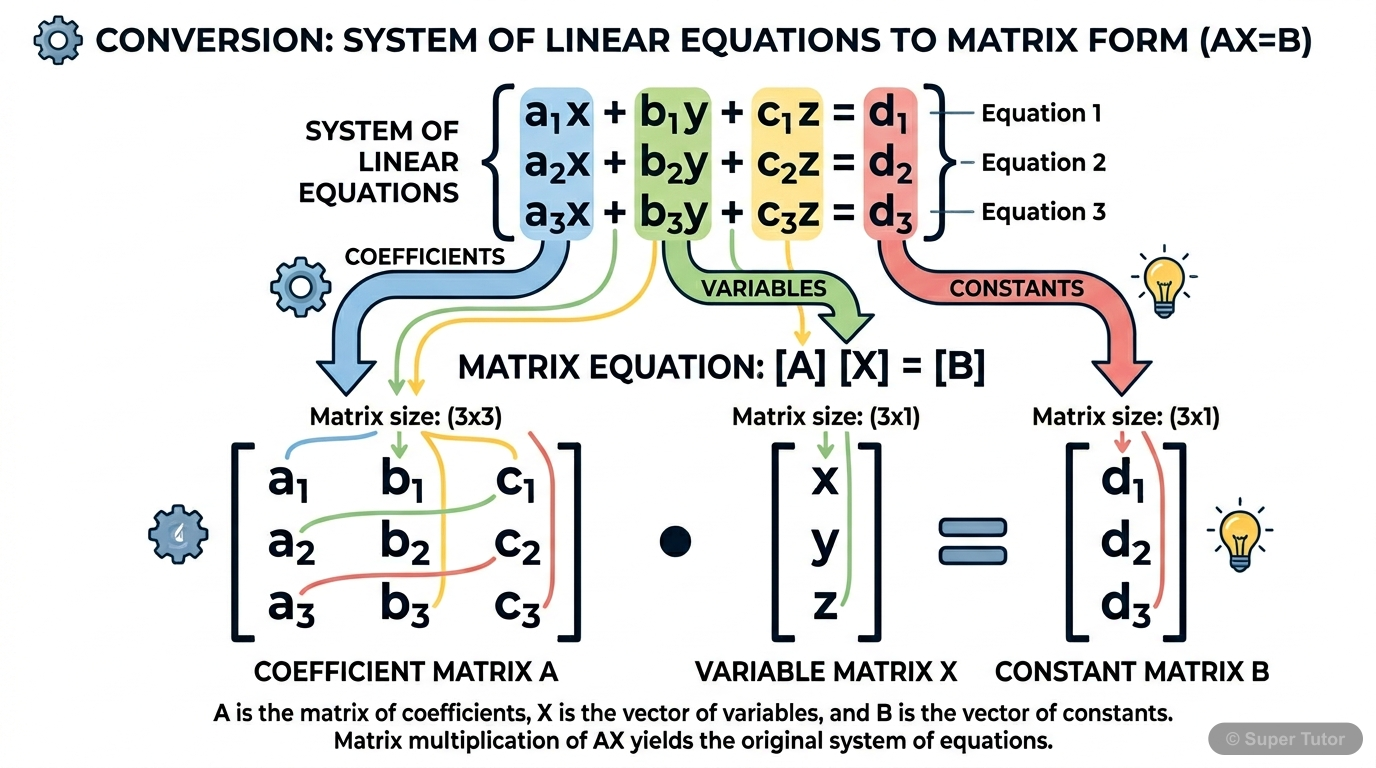
An illustration from Super Tutor's Applications of Matrices and Determinants chapter — alongside flashcards, concept maps and practice questions.
Quick Quiz: Applications of Matrices and Determinants
0/4Tap an answer to check it instantly. No sign-up needed for these 4.
If A is a non-singular matrix of order 3 with |A| = 5, then |adj(adj A)| equals:
For the system of equations: x + 2y - z = 3, 3x - y + 2z = 1, x - 2y + 3z = 3, x - y + z = -1, what is the rank of the augmented matrix [A|B]?
If A = [[2,3],[5,−2]] and λA⁻¹ = A, what is the value of λ?
Using Cramer's rule, what is the value of x₂ for the system: x₁ − x₂ = 3, 2x₁ + 3x₂ + 4x₃ = 17, x₂ + 2x₃ = 7?
Sample Questions
A square matrix A of order 3 satisfies A² − 9A + 14I = O. Which of the following correctly gives A⁻¹?
Show answer
(1/14)(9I − A)
Step 1: Start with A² − 9A + 14I = O. We want to isolate A⁻¹. Step 2: Post-multiply both sides by A⁻¹: A²·A⁻¹ − 9A·A⁻¹ + 14I·A⁻¹ = O·A⁻¹. Step 3: This gives A − 9I + 14A⁻¹ = O. Step 4: Rearranging: 14A⁻¹ = 9I − A → A⁻¹ = (1/14)(9I − A). Final Answer: A⁻¹ = (1/14)(9I − A). Common mistake: Students post-multiply incorrectly or forget the sign change when isolating A⁻¹.
For a 3×3 non-singular matrix A, if |adj A| = 64, then |A| equals:
Show answer
8
Step 1: Use the property |adj A| = |A|^(n−1) for an n×n matrix. Step 2: For n = 3: |adj A| = |A|^(3−1) = |A|² = 64. Step 3: So |A|² = 64, giving |A| = ±8. Step 4: However, the problem states matrix is non-singular (|A| ≠ 0). From the note in the textbook, for a 3×3 non-singular matrix, |adj A| = |A|² is always positive, so |A| could be ±8. But by the theorem that |adj A| is positive for odd-order matrices, |A|^(2m) > 0 holds for both signs. The standard answer given is 8 (positive root) unless sign is specified. Final Answer: |A| = 8 (taking positive value as standard). Note: ±8 is technically
The system 2x − y + z = 2, 6x − 3y + 3z = 6, 4x − 2y + 2z = 4 has:
Show answer
Infinitely many solutions forming a two-parameter family
Step 1: Notice equations 2, 3 are multiples of equation 1: 6x−3y+3z=6 is 3× eq.1, and 4x−2y+2z=4 is 2× eq.1. Step 2: Form augmented matrix and reduce. All three rows reduce to the same equation: 2x − y + z = 2. Step 3: Row-echelon form gives only 1 non-zero row. So ρ(A) = ρ([A|B]) = 1. Step 4: Number of unknowns = 3. Since ρ = 1 < 3, the solution has 3 − 1 = 2 free parameters → two-parameter family. Final Answer: Infinitely many solutions forming a two-parameter family. Common mistake: Counting parameters incorrectly as n − ρ.
If A and B are non-singular matrices of order 3, which of the following is INCORRECT?
Show answer
adj(AB) = (adj A)(adj B)
Step 1: We check each option against known theorems. Step 2: (AB)⁻¹ = B⁻¹A⁻¹ is TRUE by the Reversal Law for Inverses. Step 3: |A⁻¹| = 1/|A| is TRUE since |A||A⁻¹| = |I| = 1. Step 4: (Aᵀ)⁻¹ = (A⁻¹)ᵀ is TRUE by Theorem 1.4. Step 5: adj(AB) = (adj B)(adj A) — note the ORDER is REVERSED, like the reversal law. So adj(AB) = (adj A)(adj B) is INCORRECT; the correct formula is adj(AB) = (adj B)(adj A). Final Answer: adj(AB) = (adj A)(adj B) is incorrect.
+41 more questions on Applications of Matrices and Determinants (Tamil Nadu Board Class 12 Mathematics)
Practise AllFrequently Asked Questions
What are the important topics in Applications of Matrices and Determinants for Tamil Nadu Board Class 12 Mathematics?
How many practice questions are there for Applications of Matrices and Determinants?
Sources & Official References
Content is aligned to the official syllabus. Refer to the board website for the latest curriculum.
More resources for Applications of Matrices and Determinants
Important Questions
Exam-style questions with answers
Revision Notes
Key points for last-minute revision
Formula Sheet
The chapter's formulas in one place
Chapter Summary
Understand the chapter at a glance
Concept Maps
See how topics connect
Flashcards
Quick-fire cards for active recall
Syllabus
What topics to cover
For serious students
Get the full Applications of Matrices and Determinants chapter — start free.
Quizzes, flashcards, an AI doubt solver and a study plan for Tamil Nadu Board Class 12 Mathematics. Free to start, no card needed.