Ordinary Differential Equations — Practice Quiz
Tamil Nadu Board · Class 12 · Mathematics
Try a 4-question quiz on Ordinary Differential Equations for Tamil Nadu Board Class 12 Mathematics: tap an answer to check it and see why.
Interactive on Super Tutor
Studying Ordinary Differential Equations? Get the full interactive chapter.
Quizzes, flashcards, AI doubt-solver and a step-by-step study plan — built for practice quiz and more.
Free trial, no card needed.
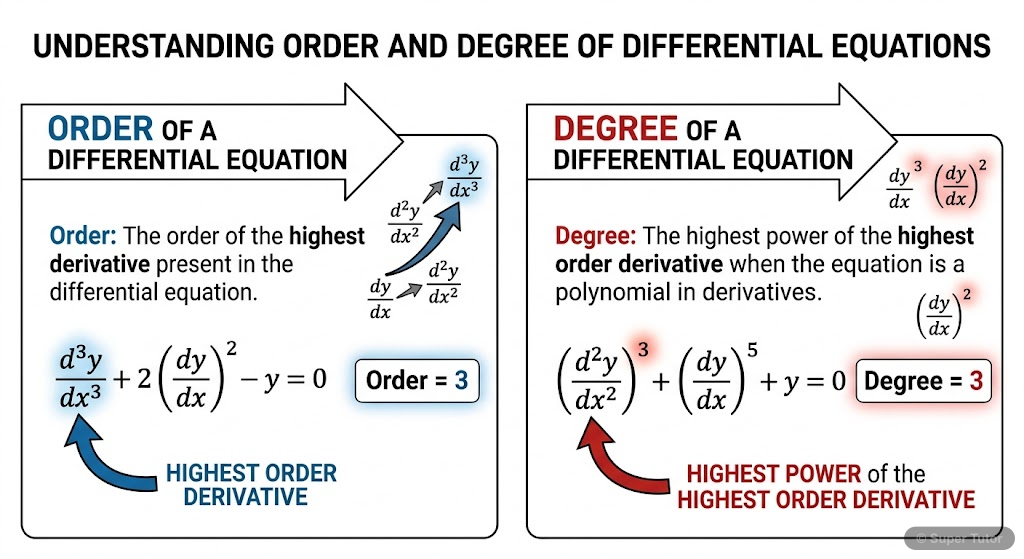
An illustration from Super Tutor's Ordinary Differential Equations chapter — alongside flashcards, concept maps and practice questions.
Quick Quiz: Ordinary Differential Equations
0/4Tap an answer to check it instantly. No sign-up needed for these 4.
Find the order and degree of the differential equation: 3(d²y/dx²) = [4 + (dy/dx)²]^(5/2). After squaring both sides, what are the order and degree respectively?
The differential equation formed by eliminating the arbitrary constants A and B from y = Ae^(3x) + Be^(-3x) is:
The particular solution of (1 + x³)dy - x²y dx = 0 with y(1) = 2 is:
The solution of the homogeneous differential equation (x² - 3y²)dx + 2xy dy = 0 is:
Sample Questions
For the linear differential equation dy/dx + 2y cot x = 3x² csc²x, the integrating factor is:
Show answer
sin²x
Step 1: The equation is dy/dx + Py = Q where P = 2cot x. Step 2: Compute ∫P dx = ∫2cot x dx = 2log|sin x| = log(sin²x). Step 3: I.F. = e^(∫P dx) = e^(log sin²x) = sin²x. Step 4: The integrating factor is sin²x. With this I.F., the solution becomes y·sin²x = ∫3x²csc²x·sin²x dx = ∫3x² dx = x³ + C. Common mistake: Students confuse ∫cot x dx = log|sin x| with log|cos x| (which is ∫(-tan x)dx). Also, multiplying by 2 inside the log gives sin²x, not 2sin x.
A population doubles in 50 years with growth rate proportional to the population. In how many years will the population become triple?
Show answer
50(log 3/log 2) years
Step 1: Population model: dx/dt = kx, giving x = x₀e^(kt). Step 2: Population doubles in 50 years: 2x₀ = x₀e^(50k), so e^(50k) = 2, giving k = (1/50)log 2. Step 3: For tripling: 3x₀ = x₀e^(kt₁), so e^(kt₁) = 3. Step 4: kt₁ = log 3, therefore t₁ = (log 3)/k = (log 3)/[(1/50)log 2] = 50(log 3/log 2). Final: The population triples in 50(log 3/log 2) years ≈ 79.25 years. Common mistake: Students use t₁ = 150 years (triple the 50 years), which is wrong because exponential growth is not linear.
The solution of the differential equation dy/dx = sin²(x - y + 1) using the substitution z = x - y + 1 is:
Show answer
tan(x - y + 1) = x + C
Step 1: Let z = x - y + 1. Then dz/dx = 1 - dy/dx, so dy/dx = 1 - dz/dx. Step 2: Substituting into the DE: 1 - dz/dx = sin²z. Therefore dz/dx = 1 - sin²z = cos²z. Step 3: Separate variables: dz/cos²z = dx, i.e., sec²z dz = dx. Step 4: Integrate both sides: tan z = x + C. Step 5: Substitute back z = x - y + 1: tan(x - y + 1) = x + C. Common mistake: Students make sign errors when computing dz/dx and forget that dy/dx = 1 - dz/dx (not dz/dx - 1).
What is the degree of the differential equation: (d³y/dx³)^(2/3) - 3(d²y/dx²) + 5(dy/dx) + 4 = 0?
Show answer
2
Step 1: Identify the highest order derivative: it is d³y/dx³ (order = 3). Step 2: The term (d³y/dx³)^(2/3) has a fractional power. We must eliminate this fractional power. Step 3: Isolate the fractional term: (d³y/dx³)^(2/3) = 3(d²y/dx²) - 5(dy/dx) - 4. Cube both sides: (d³y/dx³)² = [3(d²y/dx²) - 5(dy/dx) - 4]³. Step 4: Now the highest order derivative d³y/dx³ appears with power 2. Therefore degree = 2. Common mistake: Taking degree = 2/3 directly from the original equation without cubing to remove the fractional power.
+39 more questions on Ordinary Differential Equations (Tamil Nadu Board Class 12 Mathematics)
Practise AllFrequently Asked Questions
What are the important topics in Ordinary Differential Equations for Tamil Nadu Board Class 12 Mathematics?
How many practice questions are there for Ordinary Differential Equations?
Sources & Official References
Content is aligned to the official syllabus. Refer to the board website for the latest curriculum.
More resources for Ordinary Differential Equations
Important Questions
Exam-style questions with answers
Revision Notes
Key points for last-minute revision
Formula Sheet
The chapter's formulas in one place
Chapter Summary
Understand the chapter at a glance
Concept Maps
See how topics connect
Flashcards
Quick-fire cards for active recall
Syllabus
What topics to cover
For serious students
Get the full Ordinary Differential Equations chapter — start free.
Quizzes, flashcards, an AI doubt solver and a study plan for Tamil Nadu Board Class 12 Mathematics. Free to start, no card needed.