Reproductive Health — Important Questions
Tamil Nadu Board · Class 12 · Zoology
45 important questions from Reproductive Health for Tamil Nadu Board Class 12 Zoology, with answers. Includes multiple choice questions.
Interactive on Super Tutor
Studying Reproductive Health? Get the full interactive chapter.
Quizzes, flashcards, AI doubt-solver and a step-by-step study plan — built for important questions and more.
Free trial, no card needed.
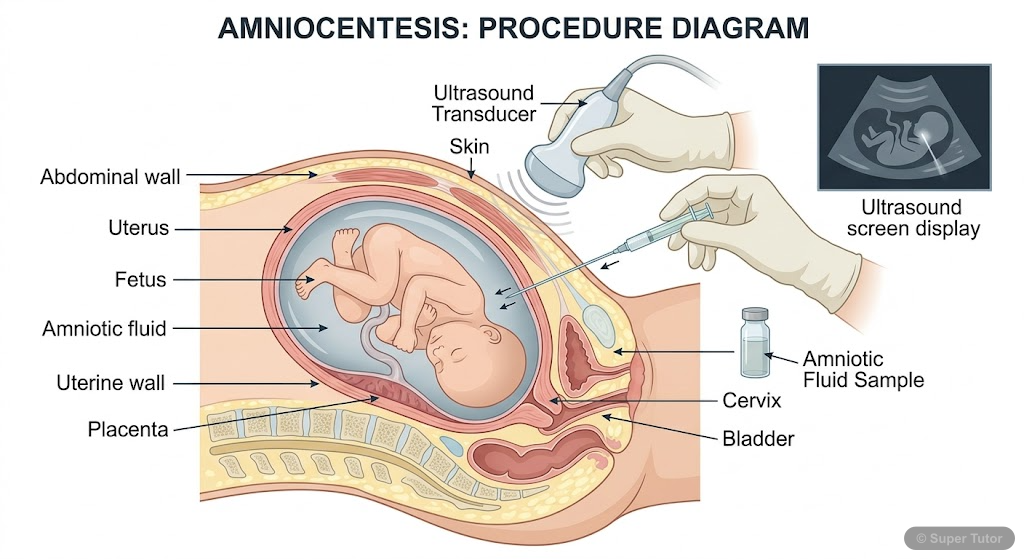
One of 3 illustrations for Reproductive Health in Super Tutor — alongside flashcards, concept maps and practice questions.
Important Questions from Reproductive Health
In the ART procedure called ZIFT, up to what blastomere stage is the zygote transferred, and where is it transferred?
Show answer
Up to 8 blastomeres; transferred to the fallopian tube
Step 1: ZIFT stands for Zygote Intra-Fallopian Transfer. Step 2: In this technique, fertilization is done outside the body (as in IVF). Step 3: The key feature of ZIFT is that the zygote — allowed to develop up to the 8-blastomere stage — is transferred into the fallopian tube (not the uterus) using laparoscopy. Step 4: After transfer, the zygote continues its natural cell divisions and migrates toward the uterus where it implants. Step 5: This is different from IUT (Intra Uterine Transfer), where an embryo with MORE than 8 blastomeres is placed directly into the uterus. The fallopian tube des
Lactational amenorrhoea serves as a natural birth control method. What is the hormonal mechanism behind it?
Show answer
High prolactin levels suppress GnRH release, thereby preventing menstrual cycles
Step 1: During breastfeeding, suckling by the baby stimulates the mother's pituitary gland. Step 2: This stimulation causes increased secretion of prolactin, a hormone responsible for milk production. Step 3: The high concentration of prolactin in the mother's blood acts on the hypothalamus to suppress the release of GnRH (Gonadotropin Releasing Hormone). Step 4: Without adequate GnRH, the pituitary does not release sufficient gonadotropins (FSH and LH), which are needed for the menstrual cycle and ovulation. Step 5: This results in delayed ovarian cycles — called lactational amenorrhoea — whi
Which of the following correctly pairs a sexually transmitted disease with its causative organism?
Show answer
Chlamydiasis — Chlamydia trachomatis
Step 1: This question tests your ability to correctly match diseases with their causative agents. Step 2: Syphilis is caused by Treponema pallidum (a spirochaete bacterium), NOT Neisseria gonorrhoeae. Step 3: Gonorrhoea is caused by Neisseria gonorrhoeae, NOT Treponema pallidum. Students often confuse these two. Step 4: Genital warts are caused by Human Papilloma Virus (HPV), NOT Herpes simplex virus. Herpes simplex virus causes genital herpes. Step 5: Chlamydiasis is correctly caused by Chlamydia trachomatis — this is the only correctly matched pair among the options. Chlamydia also causes ly
The PCPNDT Act (1994) was enacted by the Government of India primarily to:
Show answer
Ban sex determination using prenatal diagnostic techniques to prevent female foeticide
Step 1: PCPNDT stands for Pre-Conception and Pre-Natal Diagnostic Techniques Act. Step 2: With small family norms and a cultural preference for male children, techniques like amniocentesis were being misused to determine the sex of the foetus. Step 3: If the foetus was found to be female, selective abortions (female foeticide) were performed, leading to a skewed sex ratio (declining from 927 to 919 females per 1000 males). Step 4: To address this, the PCPNDT Act of 1994 was enacted to ban the use of prenatal diagnostic techniques for the purpose of sex identification. Step 5: MTP was legalized
+41 more questions on Reproductive Health (Tamil Nadu Board Class 12 Zoology)
Practise AllFrequently Asked Questions
What are the important topics in Reproductive Health for Tamil Nadu Board Class 12 Zoology?
How many important questions are there in Reproductive Health?
Sources & Official References
Content is aligned to the official syllabus. Refer to the board website for the latest curriculum.
More resources for Reproductive Health
For serious students
Get the full Reproductive Health chapter — start free.
Quizzes, flashcards, an AI doubt solver and a study plan for Tamil Nadu Board Class 12 Zoology. Free to start, no card needed.