Set Language — Practice Quiz
Tamil Nadu Board · Class 9 · Mathematics
Try a 4-question quiz on Set Language for Tamil Nadu Board Class 9 Mathematics: tap an answer to check it and see why.
Interactive on Super Tutor
Studying Set Language? Get the full interactive chapter.
Quizzes, flashcards, AI doubt-solver and a step-by-step study plan — built for practice quiz and more.
Free trial, no card needed.
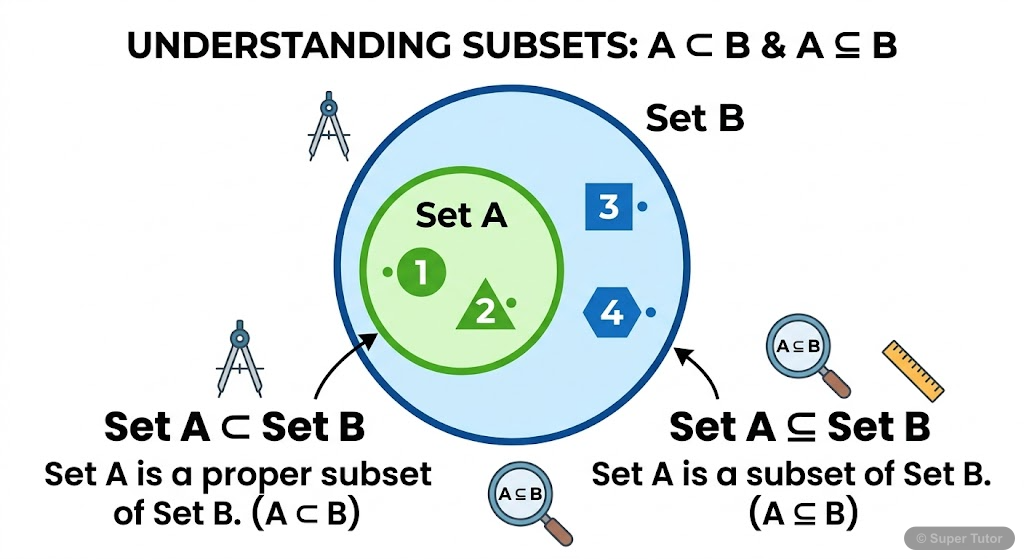
One of 6 illustrations for Set Language in Super Tutor — alongside flashcards, concept maps and practice questions.
Quick Quiz: Set Language
0/4Tap an answer to check it instantly. No sign-up needed for these 4.
If A = {1, 2, 3, 4, 5} and B = {3, 4, 5, 6, 7}, then n(A ∪ B) = ?
If n(A) = 20, n(B) = 15, and n(A ∩ B) = 8, what is n(A ∪ B)?
If n[P(A)] = 32, what is n(A)?
Set A = {x : x ∈ N, x² < 25}. What is n(A)?
Sample Questions
If U = {1,2,3,4,5,6,7,8}, A = {2,4,6,8} and B = {1,2,3,4}, then (A ∪ B)' = ?
Show answer
{5, 7}
Step 1: Find A ∪ B first. A∪B = {1,2,3,4,6,8}. Step 2: (A∪B)' = U − (A∪B) = elements in U but NOT in A∪B. Step 3: U = {1,2,3,4,5,6,7,8}. Remove {1,2,3,4,6,8}. Step 4: Remaining elements = {5, 7}. So (A∪B)' = {5, 7}. Common mistake: Finding A' ∪ B' instead of (A∪B)'. Note: By De Morgan's law, (A∪B)' = A'∩B' = {1,3,5,7}∩{5,6,7,8} = {5,7}. Same answer. ✓
If A = {1,2,3,4,5} and B = {3,4,5,6,7}, then A − B = ?
Show answer
{1, 2}
Step 1: A − B means elements in A that are NOT in B. Step 2: A = {1,2,3,4,5} and B = {3,4,5,6,7}. Step 3: Elements of A: check each — 1∉B ✓, 2∉B ✓, 3∈B ✗, 4∈B ✗, 5∈B ✗. Step 4: A − B = {1, 2}. Common mistake: {1,2,6,7} is A△B (symmetric difference), not A−B. {6,7} would be B−A.
Two sets A and B are such that n(A) = 12, n(B) = 9 and n(A ∪ B) = 18. How many elements are in A ∩ B?
Show answer
3
Step 1: Use the formula n(A∪B) = n(A)+n(B)−n(A∩B). Step 2: Substitute: 18 = 12 + 9 − n(A∩B). Step 3: 18 = 21 − n(A∩B). Step 4: n(A∩B) = 21 − 18 = 3. Common mistake: Adding 12+9 to get 21 and thinking that is n(A∪B), or not rearranging the formula correctly.
If A = {a,b,c,d} and B = {c,d,e,f}, then A △ B (symmetric difference) = ?
Show answer
{a, b, e, f}
Step 1: A△B = (A−B) ∪ (B−A). Find each part. Step 2: A−B = elements in A not in B = {a, b} (since c,d are in B). Step 3: B−A = elements in B not in A = {e, f} (since c,d are in A). Step 4: A△B = {a,b} ∪ {e,f} = {a,b,e,f}. Common mistake: {c,d} is the intersection, not the symmetric difference. {a,b,c,d,e,f} is the union.
+41 more questions on Set Language (Tamil Nadu Board Class 9 Mathematics)
Practise AllFrequently Asked Questions
What are the important topics in Set Language for Tamil Nadu Board Class 9 Mathematics?
How many practice questions are there for Set Language?
Sources & Official References
Content is aligned to the official syllabus. Refer to the board website for the latest curriculum.
More resources for Set Language
For serious students
Get the full Set Language chapter — start free.
Quizzes, flashcards, an AI doubt solver and a study plan for Tamil Nadu Board Class 9 Mathematics. Free to start, no card needed.