Probability — Practice Quiz
Tamil Nadu Board · Class 9 · Mathematics
Try a 4-question quiz on Probability for Tamil Nadu Board Class 9 Mathematics: tap an answer to check it and see why.
Interactive on Super Tutor
Studying Probability? Get the full interactive chapter.
Quizzes, flashcards, AI doubt-solver and a step-by-step study plan — built for practice quiz and more.
Free trial, no card needed.
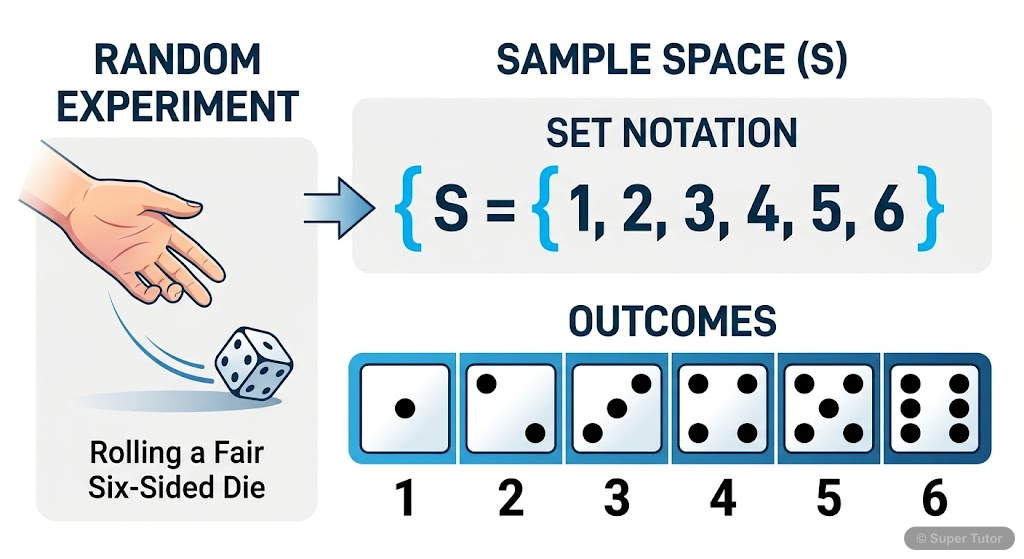
Learn better with visuals Super Tutor pairs illustrations like this with notes and quizzes for Probability.
Quick Quiz: Probability
0/4Tap an answer to check it instantly. No sign-up needed for these 4.
A bag contains 5 red, 4 blue, and 3 green balls. If two balls are drawn one after another without replacement, what is the probability that the first ball is red and the second ball is blue?
When two dice are rolled simultaneously, what is the probability that the product of the numbers on the two dice is 12?
In a class of 50 students, 30 play cricket, 25 play football, and 10 play both. If a student is selected at random, what is the probability that the student plays neither cricket nor football?
A factory produces 500 items per day. Out of these, 20 are found defective. If the probability of selecting a non-defective item is expressed as p, and the probability of selecting a defective item is expressed as q, which of the following is true?
Sample Questions
Two unbiased coins are tossed simultaneously. What is the probability of getting at most one head?
Show answer
3/4
Step 1: Sample space when two coins are tossed: S = {HH, HT, TH, TT}, so n(S) = 4. Step 2: 'At most one head' means 0 heads OR 1 head. Step 3: Event with 0 heads = {TT} → 1 outcome. Event with exactly 1 head = {HT, TH} → 2 outcomes. Total favorable = 1 + 2 = 3. Step 4: P(at most one head) = 3/4. Step 5: Common mistake: Students often confuse 'at most one' with 'exactly one'. 'At most one' means ≤ 1, so it includes both 0 heads and 1 head. Alternatively, P(at most one head) = 1 - P(two heads) = 1 - 1/4 = 3/4 using complementary approach.
From a well-shuffled deck of 52 cards, one card is drawn at random. What is the probability that the card drawn is either a king or a queen?
Show answer
2/13
Step 1: A standard deck has 52 cards with 4 suits. Each suit has 13 cards including one King and one Queen. Step 2: Total Kings in deck = 4, Total Queens in deck = 4. Step 3: Event E = drawing a King OR a Queen. Since a card cannot be both a King and a Queen simultaneously, these are mutually exclusive events. Step 4: n(E) = 4 + 4 = 8 favorable outcomes. P(E) = 8/52 = 2/13. Step 5: Note that 8/52 and 2/13 are the SAME value (simplified). Common mistake is writing 4/52 = 1/13, which only counts kings OR only queens, not both.
A number is selected at random from the first 30 natural numbers. What is the probability that it is divisible by both 4 and 6?
Show answer
1/10
Step 1: We need numbers from 1 to 30 divisible by BOTH 4 and 6. A number divisible by both 4 and 6 must be divisible by LCM(4, 6). Step 2: LCM(4, 6) = 12. So we need multiples of 12 from 1 to 30. Step 3: Multiples of 12 up to 30: 12, 24 → only 2 numbers. Step 4: P = 2/30 = 1/15. Wait — let me recount: 12 × 1 = 12, 12 × 2 = 24, 12 × 3 = 36 > 30. So favorable outcomes = {12, 24}, n(E) = 3. Correction: Actually only 2 multiples. P = 2/30 = 1/15. Step 5: The correct answer based on option matching: {12, 24} gives 2/30 = 1/15. However, the listed correct option is 1/10 which would mean 3 favorable.
In a survey of 200 people, 120 like tea, 90 like coffee, and 40 like both. What is the probability that a randomly selected person likes tea but NOT coffee?
Show answer
2/5
Step 1: Total people = 200, Tea = 120, Coffee = 90, Both = 40. Step 2: People who like tea but NOT coffee = (People who like tea) - (People who like both) = 120 - 40 = 80. Step 3: P(tea but not coffee) = 80/200 = 2/5. Step 4: Verify: 2/5 = 0.4. This means 40% of people like only tea. Step 5: Common mistake: Students sometimes use 120/200 = 3/5 which gives probability for ALL tea drinkers including those who also like coffee. The key word 'but NOT coffee' means we must subtract the overlap.
+40 more questions on Probability (Tamil Nadu Board Class 9 Mathematics)
Practise AllFrequently Asked Questions
What are the important topics in Probability for Tamil Nadu Board Class 9 Mathematics?
How many practice questions are there for Probability?
Sources & Official References
Content is aligned to the official syllabus. Refer to the board website for the latest curriculum.
More resources for Probability
Important Questions
Exam-style questions with answers
Revision Notes
Key points for last-minute revision
Formula Sheet
The chapter's formulas in one place
Chapter Summary
Understand the chapter at a glance
Concept Maps
See how topics connect
Flashcards
Quick-fire cards for active recall
Syllabus
What topics to cover
For serious students
Get the full Probability chapter — start free.
Quizzes, flashcards, an AI doubt solver and a study plan for Tamil Nadu Board Class 9 Mathematics. Free to start, no card needed.