Chapter 7 of 16
NCERT Solutions

Coordinate Geometry — NCERT Solutions

CBSE · Class 10 · Mathematics

NCERT Solutions for Coordinate Geometry, CBSE Class 10 Mathematics: 24 textbook questions solved step by step. Covers Exercise 7.1 and Exercise 7.2.

144 questions48 flashcards12 formulas & key relations5 concepts

Interactive on Super Tutor

Studying Coordinate Geometry? Get the full interactive chapter.

Quizzes, flashcards, AI doubt-solver and a step-by-step study plan — built for NCERT solutions and more.

Free trial, no card needed.
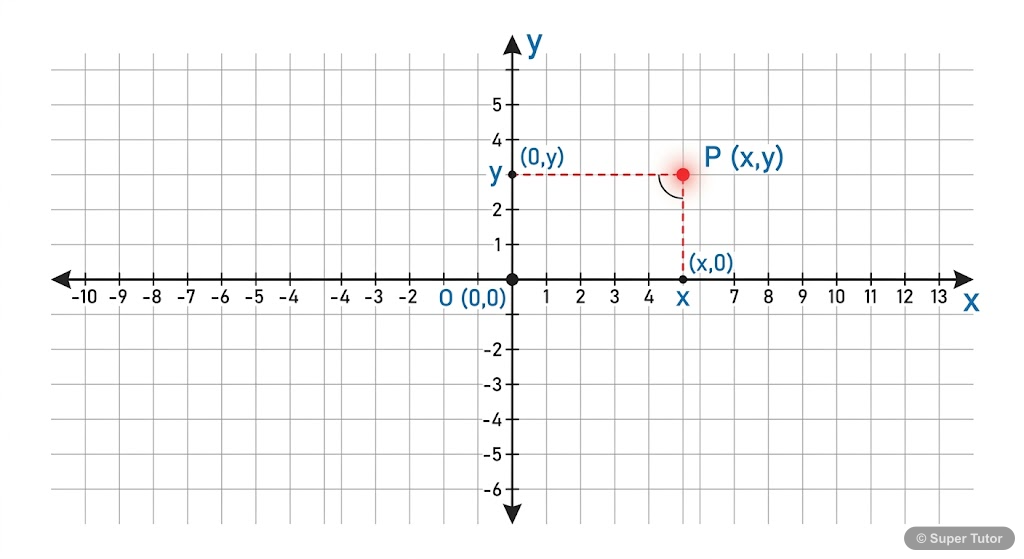
A labeled diagram showing the x-axis, y-axis, origin, and a point (x, y) in the first quadrant, illustrating the basic setup of a Cartesian coordinate system.
Super Tutor

Learn better with visuals Super Tutor pairs illustrations like this with notes and quizzes for Coordinate Geometry.

24 Questions Solved · 2 Sections

The first 12 solutions are open to read. The other 12 are free with a Super Tutor account.

Exercise 7.1

1(i)Find the distance between the points (2,3)(2,3) and (4,1)(4,1).Show solution

Given: Points (2,3)(2,3) and (4,1)(4,1).

Formula: Distance =(x2−x1)2+(y2−y1)2= \sqrt{(x_2-x_1)^2+(y_2-y_1)^2}

Working:
d=(4−2)2+(1−3)2=4+4=8=22d = \sqrt{(4-2)^2+(1-3)^2} = \sqrt{4+4} = \sqrt{8} = 2\sqrt{2}

Answer: The distance is 222\sqrt{2} units.

1(ii)Find the distance between the points (−5,7)(-5,7) and (−1,3)(-1,3).Show solution

Given: Points (−5,7)(-5,7) and (−1,3)(-1,3).

Formula: Distance =(x2−x1)2+(y2−y1)2= \sqrt{(x_2-x_1)^2+(y_2-y_1)^2}

Working:
d=(−1−(−5))2+(3−7)2=(4)2+(−4)2=16+16=32=42d = \sqrt{(-1-(-5))^2+(3-7)^2} = \sqrt{(4)^2+(-4)^2} = \sqrt{16+16} = \sqrt{32} = 4\sqrt{2}

Answer: The distance is 424\sqrt{2} units.

1(iii)Find the distance between the points (a,b)(a,b) and (−a,−b)(-a,-b).Show solution

Given: Points (a,b)(a,b) and (−a,−b)(-a,-b).

Formula: Distance =(x2−x1)2+(y2−y1)2= \sqrt{(x_2-x_1)^2+(y_2-y_1)^2}

Working:
d=(−a−a)2+(−b−b)2=(−2a)2+(−2b)2=4a2+4b2=2a2+b2d = \sqrt{(-a-a)^2+(-b-b)^2} = \sqrt{(-2a)^2+(-2b)^2} = \sqrt{4a^2+4b^2} = 2\sqrt{a^2+b^2}

Answer: The distance is 2a2+b22\sqrt{a^2+b^2} units.

2Find the distance between the points (0,0)(0,0) and (36,15)(36,15). Can you now find the distance between the two towns A and B discussed in Section 7.2?Show solution

Given: Points (0,0)(0,0) and (36,15)(36,15).

Formula: Distance =(x2−x1)2+(y2−y1)2= \sqrt{(x_2-x_1)^2+(y_2-y_1)^2}

Working:
d=(36−0)2+(15−0)2=1296+225=1521=39d = \sqrt{(36-0)^2+(15-0)^2} = \sqrt{1296+225} = \sqrt{1521} = 39

Answer: The distance between the two points is 3939 units.

Since in Section 7.2 the scale is 1 km=11\text{ km} = 1 unit, the distance between towns A and B is 39\mathbf{39} km.

3Determine if the points (1,5)(1,5), (2,3)(2,3) and (−2,−11)(-2,-11) are collinear.Show solution

Given: Points A(1,5)A(1,5), B(2,3)B(2,3), C(−2,−11)C(-2,-11).

Concept: Three points are collinear if the sum of any two distances equals the third.

Working:
AB=(2−1)2+(3−5)2=1+4=5AB = \sqrt{(2-1)^2+(3-5)^2} = \sqrt{1+4} = \sqrt{5}
BC=(−2−2)2+(−11−3)2=16+196=212=253BC = \sqrt{(-2-2)^2+(-11-3)^2} = \sqrt{16+196} = \sqrt{212} = 2\sqrt{53}
AC=(−2−1)2+(−11−5)2=9+256=265AC = \sqrt{(-2-1)^2+(-11-5)^2} = \sqrt{9+256} = \sqrt{265}

Check: AB+BC=5+253≈2.236+14.56=16.796AB + BC = \sqrt{5}+2\sqrt{53} \approx 2.236+14.56 = 16.796

AC=265≈16.279AC = \sqrt{265} \approx 16.279

Since AB+BC≠ACAB + BC \neq AC, the points are not collinear.

4Check whether (5,−2)(5,-2), (6,4)(6,4) and (7,−2)(7,-2) are the vertices of an isosceles triangle.Show solution

Given: A(5,−2)A(5,-2), B(6,4)B(6,4), C(7,−2)C(7,-2).

Concept: A triangle is isosceles if at least two sides are equal.

Working:
AB=(6−5)2+(4−(−2))2=1+36=37AB = \sqrt{(6-5)^2+(4-(-2))^2} = \sqrt{1+36} = \sqrt{37}
BC=(7−6)2+(−2−4)2=1+36=37BC = \sqrt{(7-6)^2+(-2-4)^2} = \sqrt{1+36} = \sqrt{37}
CA=(5−7)2+(−2−(−2))2=4+0=2CA = \sqrt{(5-7)^2+(-2-(-2))^2} = \sqrt{4+0} = 2

Since AB=BC=37AB = BC = \sqrt{37} and CA=2CA = 2, two sides are equal.

Answer: Yes, (5,−2)(5,-2), (6,4)(6,4) and (7,−2)(7,-2) are the vertices of an isosceles triangle.

5In a classroom, 4 friends are seated at the points A, B, C and D as shown in Fig. 7.8. Using distance formula, find whether ABCD is a square (Champa's claim) or not (Chameli's claim).Show solution

Note: From Fig. 7.8 (standard NCERT figure), the coordinates are: A(3,4)A(3,4), B(6,7)B(6,7), C(9,4)C(9,4), D(6,1)D(6,1).

Concept: A quadrilateral is a square if all four sides are equal and both diagonals are equal.

Working — Sides:
AB=(6−3)2+(7−4)2=9+9=32AB = \sqrt{(6-3)^2+(7-4)^2} = \sqrt{9+9} = 3\sqrt{2}
BC=(9−6)2+(4−7)2=9+9=32BC = \sqrt{(9-6)^2+(4-7)^2} = \sqrt{9+9} = 3\sqrt{2}
CD=(6−9)2+(1−4)2=9+9=32CD = \sqrt{(6-9)^2+(1-4)^2} = \sqrt{9+9} = 3\sqrt{2}
DA=(3−6)2+(4−1)2=9+9=32DA = \sqrt{(3-6)^2+(4-1)^2} = \sqrt{9+9} = 3\sqrt{2}

All four sides are equal.

Working — Diagonals:
AC=(9−3)2+(4−4)2=36=6AC = \sqrt{(9-3)^2+(4-4)^2} = \sqrt{36} = 6
BD=(6−6)2+(1−7)2=36=6BD = \sqrt{(6-6)^2+(1-7)^2} = \sqrt{36} = 6

Both diagonals are equal.

Answer: Since all sides are equal and both diagonals are equal, ABCD is a square. Hence Champa is correct.

6(i)Name the type of quadrilateral formed by the points (−1,−2)(-1,-2), (1,0)(1,0), (−1,2)(-1,2), (−3,0)(-3,0), and give reasons.Show solution

Given: A(−1,−2)A(-1,-2), B(1,0)B(1,0), C(−1,2)C(-1,2), D(−3,0)D(-3,0).

Working — Sides:
AB=(1−(−1))2+(0−(−2))2=4+4=22AB = \sqrt{(1-(-1))^2+(0-(-2))^2} = \sqrt{4+4} = 2\sqrt{2}
BC=(−1−1)2+(2−0)2=4+4=22BC = \sqrt{(-1-1)^2+(2-0)^2} = \sqrt{4+4} = 2\sqrt{2}
CD=(−3−(−1))2+(0−2)2=4+4=22CD = \sqrt{(-3-(-1))^2+(0-2)^2} = \sqrt{4+4} = 2\sqrt{2}
DA=(−1−(−3))2+(−2−0)2=4+4=22DA = \sqrt{(-1-(-3))^2+(-2-0)^2} = \sqrt{4+4} = 2\sqrt{2}

All four sides are equal.

Working — Diagonals:
AC=(−1−(−1))2+(2−(−2))2=0+16=4AC = \sqrt{(-1-(-1))^2+(2-(-2))^2} = \sqrt{0+16} = 4
BD=(−3−1)2+(0−0)2=16=4BD = \sqrt{(-3-1)^2+(0-0)^2} = \sqrt{16} = 4

Both diagonals are also equal.

Answer: Since all four sides are equal and both diagonals are equal, the quadrilateral is a square.

6(ii)Name the type of quadrilateral formed by the points (−3,5)(-3,5), (3,1)(3,1), (0,3)(0,3), (−1,−4)(-1,-4), and give reasons.Show solution

Given: A(−3,5)A(-3,5), B(3,1)B(3,1), C(0,3)C(0,3), D(−1,−4)D(-1,-4).

Working:
AB=(3−(−3))2+(1−5)2=36+16=52AB = \sqrt{(3-(-3))^2+(1-5)^2} = \sqrt{36+16} = \sqrt{52}
BC=(0−3)2+(3−1)2=9+4=13BC = \sqrt{(0-3)^2+(3-1)^2} = \sqrt{9+4} = \sqrt{13}

Notice that AB=213AB = 2\sqrt{13} and BC=13BC = \sqrt{13}, so AB=2⋅BCAB = 2 \cdot BC.

Also check if A, B, C are collinear:
AC=(0−(−3))2+(3−5)2=9+4=13AC = \sqrt{(0-(-3))^2+(3-5)^2} = \sqrt{9+4} = \sqrt{13}

Since BC+AC=13+13=213=ABBC + AC = \sqrt{13}+\sqrt{13} = 2\sqrt{13} = AB, the points A, B, C are collinear.

Answer: Since three of the four points are collinear, the four points do not form a quadrilateral.

6(iii)Name the type of quadrilateral formed by the points (4,5)(4,5), (7,6)(7,6), (4,3)(4,3), (1,2)(1,2), and give reasons.Show solution

Given: A(4,5)A(4,5), B(7,6)B(7,6), C(4,3)C(4,3), D(1,2)D(1,2).

Working — Sides:
AB=(7−4)2+(6−5)2=9+1=10AB = \sqrt{(7-4)^2+(6-5)^2} = \sqrt{9+1} = \sqrt{10}
BC=(4−7)2+(3−6)2=9+9=32BC = \sqrt{(4-7)^2+(3-6)^2} = \sqrt{9+9} = 3\sqrt{2}
CD=(1−4)2+(2−3)2=9+1=10CD = \sqrt{(1-4)^2+(2-3)^2} = \sqrt{9+1} = \sqrt{10}
DA=(4−1)2+(5−2)2=9+9=32DA = \sqrt{(4-1)^2+(5-2)^2} = \sqrt{9+9} = 3\sqrt{2}

Opposite sides are equal: AB=CD=10AB = CD = \sqrt{10} and BC=DA=32BC = DA = 3\sqrt{2}.

Working — Diagonals:
AC=(4−4)2+(3−5)2=0+4=2AC = \sqrt{(4-4)^2+(3-5)^2} = \sqrt{0+4} = 2
BD=(1−7)2+(2−6)2=36+16=52=213BD = \sqrt{(1-7)^2+(2-6)^2} = \sqrt{36+16} = \sqrt{52} = 2\sqrt{13}

The diagonals are not equal.

Answer: Since opposite sides are equal but diagonals are unequal, the quadrilateral is a parallelogram.

7Find the point on the xx-axis which is equidistant from (2,−5)(2,-5) and (−2,9)(-2,9).Show solution

Given: Points A(2,−5)A(2,-5) and B(−2,9)B(-2,9). Let the required point on the xx-axis be P(x,0)P(x,0).

Condition: PA=PBPA = PB

Working:
PA=(x−2)2+(0−(−5))2=(x−2)2+25PA = \sqrt{(x-2)^2+(0-(-5))^2} = \sqrt{(x-2)^2+25}
PB=(x−(−2))2+(0−9)2=(x+2)2+81PB = \sqrt{(x-(-2))^2+(0-9)^2} = \sqrt{(x+2)^2+81}

Setting PA=PBPA = PB and squaring:
(x−2)2+25=(x+2)2+81(x-2)^2+25 = (x+2)^2+81
x2−4x+4+25=x2+4x+4+81x^2-4x+4+25 = x^2+4x+4+81
−4x+29=4x+85-4x+29 = 4x+85
−8x=56-8x = 56
x=−7x = -7

Answer: The required point on the xx-axis is (−7,0)(-7, 0).

8Find the values of yy for which the distance between the points P(2,−3)P(2,-3) and Q(10,y)Q(10,y) is 10 units.Show solution

Given: P(2,−3)P(2,-3), Q(10,y)Q(10,y), PQ=10PQ = 10.

Working:
PQ=(10−2)2+(y−(−3))2=10PQ = \sqrt{(10-2)^2+(y-(-3))^2} = 10
64+(y+3)2=10\sqrt{64+(y+3)^2} = 10

Squaring both sides:
64+(y+3)2=10064+(y+3)^2 = 100
(y+3)2=36(y+3)^2 = 36
y+3=±6y+3 = \pm 6

y+3=6⇒y=3y+3 = 6 \Rightarrow y = 3
y+3=−6⇒y=−9y+3 = -6 \Rightarrow y = -9

Answer: y=3y = 3 or y=−9y = -9.

9If Q(0,1)Q(0,1) is equidistant from P(5,−3)P(5,-3) and R(x,6)R(x,6), find the values of xx. Also find the distances QR and PR.

Free with a Super Tutor account

10Find a relation between xx and yy such that the point (x,y)(x,y) is equidistant from the point (3,6)(3,6) and (−3,4)(-3,4).

Free with a Super Tutor account

Exercise 7.2

1Find the coordinates of the point which divides the join of (−1,7)(-1,7) and (4,−3)(4,-3) in the ratio 2:32:3.

Free with a Super Tutor account

2Find the coordinates of the points of trisection of the line segment joining (4,−1)(4,-1) and (−2,−3)(-2,-3).

Free with a Super Tutor account

3To conduct Sports Day activities, in a rectangular school ground ABCD, lines are drawn with chalk powder at a distance of 1 m each. 100 flower pots are placed at a distance of 1 m from each other along AD. Niharika runs 14\frac{1}{4}th the distance AD on the 2nd line and posts a green flag. Preet runs 15\frac{1}{5}th the distance AD on the 8th line and posts a red flag. What is the distance between both the flags? If Rashmi has to post a blue flag exactly halfway between the line segment joining the two flags, where should she post her flag?

Free with a Super Tutor account

4Find the ratio in which the line segment joining the points (−3,10)(-3,10) and (6,−8)(6,-8) is divided by (−1,6)(-1,6).

Free with a Super Tutor account

5Find the ratio in which the line segment joining A(1,−5)A(1,-5) and B(−4,5)B(-4,5) is divided by the xx-axis. Also find the coordinates of the point of division.

Free with a Super Tutor account

6If (1,2)(1,2), (4,y)(4,y), (x,6)(x,6) and (3,5)(3,5) are the vertices of a parallelogram taken in order, find xx and yy.

Free with a Super Tutor account

7Find the coordinates of a point A, where AB is the diameter of a circle whose centre is (2,−3)(2,-3) and B is (1,4)(1,4).

Free with a Super Tutor account

8If A and B are (−2,−2)(-2,-2) and (2,−4)(2,-4), respectively, find the coordinates of P such that AP=37ABAP = \frac{3}{7}AB and P lies on the line segment AB.

Free with a Super Tutor account

9Find the coordinates of the points which divide the line segment joining A(−2,2)A(-2,2) and B(2,8)B(2,8) into four equal parts.

Free with a Super Tutor account

10Find the area of a rhombus if its vertices are (3,0)(3,0), (4,5)(4,5), (−1,4)(-1,4) and (−2,−1)(-2,-1) taken in order. [Hint: Area of a rhombus =12= \frac{1}{2} (product of its diagonals)]

Free with a Super Tutor account

12 more solved questions in Coordinate Geometry

They are free with a Super Tutor account, along with practice quizzes and flashcards for this chapter. Free to start, no card needed.

Frequently Asked Questions

What are the important topics in Coordinate Geometry for CBSE Class 10 Mathematics?
Key topics in Coordinate Geometry include Basic Coordinate Terms, Distance Formula, Applications of Distance Formula, Equidistant Points and Locus Idea. Study these first, then practise questions on each for the CBSE Class 10 board exam.
Are these NCERT Solutions for Coordinate Geometry free?
The first 12 of the 24 solutions on this page are open to read. The other 12 are free with a Super Tutor account — signing up is free and needs no card.
How should I revise Coordinate Geometry for the CBSE Class 10 board exam?
Learn the core ideas first, then work through the 144 practice questions on Coordinate Geometry. Revise definitions regularly and use flashcards for quick recall before the exam.

Sources & Official References

Content is aligned to the official syllabus. Refer to the board website for the latest curriculum.

For serious students

Get the full Coordinate Geometry chapter — start free.

Quizzes, flashcards, an AI doubt solver and a study plan for CBSE Class 10 Mathematics. Free to start, no card needed.