Chapter 2 of 14
NCERT Solutions

Polynomials

CBSE · Class 10 · Mathematics

NCERT Solutions for Polynomials — CBSE Class 10 Mathematics.

56 questions20 flashcards5 concepts

Interactive on Super Tutor

Studying Polynomials? Get the full interactive chapter.

Quizzes, flashcards, AI doubt-solver and a step-by-step study plan — built for ncert solutions and more.

1,000+ Class 10 students started this chapter today

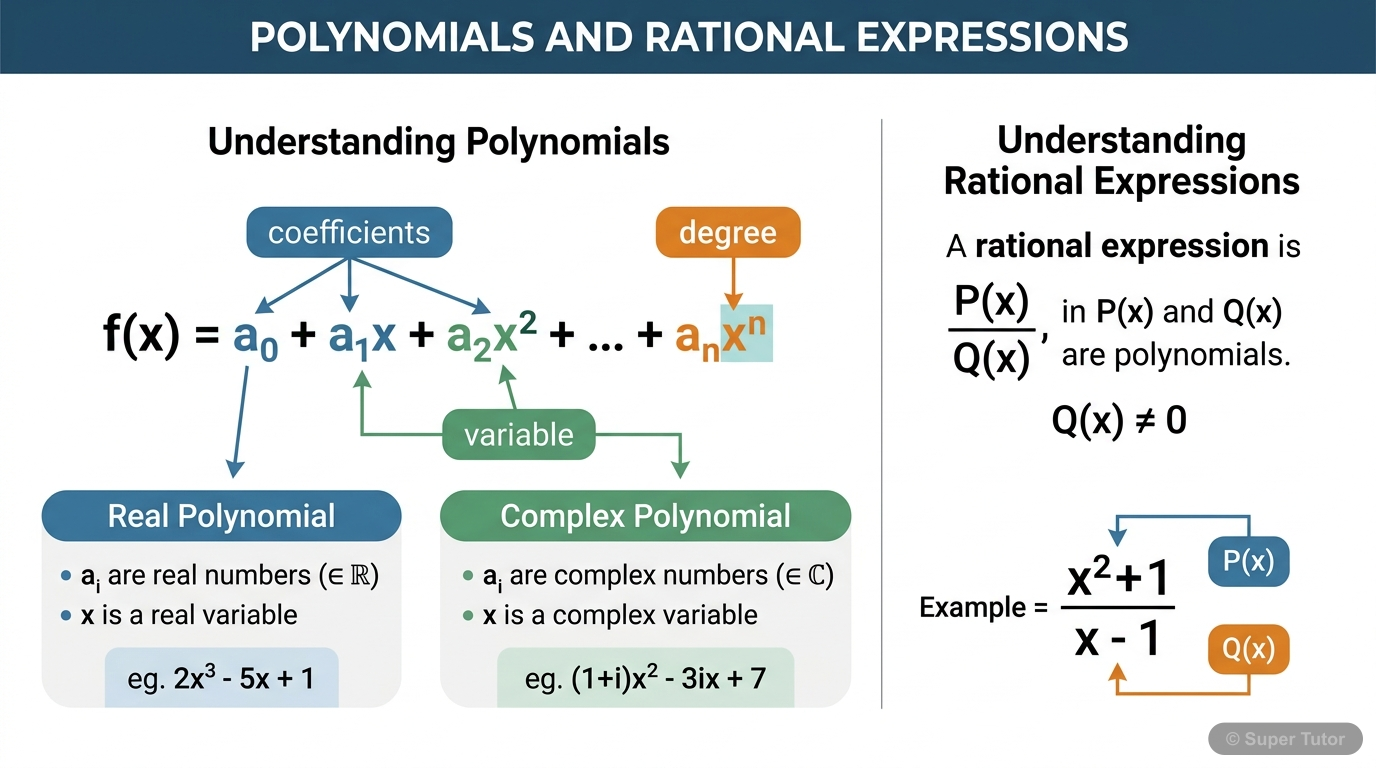
A labeled diagram illustrating the general form of a polynomial, distinguishing between real and complex polynomials by highlighting the nature of coefficients and variables. Also includes the definit
Super Tutor

Learn better with visuals Super Tutor has hundreds of illustrations like this across every chapter — all free to try.

Get started
3 Questions Solved · 2 Sections

EXERCISE 2.1

1The graphs of y=p(x)y = p(x) are given in Fig. 2.10 below, for some polynomials p(x)p(x). Find the number of zeroes of p(x)p(x), in each case: (i), (ii), (iii), (iv), (v), (vi).Show solution
The number of zeroes of p(x)p(x) equals the number of times the graph of y=p(x)y = p(x) intersects (or touches) the xx-axis.

(i) The graph does not intersect the xx-axis at all.
Number of zeroes=0\text{Number of zeroes} = 0

(ii) The graph intersects the xx-axis at exactly one point.
Number of zeroes=1\text{Number of zeroes} = 1

(iii) The graph intersects the xx-axis at exactly three points.
Number of zeroes=3\text{Number of zeroes} = 3

(iv) The graph intersects the xx-axis at exactly two points.
Number of zeroes=2\text{Number of zeroes} = 2

(v) The graph intersects the xx-axis at exactly four points.
Number of zeroes=4\text{Number of zeroes} = 4

(vi) The graph intersects the xx-axis at exactly three points.
Number of zeroes=3\text{Number of zeroes} = 3

EXERCISE 2.2

1Find the zeroes of the following quadratic polynomials and verify the relationship between the zeroes and the coefficients.
(i) x22x8x^{2} - 2x - 8
(ii) 4s24s+14s^2 - 4s + 1
(iii) 6x237x6x^{2} - 3 - 7x
(iv) 4u2+8u4u^{2} + 8u
(v) t215t^2 - 15
(vi) 3x2x43x^{2} - x - 4
Show solution
Concept: The zeroes of a quadratic polynomial ax2+bx+cax^2+bx+c are found by factorisation (or formula). If α\alpha and β\beta are the zeroes, then:
α+β=ba,αβ=ca\alpha+\beta = -\frac{b}{a}, \qquad \alpha\beta = \frac{c}{a}

---

(i) p(x)=x22x8p(x) = x^2 - 2x - 8

Splitting the middle term:
x22x8=x24x+2x8=x(x4)+2(x4)=(x4)(x+2)x^2 - 2x - 8 = x^2 - 4x + 2x - 8 = x(x-4)+2(x-4) = (x-4)(x+2)

Zeroes: x4=0x=4x - 4 = 0 \Rightarrow x = 4 and x+2=0x=2x + 2 = 0 \Rightarrow x = -2

So α=4, β=2\alpha = 4,\ \beta = -2.

Verification: Here a=1, b=2, c=8a=1,\ b=-2,\ c=-8.
α+β=4+(2)=2=(2)1=ba\alpha+\beta = 4+(-2) = 2 = -\frac{(-2)}{1} = -\frac{b}{a} \checkmark
αβ=4×(2)=8=81=ca\alpha\beta = 4\times(-2) = -8 = \frac{-8}{1} = \frac{c}{a} \checkmark

---

(ii) p(s)=4s24s+1p(s) = 4s^2 - 4s + 1

Splitting the middle term:
4s24s+1=4s22s2s+1=2s(2s1)1(2s1)=(2s1)(2s1)4s^2 - 4s + 1 = 4s^2 - 2s - 2s + 1 = 2s(2s-1)-1(2s-1) = (2s-1)(2s-1)

Zeroes: 2s1=0s=122s - 1 = 0 \Rightarrow s = \dfrac{1}{2} (repeated)

So α=β=12\alpha = \beta = \dfrac{1}{2}.

Verification: Here a=4, b=4, c=1a=4,\ b=-4,\ c=1.
α+β=12+12=1=(4)4=ba\alpha+\beta = \frac{1}{2}+\frac{1}{2} = 1 = -\frac{(-4)}{4} = -\frac{b}{a} \checkmark
αβ=12×12=14=14=ca\alpha\beta = \frac{1}{2}\times\frac{1}{2} = \frac{1}{4} = \frac{1}{4} = \frac{c}{a} \checkmark

---

(iii) p(x)=6x27x3p(x) = 6x^2 - 7x - 3

(Rewriting: 6x237x=6x27x36x^2 - 3 - 7x = 6x^2 - 7x - 3)

Splitting the middle term (product =6×(3)=18= 6\times(-3)=-18; factors 9-9 and +2+2):
6x29x+2x3=3x(2x3)+1(2x3)=(3x+1)(2x3)6x^2 - 9x + 2x - 3 = 3x(2x-3)+1(2x-3) = (3x+1)(2x-3)

Zeroes: 3x+1=0x=133x+1=0 \Rightarrow x = -\dfrac{1}{3} and 2x3=0x=322x-3=0 \Rightarrow x = \dfrac{3}{2}

So α=13, β=32\alpha = -\dfrac{1}{3},\ \beta = \dfrac{3}{2}.

Verification: Here a=6, b=7, c=3a=6,\ b=-7,\ c=-3.
α+β=13+32=2+96=76=(7)6=ba\alpha+\beta = -\frac{1}{3}+\frac{3}{2} = \frac{-2+9}{6} = \frac{7}{6} = -\frac{(-7)}{6} = -\frac{b}{a} \checkmark
αβ=(13)×32=12=36=ca\alpha\beta = \left(-\frac{1}{3}\right)\times\frac{3}{2} = -\frac{1}{2} = \frac{-3}{6} = \frac{c}{a} \checkmark

---

(iv) p(u)=4u2+8up(u) = 4u^2 + 8u

Factorising:
4u2+8u=4u(u+2)4u^2 + 8u = 4u(u + 2)

Zeroes: 4u=0u=04u = 0 \Rightarrow u = 0 and u+2=0u=2u+2=0 \Rightarrow u = -2

So α=0, β=2\alpha = 0,\ \beta = -2.

Verification: Here a=4, b=8, c=0a=4,\ b=8,\ c=0.
α+β=0+(2)=2=84=ba\alpha+\beta = 0+(-2) = -2 = -\frac{8}{4} = -\frac{b}{a} \checkmark
αβ=0×(2)=0=04=ca\alpha\beta = 0\times(-2) = 0 = \frac{0}{4} = \frac{c}{a} \checkmark

---

(v) p(t)=t215p(t) = t^2 - 15

Factorising:
t215=(t15)(t+15)t^2 - 15 = \left(t-\sqrt{15}\right)\left(t+\sqrt{15}\right)

Zeroes: t=15t = \sqrt{15} and t=15t = -\sqrt{15}

So α=15, β=15\alpha = \sqrt{15},\ \beta = -\sqrt{15}.

Verification: Here a=1, b=0, c=15a=1,\ b=0,\ c=-15.
α+β=15+(15)=0=01=ba\alpha+\beta = \sqrt{15}+(-\sqrt{15}) = 0 = -\frac{0}{1} = -\frac{b}{a} \checkmark
αβ=15×(15)=15=151=ca\alpha\beta = \sqrt{15}\times(-\sqrt{15}) = -15 = \frac{-15}{1} = \frac{c}{a} \checkmark

---

(vi) p(x)=3x2x4p(x) = 3x^2 - x - 4

Splitting the middle term (product =3×(4)=12= 3\times(-4)=-12; factors 4-4 and +3+3):
3x24x+3x4=x(3x4)+1(3x4)=(x+1)(3x4)3x^2 - 4x + 3x - 4 = x(3x-4)+1(3x-4) = (x+1)(3x-4)

Zeroes: x+1=0x=1x+1=0 \Rightarrow x=-1 and 3x4=0x=433x-4=0 \Rightarrow x=\dfrac{4}{3}

So α=1, β=43\alpha = -1,\ \beta = \dfrac{4}{3}.

Verification: Here a=3, b=1, c=4a=3,\ b=-1,\ c=-4.
α+β=1+43=3+43=13=(1)3=ba\alpha+\beta = -1+\frac{4}{3} = \frac{-3+4}{3} = \frac{1}{3} = -\frac{(-1)}{3} = -\frac{b}{a} \checkmark
αβ=(1)×43=43=43=ca\alpha\beta = (-1)\times\frac{4}{3} = -\frac{4}{3} = \frac{-4}{3} = \frac{c}{a} \checkmark
2Find a quadratic polynomial each with the given numbers as the sum and product of its zeroes respectively.
(i) 14,1\frac{1}{4}, -1
(ii) 2,13\sqrt{2}, \frac{1}{3}
(iii) 0,50, \sqrt{5}
(iv) 1,11, 1
(v) 14,14-\frac{1}{4}, \frac{1}{4}
(vi) 4,14, 1
Show solution
Concept: If α+β=S\alpha+\beta = S and αβ=P\alpha\beta = P, then the quadratic polynomial is:
k[x2(α+β)x+αβ]=k[x2Sx+P],k0k\left[x^2 - (\alpha+\beta)x + \alpha\beta\right] = k\left[x^2 - Sx + P\right], \quad k \neq 0
We take k=1k=1 for the simplest polynomial.

---

(i) Sum =14= \dfrac{1}{4}, Product =1= -1

p(x)=x214x+(1)=x214x1p(x) = x^2 - \frac{1}{4}x + (-1) = x^2 - \frac{1}{4}x - 1

Multiplying by 4 to clear fractions (still a valid polynomial up to scalar):
p(x)=4x2x4p(x) = 4x^2 - x - 4

---

(ii) Sum =2= \sqrt{2}, Product =13= \dfrac{1}{3}

p(x)=x22x+13p(x) = x^2 - \sqrt{2}\,x + \frac{1}{3}

Multiplying by 3:
p(x)=3x232x+1p(x) = 3x^2 - 3\sqrt{2}\,x + 1

---

(iii) Sum =0= 0, Product =5= \sqrt{5}

p(x)=x20x+5=x2+5p(x) = x^2 - 0\cdot x + \sqrt{5} = x^2 + \sqrt{5}

---

(iv) Sum =1= 1, Product =1= 1

p(x)=x21x+1=x2x+1p(x) = x^2 - 1\cdot x + 1 = x^2 - x + 1

---

(v) Sum =14= -\dfrac{1}{4}, Product =14= \dfrac{1}{4}

p(x)=x2(14)x+14=x2+14x+14p(x) = x^2 - \left(-\frac{1}{4}\right)x + \frac{1}{4} = x^2 + \frac{1}{4}x + \frac{1}{4}

Multiplying by 4:
p(x)=4x2+x+1p(x) = 4x^2 + x + 1

---

(vi) Sum =4= 4, Product =1= 1

p(x)=x24x+1p(x) = x^2 - 4x + 1

Stuck on a step?

Ask Super Tutor AI to explain any solution on this page in a simpler way — free, 24x7.

Ask a Doubt Free

Frequently Asked Questions

What are the important topics in Polynomials for CBSE Class 10 Mathematics?
Key topics in Polynomials include Polynomials - Full Chapter Concept Map, Polynomials Chapter — Complete Concept Map, How to Apply Zeroes-Coefficient Formulas Correctly. These are the concepts CBSE Class 10 examiners draw on most — study them first, then practise related questions.
How to score full marks in Polynomials — CBSE Class 10 Mathematics?
Understand the core concepts first, then work through the 56 practice questions available for this chapter. Revise formulas and definitions regularly, and use flashcards for quick recall before the exam.
Where can I get free NCERT Solutions for Polynomials Class 10 Mathematics?
This page has free step-by-step NCERT Solutions for every exercise question in Polynomials (CBSE Class 10 Mathematics) — written the way examiners award marks: given, formula, working, answer.

Sources & Official References

Content is aligned to the official syllabus. Refer to the board website for the latest curriculum.

For serious students

Get the full Polynomials chapter — for free.

Quizzes, flashcards, AI doubt-solver and a step-by-step study plan for CBSE Class 10 Mathematics.