Chapter 8 of 14
NCERT Solutions

Introduction to Trigonometry

CBSE · Class 10 · Mathematics

NCERT Solutions for Introduction to Trigonometry — CBSE Class 10 Mathematics.

59 questions24 flashcards4 concepts

Interactive on Super Tutor

Studying Introduction to Trigonometry? Get the full interactive chapter.

Quizzes, flashcards, AI doubt-solver and a step-by-step study plan — built for ncert solutions and more.

1,000+ Class 10 students started this chapter today

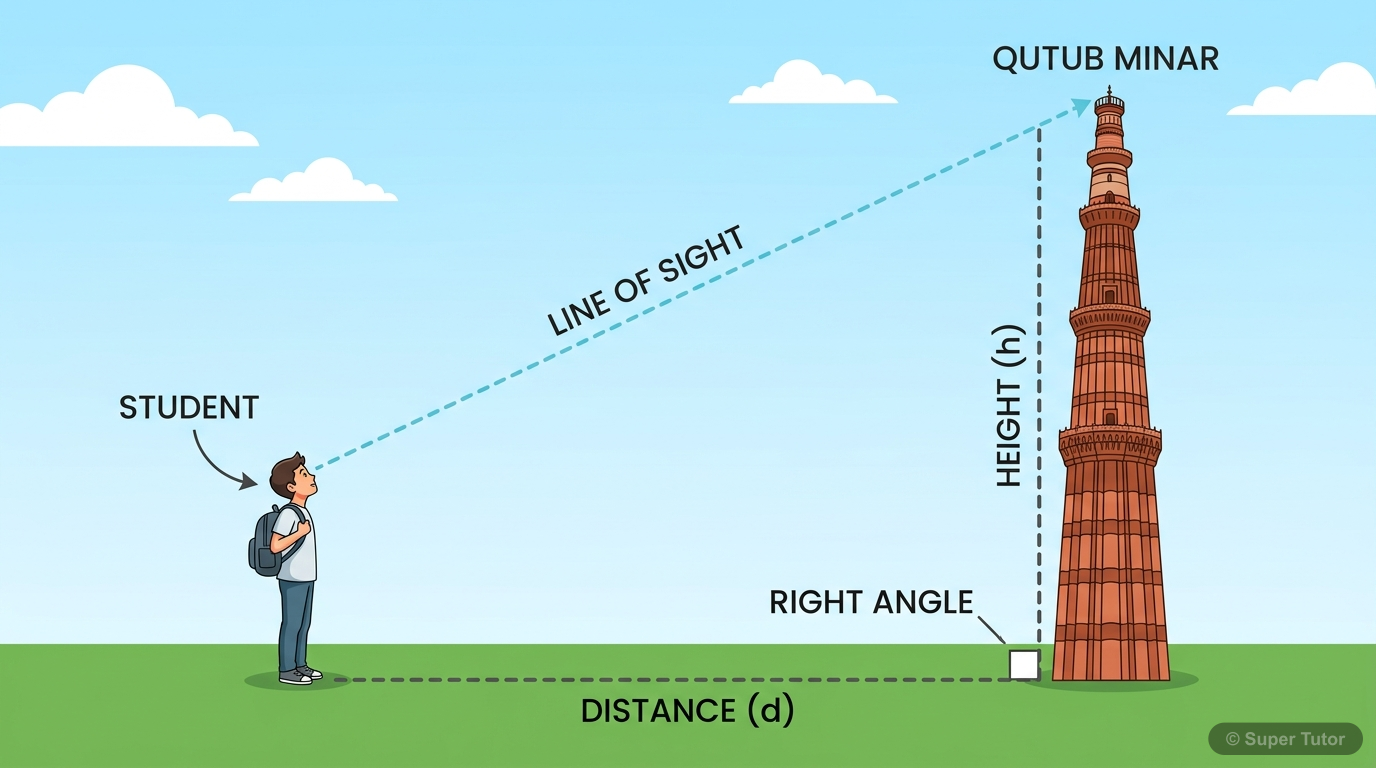
An illustration showing a student looking at the top of Qutub Minar, forming a right triangle to find its height using trigonometry.
Super Tutor

This is just one of 16+ visuals inside Super Tutor's Introduction to Trigonometry chapter

Explore the full set
28 Questions Solved · 3 Sections

Exercise 8.1

1In △ABC, right-angled at B, AB = 24 cm, BC = 7 cm. Determine: (i) sin A, cos A (ii) sin C, cos CShow solution
Given: △ABC right-angled at B, AB = 24 cm, BC = 7 cm.

Step 1: Find the hypotenuse AC.

By Pythagoras theorem:
AC2=AB2+BC2=242+72=576+49=625AC^2 = AB^2 + BC^2 = 24^2 + 7^2 = 576 + 49 = 625
AC=25 cmAC = 25 \text{ cm}

(i) For angle A:
- Side opposite to A = BC = 7 cm
- Side adjacent to A = AB = 24 cm
- Hypotenuse = AC = 25 cm

sinA=oppositehypotenuse=BCAC=725\sin A = \frac{\text{opposite}}{\text{hypotenuse}} = \frac{BC}{AC} = \frac{7}{25}

cosA=adjacenthypotenuse=ABAC=2425\cos A = \frac{\text{adjacent}}{\text{hypotenuse}} = \frac{AB}{AC} = \frac{24}{25}

(ii) For angle C:
- Side opposite to C = AB = 24 cm
- Side adjacent to C = BC = 7 cm
- Hypotenuse = AC = 25 cm

sinC=ABAC=2425\sin C = \frac{AB}{AC} = \frac{24}{25}

cosC=BCAC=725\cos C = \frac{BC}{AC} = \frac{7}{25}
2In Fig. 8.13, find tan P – cot R. (Figure shows △PQR right-angled at Q with PQ = 12 cm, PR = 13 cm.)Show solution
Note: From the figure, △PQR is right-angled at Q with PQ = 12 cm and PR = 13 cm.

Step 1: Find QR using Pythagoras theorem.
PR2=PQ2+QR2PR^2 = PQ^2 + QR^2
132=122+QR213^2 = 12^2 + QR^2
169=144+QR2169 = 144 + QR^2
QR2=25    QR=5 cmQR^2 = 25 \implies QR = 5 \text{ cm}

Step 2: Calculate tan P and cot R.

tanP=oppositeadjacent=QRPQ=512\tan P = \frac{\text{opposite}}{\text{adjacent}} = \frac{QR}{PQ} = \frac{5}{12}

cotR=adjacentopposite=QRPQ=512\cot R = \frac{\text{adjacent}}{\text{opposite}} = \frac{QR}{PQ} = \frac{5}{12}

(For angle R: opposite = PQ = 12, adjacent = QR = 5, so tanR=125\tan R = \frac{12}{5} and cotR=512\cot R = \frac{5}{12}.)

Step 3:
tanPcotR=512512=0\tan P - \cot R = \frac{5}{12} - \frac{5}{12} = \boxed{0}
3If sinA=34\sin A = \dfrac{3}{4}, calculate cos A and tan A.Show solution
Given: sinA=34\sin A = \dfrac{3}{4}

Step 1: Use the identity sin2A+cos2A=1\sin^2 A + \cos^2 A = 1.
cos2A=1sin2A=1(34)2=1916=716\cos^2 A = 1 - \sin^2 A = 1 - \left(\frac{3}{4}\right)^2 = 1 - \frac{9}{16} = \frac{7}{16}
cosA=74\cos A = \frac{\sqrt{7}}{4}

(Taking positive value since A is acute.)

Step 2: Calculate tan A.
tanA=sinAcosA=3/47/4=37=377\tan A = \frac{\sin A}{\cos A} = \frac{3/4}{\sqrt{7}/4} = \frac{3}{\sqrt{7}} = \frac{3\sqrt{7}}{7}

Answer: cosA=74\cos A = \dfrac{\sqrt{7}}{4}, tanA=37=377\tan A = \dfrac{3}{\sqrt{7}} = \dfrac{3\sqrt{7}}{7}
4Given 15 cot A = 8, find sin A and sec A.Show solution
Given: 15cotA=8    cotA=81515\cot A = 8 \implies \cot A = \dfrac{8}{15}

Step 1: Construct a right triangle.

Let the side adjacent to A = 8k and side opposite to A = 15k.

Hypotenuse =(8k)2+(15k)2=64k2+225k2=289k2=17k= \sqrt{(8k)^2 + (15k)^2} = \sqrt{64k^2 + 225k^2} = \sqrt{289k^2} = 17k

Step 2: Find sin A and sec A.
sinA=oppositehypotenuse=15k17k=1517\sin A = \frac{\text{opposite}}{\text{hypotenuse}} = \frac{15k}{17k} = \frac{15}{17}

secA=hypotenuseadjacent=17k8k=178\sec A = \frac{\text{hypotenuse}}{\text{adjacent}} = \frac{17k}{8k} = \frac{17}{8}

Answer: sinA=1517\sin A = \dfrac{15}{17}, secA=178\sec A = \dfrac{17}{8}
5Given secθ=1312\sec\theta = \dfrac{13}{12}, calculate all other trigonometric ratios.Show solution
Given: secθ=1312\sec\theta = \dfrac{13}{12}, so cosθ=1213\cos\theta = \dfrac{12}{13}.

Step 1: Construct a right triangle.

Hypotenuse = 13k, adjacent side = 12k.

Opposite side =(13k)2(12k)2=169k2144k2=25k2=5k= \sqrt{(13k)^2 - (12k)^2} = \sqrt{169k^2 - 144k^2} = \sqrt{25k^2} = 5k

Step 2: Write all ratios.

sinθ=5k13k=513\sin\theta = \frac{5k}{13k} = \frac{5}{13}

cosθ=1213\cos\theta = \frac{12}{13}

tanθ=5k12k=512\tan\theta = \frac{5k}{12k} = \frac{5}{12}

cotθ=125\cot\theta = \frac{12}{5}

secθ=1312\sec\theta = \frac{13}{12}

cscθ=135\csc\theta = \frac{13}{5}
6If ∠A and ∠B are acute angles such that cos A = cos B, then show that ∠A = ∠B.Show solution
Given: ∠A and ∠B are acute angles and cosA=cosB\cos A = \cos B.

To prove: A=B\angle A = \angle B

Proof:

Consider a right triangle. Let cosA=adjacenthypotenuse\cos A = \dfrac{\text{adjacent}}{\text{hypotenuse}}.

Suppose the triangles have the same hypotenuse (or we can use the ratio argument):

Let cosA=AC1H\cos A = \dfrac{AC_1}{H} and cosB=AC2H\cos B = \dfrac{AC_2}{H} for the same hypotenuse HH.

Since cosA=cosB\cos A = \cos B:
AC1H=AC2H    AC1=AC2\frac{AC_1}{H} = \frac{AC_2}{H} \implies AC_1 = AC_2

This means the adjacent sides are equal, so the triangles are congruent (by RHS), which gives A=B\angle A = \angle B.

Alternatively (using the fact that cosine is a one-to-one function for acute angles):

For acute angles, cosθ\cos\theta is a strictly decreasing function. Therefore, if cosA=cosB\cos A = \cos B and both A, B are acute, then:
A=B\angle A = \angle B \quad \blacksquare
7If cotθ=78\cot\theta = \dfrac{7}{8}, evaluate: (i) (1+sinθ)(1sinθ)(1+cosθ)(1cosθ)\dfrac{(1+\sin\theta)(1-\sin\theta)}{(1+\cos\theta)(1-\cos\theta)} (ii) cot2θ\cot^2\thetaShow solution
Given: cotθ=78\cot\theta = \dfrac{7}{8}

Step 1: Find sin θ and cos θ.

Opposite = 8k, Adjacent = 7k, Hypotenuse =64k2+49k2=113k= \sqrt{64k^2+49k^2} = \sqrt{113}\,k

sinθ=8113,cosθ=7113\sin\theta = \frac{8}{\sqrt{113}}, \quad \cos\theta = \frac{7}{\sqrt{113}}

(i) Using the identity (1sin2θ)=cos2θ(1-\sin^2\theta) = \cos^2\theta and (1cos2θ)=sin2θ(1-\cos^2\theta) = \sin^2\theta:

(1+sinθ)(1sinθ)(1+cosθ)(1cosθ)=1sin2θ1cos2θ=cos2θsin2θ=cot2θ\frac{(1+\sin\theta)(1-\sin\theta)}{(1+\cos\theta)(1-\cos\theta)} = \frac{1-\sin^2\theta}{1-\cos^2\theta} = \frac{\cos^2\theta}{\sin^2\theta} = \cot^2\theta

=(78)2=4964= \left(\frac{7}{8}\right)^2 = \frac{49}{64}

(ii)
cot2θ=(78)2=4964\cot^2\theta = \left(\frac{7}{8}\right)^2 = \frac{49}{64}
8If 3 cot A = 4, check whether 1tan2A1+tan2A=cos2Asin2A\dfrac{1-\tan^2 A}{1+\tan^2 A} = \cos^2 A - \sin^2 A or not.Show solution
Given: 3cotA=4    cotA=43    tanA=343\cot A = 4 \implies \cot A = \dfrac{4}{3} \implies \tan A = \dfrac{3}{4}

Step 1: Find sin A and cos A.

Opposite = 3k, Adjacent = 4k, Hypotenuse = 5k.

sinA=35,cosA=45\sin A = \frac{3}{5}, \quad \cos A = \frac{4}{5}

Step 2: Calculate LHS.
LHS=1tan2A1+tan2A=1(3/4)21+(3/4)2=19/161+9/16=7/1625/16=725\text{LHS} = \frac{1-\tan^2 A}{1+\tan^2 A} = \frac{1 - (3/4)^2}{1 + (3/4)^2} = \frac{1 - 9/16}{1 + 9/16} = \frac{7/16}{25/16} = \frac{7}{25}

Step 3: Calculate RHS.
RHS=cos2Asin2A=(45)2(35)2=1625925=725\text{RHS} = \cos^2 A - \sin^2 A = \left(\frac{4}{5}\right)^2 - \left(\frac{3}{5}\right)^2 = \frac{16}{25} - \frac{9}{25} = \frac{7}{25}

Conclusion: LHS = RHS = 725\dfrac{7}{25}. ✓ The equation holds true.
9In triangle ABC, right-angled at B, if tanA=13\tan A = \dfrac{1}{\sqrt{3}}, find the value of: (i) sin A cos C + cos A sin C (ii) cos A cos C – sin A sin CShow solution
Given: △ABC right-angled at B, tanA=13\tan A = \dfrac{1}{\sqrt{3}}.

Step 1: Find angle A.
tanA=13=tan30    A=30\tan A = \frac{1}{\sqrt{3}} = \tan 30^\circ \implies \angle A = 30^\circ

Since ∠B = 90°, we have C=180°90°30°=60°\angle C = 180° - 90° - 30° = 60°.

Step 2: Write the values.
sinA=sin30=12,cosA=cos30=32\sin A = \sin 30^\circ = \frac{1}{2}, \quad \cos A = \cos 30^\circ = \frac{\sqrt{3}}{2}
sinC=sin60=32,cosC=cos60=12\sin C = \sin 60^\circ = \frac{\sqrt{3}}{2}, \quad \cos C = \cos 60^\circ = \frac{1}{2}

(i)
sinAcosC+cosAsinC=1212+3232=14+34=1\sin A\cos C + \cos A\sin C = \frac{1}{2}\cdot\frac{1}{2} + \frac{\sqrt{3}}{2}\cdot\frac{\sqrt{3}}{2} = \frac{1}{4} + \frac{3}{4} = 1

(ii)
cosAcosCsinAsinC=32121232=3434=0\cos A\cos C - \sin A\sin C = \frac{\sqrt{3}}{2}\cdot\frac{1}{2} - \frac{1}{2}\cdot\frac{\sqrt{3}}{2} = \frac{\sqrt{3}}{4} - \frac{\sqrt{3}}{4} = 0
10In △PQR, right-angled at Q, PR + QR = 25 cm and PQ = 5 cm. Determine the values of sin P, cos P and tan P.Show solution
Given: △PQR right-angled at Q, PR + QR = 25 cm, PQ = 5 cm.

Step 1: Let QR = x, then PR = 25 – x.

By Pythagoras theorem:
PR2=PQ2+QR2PR^2 = PQ^2 + QR^2
(25x)2=52+x2(25-x)^2 = 5^2 + x^2
62550x+x2=25+x2625 - 50x + x^2 = 25 + x^2
62550x=25625 - 50x = 25
50x=600    x=1250x = 600 \implies x = 12

So QR=12QR = 12 cm and PR=2512=13PR = 25 - 12 = 13 cm.

Step 2: Calculate the ratios.

sinP=QRPR=1213\sin P = \frac{QR}{PR} = \frac{12}{13}

cosP=PQPR=513\cos P = \frac{PQ}{PR} = \frac{5}{13}

tanP=QRPQ=125\tan P = \frac{QR}{PQ} = \frac{12}{5}
11State whether the following are true or false. Justify your answer. (i) The value of tan A is always less than 1. (ii) sec A = 12/5 for some value of angle A. (iii) cos A is the abbreviation used for the cosecant of angle A. (iv) cot A is the product of cot and A. (v) sin θ = 4/3 for some angle θ.Show solution
(i) False.
tanA\tan A is the ratio of the opposite side to the adjacent side. For example, \tan 60^\circ = \sqrt{3} > 1. So tan A can be greater than, equal to, or less than 1. The statement is False.

(ii) True.
secA=hypotenuseadjacent side1\sec A = \dfrac{\text{hypotenuse}}{\text{adjacent side}} \geq 1 for all acute angles. Since \dfrac{12}{5} = 2.4 > 1, it is possible for some angle A. The statement is True.

(iii) False.
cosA\cos A is the abbreviation for cosine of angle A, not cosecant. Cosecant is abbreviated as cscA\csc A (or cosec A\text{cosec } A). The statement is False.

(iv) False.
cotA\cot A is a single trigonometric ratio (cotangent of angle A). It is not the product of some quantity 'cot' and 'A'. The statement is False.

(v) False.
The value of sinθ\sin\theta always lies between –1 and 1 (i.e., 1sinθ1-1 \leq \sin\theta \leq 1). Since \dfrac{4}{3} > 1, sinθ=43\sin\theta = \dfrac{4}{3} is not possible for any angle θ\theta. The statement is False.

Exercise 8.2

1Evaluate the following: (i) sin 60° cos 30° + sin 30° cos 60° (ii) 2tan²45° + cos²30° – sin²60° (iii) cos45°/(sec30° + cosec30°) (iv) (sin30° + tan45° – cosec60°)/(sec30° + cos60° + cot45°) (v) (5cos²60° + 4sec²30° – tan²45°)/(sin²30° + cos²30°)Show solution
Standard values used:
sin30=12, cos30=32, sin60=32, cos60=12\sin 30^\circ = \frac{1}{2},\ \cos 30^\circ = \frac{\sqrt{3}}{2},\ \sin 60^\circ = \frac{\sqrt{3}}{2},\ \cos 60^\circ = \frac{1}{2}
tan45=1, sec30=23, csc30=2, cos45=12\tan 45^\circ = 1,\ \sec 30^\circ = \frac{2}{\sqrt{3}},\ \csc 30^\circ = 2,\ \cos 45^\circ = \frac{1}{\sqrt{2}}
cot45=1, csc60=23\cot 45^\circ = 1,\ \csc 60^\circ = \frac{2}{\sqrt{3}}

(i)
sin60cos30+sin30cos60=3232+1212=34+14=1\sin 60^\circ\cos 30^\circ + \sin 30^\circ\cos 60^\circ = \frac{\sqrt{3}}{2}\cdot\frac{\sqrt{3}}{2} + \frac{1}{2}\cdot\frac{1}{2} = \frac{3}{4} + \frac{1}{4} = \boxed{1}

(ii)
2tan245+cos230sin260=2(1)2+(32)2(32)2=2+3434=22\tan^2 45^\circ + \cos^2 30^\circ - \sin^2 60^\circ = 2(1)^2 + \left(\frac{\sqrt{3}}{2}\right)^2 - \left(\frac{\sqrt{3}}{2}\right)^2 = 2 + \frac{3}{4} - \frac{3}{4} = \boxed{2}

(iii)
cos45sec30+csc30=1223+2=122+233=1232(1+3)\frac{\cos 45^\circ}{\sec 30^\circ + \csc 30^\circ} = \frac{\dfrac{1}{\sqrt{2}}}{\dfrac{2}{\sqrt{3}} + 2} = \frac{\dfrac{1}{\sqrt{2}}}{\dfrac{2+2\sqrt{3}}{\sqrt{3}}} = \frac{1}{\sqrt{2}} \cdot \frac{\sqrt{3}}{2(1+\sqrt{3})}
=322(1+3)=322(1+3)×(31)(31)=3(31)22(31)=3342=3(31)42= \frac{\sqrt{3}}{2\sqrt{2}(1+\sqrt{3})} = \frac{\sqrt{3}}{2\sqrt{2}(1+\sqrt{3})} \times \frac{(\sqrt{3}-1)}{(\sqrt{3}-1)} = \frac{\sqrt{3}(\sqrt{3}-1)}{2\sqrt{2}(3-1)} = \frac{3-\sqrt{3}}{4\sqrt{2}} = \frac{\sqrt{3}(\sqrt{3}-1)}{4\sqrt{2}}
=3342=(33)28=3268= \frac{3-\sqrt{3}}{4\sqrt{2}} = \frac{(3-\sqrt{3})\sqrt{2}}{8} = \boxed{\dfrac{3\sqrt{2}-\sqrt{6}}{8}}

(iv)
sin30+tan45csc60sec30+cos60+cot45=12+12323+12+1\frac{\sin 30^\circ + \tan 45^\circ - \csc 60^\circ}{\sec 30^\circ + \cos 60^\circ + \cot 45^\circ} = \frac{\dfrac{1}{2} + 1 - \dfrac{2}{\sqrt{3}}}{\dfrac{2}{\sqrt{3}} + \dfrac{1}{2} + 1}

Numerator: 12+123=3223=33423\dfrac{1}{2} + 1 - \dfrac{2}{\sqrt{3}} = \dfrac{3}{2} - \dfrac{2}{\sqrt{3}} = \dfrac{3\sqrt{3} - 4}{2\sqrt{3}}

Denominator: 23+32=4+3323\dfrac{2}{\sqrt{3}} + \dfrac{3}{2} = \dfrac{4 + 3\sqrt{3}}{2\sqrt{3}}

=3344+33×433433=(334)(433)1627=1232716+12311=2434311=4324311= \frac{3\sqrt{3}-4}{4+3\sqrt{3}} \times \frac{4-3\sqrt{3}}{4-3\sqrt{3}} = \frac{(3\sqrt{3}-4)(4-3\sqrt{3})}{16-27} = \frac{12\sqrt{3}-27-16+12\sqrt{3}}{-11} = \frac{24\sqrt{3}-43}{-11} = \boxed{\dfrac{43-24\sqrt{3}}{11}}

(v)
5cos260+4sec230tan245sin230+cos230\frac{5\cos^2 60^\circ + 4\sec^2 30^\circ - \tan^2 45^\circ}{\sin^2 30^\circ + \cos^2 30^\circ}

Denominator =sin230+cos230=1= \sin^2 30^\circ + \cos^2 30^\circ = 1 (Pythagorean identity)

Numerator =5(12)2+4(23)2(1)2=514+4431=54+1631= 5\left(\dfrac{1}{2}\right)^2 + 4\left(\dfrac{2}{\sqrt{3}}\right)^2 - (1)^2 = 5\cdot\dfrac{1}{4} + 4\cdot\dfrac{4}{3} - 1 = \dfrac{5}{4} + \dfrac{16}{3} - 1

=1512+64121212=6712= \frac{15}{12} + \frac{64}{12} - \frac{12}{12} = \frac{67}{12}

Answer=67/121=6712\text{Answer} = \frac{67/12}{1} = \boxed{\dfrac{67}{12}}
2Choose the correct option and justify your choice: (i) 2tan30°/(1+tan²30°) = ? (ii) (1–tan²45°)/(1+tan²45°) = ? (iii) sin2A = 2sinA is true when A = ? (iv) 2tan30°/(1–tan²30°) = ?Show solution
(i) 2tan301+tan230\dfrac{2\tan 30^\circ}{1+\tan^2 30^\circ}

=2131+13=2343=2334=643=32=sin60= \frac{2 \cdot \dfrac{1}{\sqrt{3}}}{1 + \dfrac{1}{3}} = \frac{\dfrac{2}{\sqrt{3}}}{\dfrac{4}{3}} = \frac{2}{\sqrt{3}} \cdot \frac{3}{4} = \frac{6}{4\sqrt{3}} = \frac{\sqrt{3}}{2} = \sin 60^\circ

Correct option: (A) sin60\sin 60^\circ

(ii) 1tan2451+tan245\dfrac{1-\tan^2 45^\circ}{1+\tan^2 45^\circ}

=1121+12=02=0= \frac{1 - 1^2}{1 + 1^2} = \frac{0}{2} = 0

Correct option: (D) 0

(iii) sin2A=2sinA\sin 2A = 2\sin A

2sinAcosA=2sinA    2sinA(cosA1)=02\sin A\cos A = 2\sin A \implies 2\sin A(\cos A - 1) = 0

This holds when sinA=0\sin A = 0, i.e., A=0A = 0^\circ.

Correct option: (A) 00^\circ

(iv) 2tan301tan230\dfrac{2\tan 30^\circ}{1-\tan^2 30^\circ}

=23113=2323=2332=33=3=tan60= \frac{\dfrac{2}{\sqrt{3}}}{1 - \dfrac{1}{3}} = \frac{\dfrac{2}{\sqrt{3}}}{\dfrac{2}{3}} = \frac{2}{\sqrt{3}} \cdot \frac{3}{2} = \frac{3}{\sqrt{3}} = \sqrt{3} = \tan 60^\circ

Correct option: (C) tan60\tan 60^\circ
3If tan(A+B) = √3 and tan(A–B) = 1/√3; 0° < A+B ≤ 90°; A > B, find A and B.Show solution
Given: tan(A+B)=3\tan(A+B) = \sqrt{3} and tan(AB)=13\tan(A-B) = \dfrac{1}{\sqrt{3}}

Step 1: From tan(A+B)=3=tan60\tan(A+B) = \sqrt{3} = \tan 60^\circ:
A+B=60(1)A + B = 60^\circ \quad \cdots (1)

Step 2: From tan(AB)=13=tan30\tan(A-B) = \dfrac{1}{\sqrt{3}} = \tan 30^\circ:
AB=30(2)A - B = 30^\circ \quad \cdots (2)

Step 3: Adding (1) and (2):
2A=90    A=452A = 90^\circ \implies A = 45^\circ

Step 4: Subtracting (2) from (1):
2B=30    B=152B = 30^\circ \implies B = 15^\circ

Answer: A=45A = 45^\circ, B=15B = 15^\circ
4State whether the following are true or false. Justify your answer. (i) sin(A+B) = sinA + sinB (ii) The value of sinθ increases as θ increases. (iii) The value of cosθ increases as θ increases. (iv) sinθ = cosθ for all values of θ (v) cotA is not defined for A = 0°Show solution
(i) False.
Counterexample: Let A = B = 30°.
sin(30°+30°)=sin60°=32\sin(30°+30°) = \sin 60° = \dfrac{\sqrt{3}}{2}
sin30°+sin30°=12+12=132\sin 30° + \sin 30° = \dfrac{1}{2} + \dfrac{1}{2} = 1 \neq \dfrac{\sqrt{3}}{2}. False.

(ii) True.
From the table: sin0=0, sin30=0.5, sin450.707, sin600.866, sin90=1\sin 0^\circ = 0,\ \sin 30^\circ = 0.5,\ \sin 45^\circ \approx 0.707,\ \sin 60^\circ \approx 0.866,\ \sin 90^\circ = 1. The value increases as θ increases from 0° to 90°. True.

(iii) False.
From the table: cos0=1, cos300.866, cos450.707, cos60=0.5, cos90=0\cos 0^\circ = 1,\ \cos 30^\circ \approx 0.866,\ \cos 45^\circ \approx 0.707,\ \cos 60^\circ = 0.5,\ \cos 90^\circ = 0. The value decreases as θ increases. False.

(iv) False.
sinθ=cosθ\sin\theta = \cos\theta only when θ=45\theta = 45^\circ. For example, sin30=0.5cos30=32\sin 30^\circ = 0.5 \neq \cos 30^\circ = \dfrac{\sqrt{3}}{2}. False.

(v) True.
cotA=cosAsinA\cot A = \dfrac{\cos A}{\sin A}. At A=0A = 0^\circ, sin0=0\sin 0^\circ = 0, so cot0=10\cot 0^\circ = \dfrac{1}{0}, which is undefined. True.

Exercise 8.3

1Express the trigonometric ratios sin A, sec A and tan A in terms of cot A.Show solution
Using fundamental identities:

(i) sin A in terms of cot A:

We know csc2A=1+cot2A\csc^2 A = 1 + \cot^2 A, so sin2A=1csc2A=11+cot2A\sin^2 A = \dfrac{1}{\csc^2 A} = \dfrac{1}{1+\cot^2 A}

sinA=11+cot2A\boxed{\sin A = \frac{1}{\sqrt{1+\cot^2 A}}}

(positive since A is acute)

(ii) sec A in terms of cot A:

sec2A=1+tan2A=1+1cot2A=cot2A+1cot2A\sec^2 A = 1 + \tan^2 A = 1 + \dfrac{1}{\cot^2 A} = \dfrac{\cot^2 A + 1}{\cot^2 A}

secA=1+cot2AcotA\boxed{\sec A = \frac{\sqrt{1+\cot^2 A}}{\cot A}}

(iii) tan A in terms of cot A:

tanA=1cotA\boxed{\tan A = \frac{1}{\cot A}}
2Write all the other trigonometric ratios of ∠A in terms of sec A.Show solution
Given: sec A (so cos A = 1/sec A is known).

sin A: Using sin2A+cos2A=1\sin^2 A + \cos^2 A = 1:
sinA=1cos2A=11sec2A=sec2A1secA\sin A = \sqrt{1 - \cos^2 A} = \sqrt{1 - \frac{1}{\sec^2 A}} = \frac{\sqrt{\sec^2 A - 1}}{\sec A}

cos A:
cosA=1secA\cos A = \frac{1}{\sec A}

tan A: Using sec2Atan2A=1\sec^2 A - \tan^2 A = 1:
tanA=sec2A1\tan A = \sqrt{\sec^2 A - 1}

cot A:
cotA=1tanA=1sec2A1\cot A = \frac{1}{\tan A} = \frac{1}{\sqrt{\sec^2 A - 1}}

csc A:
cscA=1sinA=secAsec2A1\csc A = \frac{1}{\sin A} = \frac{\sec A}{\sqrt{\sec^2 A - 1}}
3Choose the correct option. Justify your choice. (i) 9sec²A – 9tan²A = ? (ii) (1+tanθ+secθ)(1+cotθ–cosecθ) = ? (iii) (secA+tanA)(1–sinA) = ? (iv) (1+tan²A)/(1+cot²A) = ?Show solution
(i) 9sec2A9tan2A=9(sec2Atan2A)=9×1=99\sec^2 A - 9\tan^2 A = 9(\sec^2 A - \tan^2 A) = 9 \times 1 = 9

Correct option: (B) 9

(ii) (1+tanθ+secθ)(1+cotθcscθ)(1+\tan\theta+\sec\theta)(1+\cot\theta-\csc\theta)

=(1+sinθcosθ+1cosθ)(1+cosθsinθ1sinθ)= \left(1 + \frac{\sin\theta}{\cos\theta} + \frac{1}{\cos\theta}\right)\left(1 + \frac{\cos\theta}{\sin\theta} - \frac{1}{\sin\theta}\right)

=cosθ+sinθ+1cosθsinθ+cosθ1sinθ= \frac{\cos\theta + \sin\theta + 1}{\cos\theta} \cdot \frac{\sin\theta + \cos\theta - 1}{\sin\theta}

=(sinθ+cosθ)21sinθcosθ=sin2θ+2sinθcosθ+cos2θ1sinθcosθ= \frac{(\sin\theta+\cos\theta)^2 - 1}{\sin\theta\cos\theta} = \frac{\sin^2\theta + 2\sin\theta\cos\theta + \cos^2\theta - 1}{\sin\theta\cos\theta}

=1+2sinθcosθ1sinθcosθ=2sinθcosθsinθcosθ=2= \frac{1 + 2\sin\theta\cos\theta - 1}{\sin\theta\cos\theta} = \frac{2\sin\theta\cos\theta}{\sin\theta\cos\theta} = 2

Correct option: (C) 2

(iii) (secA+tanA)(1sinA)(\sec A + \tan A)(1 - \sin A)

=(1cosA+sinAcosA)(1sinA)=1+sinAcosA(1sinA)= \left(\frac{1}{\cos A} + \frac{\sin A}{\cos A}\right)(1-\sin A) = \frac{1+\sin A}{\cos A}\cdot(1-\sin A)

=1sin2AcosA=cos2AcosA=cosA= \frac{1-\sin^2 A}{\cos A} = \frac{\cos^2 A}{\cos A} = \cos A

Correct option: (D) cos A

(iv) 1+tan2A1+cot2A=sec2Acsc2A=sin2Acos2A=tan2A\dfrac{1+\tan^2 A}{1+\cot^2 A} = \dfrac{\sec^2 A}{\csc^2 A} = \dfrac{\sin^2 A}{\cos^2 A} = \tan^2 A

Correct option: (D) tan2A\tan^2 A
4(i)Prove: (cscθcotθ)2=1cosθ1+cosθ(\csc\theta - \cot\theta)^2 = \dfrac{1-\cos\theta}{1+\cos\theta}Show solution
LHS:
(cscθcotθ)2=(1sinθcosθsinθ)2=(1cosθsinθ)2=(1cosθ)2sin2θ(\csc\theta - \cot\theta)^2 = \left(\frac{1}{\sin\theta} - \frac{\cos\theta}{\sin\theta}\right)^2 = \left(\frac{1-\cos\theta}{\sin\theta}\right)^2 = \frac{(1-\cos\theta)^2}{\sin^2\theta}

=(1cosθ)21cos2θ=(1cosθ)2(1cosθ)(1+cosθ)=1cosθ1+cosθ=RHS= \frac{(1-\cos\theta)^2}{1-\cos^2\theta} = \frac{(1-\cos\theta)^2}{(1-\cos\theta)(1+\cos\theta)} = \frac{1-\cos\theta}{1+\cos\theta} = \text{RHS}

\blacksquare
4(ii)Prove: cosA1+sinA+1+sinAcosA=2secA\dfrac{\cos A}{1+\sin A} + \dfrac{1+\sin A}{\cos A} = 2\sec AShow solution
LHS:
cosA1+sinA+1+sinAcosA=cos2A+(1+sinA)2cosA(1+sinA)\frac{\cos A}{1+\sin A} + \frac{1+\sin A}{\cos A} = \frac{\cos^2 A + (1+\sin A)^2}{\cos A(1+\sin A)}

=cos2A+1+2sinA+sin2AcosA(1+sinA)= \frac{\cos^2 A + 1 + 2\sin A + \sin^2 A}{\cos A(1+\sin A)}

=(sin2A+cos2A)+1+2sinAcosA(1+sinA)= \frac{(\sin^2 A + \cos^2 A) + 1 + 2\sin A}{\cos A(1+\sin A)}

=1+1+2sinAcosA(1+sinA)=2+2sinAcosA(1+sinA)= \frac{1 + 1 + 2\sin A}{\cos A(1+\sin A)} = \frac{2 + 2\sin A}{\cos A(1+\sin A)}

=2(1+sinA)cosA(1+sinA)=2cosA=2secA=RHS= \frac{2(1+\sin A)}{\cos A(1+\sin A)} = \frac{2}{\cos A} = 2\sec A = \text{RHS}

\blacksquare
4(iii)Prove: tanθ1cotθ+cotθ1tanθ=1+secθcscθ\dfrac{\tan\theta}{1-\cot\theta} + \dfrac{\cot\theta}{1-\tan\theta} = 1 + \sec\theta\csc\thetaShow solution
LHS: Write in terms of sinθ\sin\theta and cosθ\cos\theta. Let s=sinθs = \sin\theta, c=cosθc = \cos\theta.

s/c1c/s+c/s1s/c=s/c(sc)/s+c/s(cs)/c\frac{s/c}{1 - c/s} + \frac{c/s}{1 - s/c} = \frac{s/c}{(s-c)/s} + \frac{c/s}{(c-s)/c}

=s2c(sc)+c2s(cs)=s2c(sc)c2s(sc)= \frac{s^2}{c(s-c)} + \frac{c^2}{s(c-s)} = \frac{s^2}{c(s-c)} - \frac{c^2}{s(s-c)}

=1sc(s2cc2s)=1scs3c3sc= \frac{1}{s-c}\left(\frac{s^2}{c} - \frac{c^2}{s}\right) = \frac{1}{s-c}\cdot\frac{s^3 - c^3}{sc}

=(sc)(s2+sc+c2)sc(sc)=s2+sc+c2sc= \frac{(s-c)(s^2+sc+c^2)}{sc(s-c)} = \frac{s^2+sc+c^2}{sc}

=sin2θ+sinθcosθ+cos2θsinθcosθ= \frac{\sin^2\theta + \sin\theta\cos\theta + \cos^2\theta}{\sin\theta\cos\theta}

=1+sinθcosθsinθcosθ=1sinθcosθ+1=secθcscθ+1=RHS= \frac{1 + \sin\theta\cos\theta}{\sin\theta\cos\theta} = \frac{1}{\sin\theta\cos\theta} + 1 = \sec\theta\csc\theta + 1 = \text{RHS}

\blacksquare
4(iv)Prove: 1+secAsecA=sin2A1cosA\dfrac{1+\sec A}{\sec A} = \dfrac{\sin^2 A}{1-\cos A}Show solution
LHS:
1+secAsecA=1+1cosA1cosA=cosA+1cosA1cosA=cosA+1=1+cosA\frac{1+\sec A}{\sec A} = \frac{1 + \dfrac{1}{\cos A}}{\dfrac{1}{\cos A}} = \frac{\dfrac{\cos A + 1}{\cos A}}{\dfrac{1}{\cos A}} = \cos A + 1 = 1 + \cos A

RHS:
sin2A1cosA=1cos2A1cosA=(1cosA)(1+cosA)1cosA=1+cosA\frac{\sin^2 A}{1-\cos A} = \frac{1-\cos^2 A}{1-\cos A} = \frac{(1-\cos A)(1+\cos A)}{1-\cos A} = 1 + \cos A

LHS = RHS = 1+cosA1 + \cos A \blacksquare
4(v)Prove: cosAsinA+1cosA+sinA1=cscA+cotA\dfrac{\cos A - \sin A + 1}{\cos A + \sin A - 1} = \csc A + \cot A, using the identity csc2A=1+cot2A\csc^2 A = 1 + \cot^2 A.Show solution
Divide numerator and denominator by sinA\sin A:

cosAsinA+1cosA+sinA1=cotA1+cscAcotA+1cscA\frac{\cos A - \sin A + 1}{\cos A + \sin A - 1} = \frac{\cot A - 1 + \csc A}{\cot A + 1 - \csc A}

Substitute 1=csc2Acot2A1 = \csc^2 A - \cot^2 A in the denominator:

Denominator =cotAcscA+1=cotAcscA+csc2Acot2A= \cot A - \csc A + 1 = \cot A - \csc A + \csc^2 A - \cot^2 A
=(cscAcotA)(cscA+cotA)(cscAcotA)= (\csc A - \cot A)(\csc A + \cot A) - (\csc A - \cot A)
=(cscAcotA)(cscA+cotA1)= (\csc A - \cot A)(\csc A + \cot A - 1)

Numerator =cotA+cscA1= \cot A + \csc A - 1

LHS=cscA+cotA1(cscAcotA)(cscA+cotA1)=1cscAcotA\text{LHS} = \frac{\csc A + \cot A - 1}{(\csc A - \cot A)(\csc A + \cot A - 1)} = \frac{1}{\csc A - \cot A}

=1cscAcotA×cscA+cotAcscA+cotA=cscA+cotAcsc2Acot2A=cscA+cotA1=cscA+cotA=RHS= \frac{1}{\csc A - \cot A} \times \frac{\csc A + \cot A}{\csc A + \cot A} = \frac{\csc A + \cot A}{\csc^2 A - \cot^2 A} = \frac{\csc A + \cot A}{1} = \csc A + \cot A = \text{RHS}

\blacksquare
4(vi)Prove: 1+sinA1sinA=secA+tanA\sqrt{\dfrac{1+\sin A}{1-\sin A}} = \sec A + \tan AShow solution
LHS:
1+sinA1sinA=(1+sinA)(1+sinA)(1sinA)(1+sinA)=(1+sinA)21sin2A\sqrt{\frac{1+\sin A}{1-\sin A}} = \sqrt{\frac{(1+\sin A)(1+\sin A)}{(1-\sin A)(1+\sin A)}} = \sqrt{\frac{(1+\sin A)^2}{1-\sin^2 A}}

=(1+sinA)2cos2A=1+sinAcosA= \sqrt{\frac{(1+\sin A)^2}{\cos^2 A}} = \frac{1+\sin A}{\cos A}

=1cosA+sinAcosA=secA+tanA=RHS= \frac{1}{\cos A} + \frac{\sin A}{\cos A} = \sec A + \tan A = \text{RHS}

\blacksquare
4(vii)Prove: sinθ2sin3θ2cos3θcosθ=tanθ\dfrac{\sin\theta - 2\sin^3\theta}{2\cos^3\theta - \cos\theta} = \tan\thetaShow solution
LHS:
sinθ2sin3θ2cos3θcosθ=sinθ(12sin2θ)cosθ(2cos2θ1)\frac{\sin\theta - 2\sin^3\theta}{2\cos^3\theta - \cos\theta} = \frac{\sin\theta(1 - 2\sin^2\theta)}{\cos\theta(2\cos^2\theta - 1)}

Note: 12sin2θ=12(1cos2θ)=2cos2θ11 - 2\sin^2\theta = 1 - 2(1-\cos^2\theta) = 2\cos^2\theta - 1

=sinθ(2cos2θ1)cosθ(2cos2θ1)=sinθcosθ=tanθ=RHS= \frac{\sin\theta(2\cos^2\theta - 1)}{\cos\theta(2\cos^2\theta - 1)} = \frac{\sin\theta}{\cos\theta} = \tan\theta = \text{RHS}

\blacksquare
4(viii)Prove: (sinA+cscA)2+(cosA+secA)2=7+tan2A+cot2A(\sin A + \csc A)^2 + (\cos A + \sec A)^2 = 7 + \tan^2 A + \cot^2 AShow solution
LHS:
(sinA+cscA)2+(cosA+secA)2(\sin A + \csc A)^2 + (\cos A + \sec A)^2
=sin2A+2sinAcscA+csc2A+cos2A+2cosAsecA+sec2A= \sin^2 A + 2\sin A\csc A + \csc^2 A + \cos^2 A + 2\cos A\sec A + \sec^2 A
=(sin2A+cos2A)+2(sinA1sinA)+2(cosA1cosA)+csc2A+sec2A= (\sin^2 A + \cos^2 A) + 2(\sin A \cdot \tfrac{1}{\sin A}) + 2(\cos A \cdot \tfrac{1}{\cos A}) + \csc^2 A + \sec^2 A
=1+2+2+csc2A+sec2A= 1 + 2 + 2 + \csc^2 A + \sec^2 A
=5+(1+cot2A)+(1+tan2A)= 5 + (1 + \cot^2 A) + (1 + \tan^2 A)
=7+tan2A+cot2A=RHS= 7 + \tan^2 A + \cot^2 A = \text{RHS}

\blacksquare
4(ix)Prove: (cscAsinA)(secAcosA)=1tanA+cotA(\csc A - \sin A)(\sec A - \cos A) = \dfrac{1}{\tan A + \cot A}Show solution
LHS:
(cscAsinA)(secAcosA)=(1sinAsinA)(1cosAcosA)(\csc A - \sin A)(\sec A - \cos A) = \left(\frac{1}{\sin A} - \sin A\right)\left(\frac{1}{\cos A} - \cos A\right)

=1sin2AsinA1cos2AcosA=cos2AsinAsin2AcosA=sinAcosA= \frac{1-\sin^2 A}{\sin A} \cdot \frac{1-\cos^2 A}{\cos A} = \frac{\cos^2 A}{\sin A} \cdot \frac{\sin^2 A}{\cos A} = \sin A\cos A

RHS:
1tanA+cotA=1sinAcosA+cosAsinA=1sin2A+cos2AsinAcosA=sinAcosA1=sinAcosA\frac{1}{\tan A + \cot A} = \frac{1}{\dfrac{\sin A}{\cos A} + \dfrac{\cos A}{\sin A}} = \frac{1}{\dfrac{\sin^2 A + \cos^2 A}{\sin A\cos A}} = \frac{\sin A\cos A}{1} = \sin A\cos A

LHS = RHS = sinAcosA\sin A\cos A \blacksquare
4(x)Prove: (1+tan2A1+cot2A)=(1tanA1cotA)2=tan2A\left(\dfrac{1+\tan^2 A}{1+\cot^2 A}\right) = \left(\dfrac{1-\tan A}{1-\cot A}\right)^2 = \tan^2 AShow solution
Part 1: Show 1+tan2A1+cot2A=tan2A\dfrac{1+\tan^2 A}{1+\cot^2 A} = \tan^2 A

1+tan2A1+cot2A=sec2Acsc2A=1/cos2A1/sin2A=sin2Acos2A=tan2A\frac{1+\tan^2 A}{1+\cot^2 A} = \frac{\sec^2 A}{\csc^2 A} = \frac{1/\cos^2 A}{1/\sin^2 A} = \frac{\sin^2 A}{\cos^2 A} = \tan^2 A \checkmark

Part 2: Show (1tanA1cotA)2=tan2A\left(\dfrac{1-\tan A}{1-\cot A}\right)^2 = \tan^2 A

1tanA1cotA=1sinAcosA1cosAsinA=cosAsinAcosAsinAcosAsinA\frac{1-\tan A}{1-\cot A} = \frac{1 - \dfrac{\sin A}{\cos A}}{1 - \dfrac{\cos A}{\sin A}} = \frac{\dfrac{\cos A - \sin A}{\cos A}}{\dfrac{\sin A - \cos A}{\sin A}}

=(cosAsinA)cosAsinA(sinAcosA)=(sinAcosA)sinAcosA(sinAcosA)=sinAcosA=tanA= \frac{(\cos A - \sin A)}{\cos A} \cdot \frac{\sin A}{(\sin A - \cos A)} = \frac{-(\sin A - \cos A)\sin A}{\cos A(\sin A - \cos A)} = \frac{-\sin A}{\cos A} = -\tan A

(1tanA1cotA)2=(tanA)2=tan2A\left(\frac{1-\tan A}{1-\cot A}\right)^2 = (-\tan A)^2 = \tan^2 A \checkmark

Hence all three expressions are equal to tan2A\tan^2 A. \blacksquare

Stuck on a step?

Ask Super Tutor AI to explain any solution on this page in a simpler way — free, 24x7.

Ask a Doubt Free

Frequently Asked Questions

What are the important topics in Introduction to Trigonometry for CBSE Class 10 Mathematics?
Key topics in Introduction to Trigonometry include Trigonometry Chapter Overview — Concepts and Connections, Trigonometry Chapter Overview — Key Concepts and Formulas, Complete Chapter Concept Map - Introduction to Trigonometry. These are the concepts CBSE Class 10 examiners draw on most — study them first, then practise related questions.
How to score full marks in Introduction to Trigonometry — CBSE Class 10 Mathematics?
Understand the core concepts first, then work through the 59 practice questions available for this chapter. Revise formulas and definitions regularly, and use flashcards for quick recall before the exam.
Where can I get free NCERT Solutions for Introduction to Trigonometry Class 10 Mathematics?
This page has free step-by-step NCERT Solutions for every exercise question in Introduction to Trigonometry (CBSE Class 10 Mathematics) — written the way examiners award marks: given, formula, working, answer.

Sources & Official References

Content is aligned to the official syllabus. Refer to the board website for the latest curriculum.

For serious students

Get the full Introduction to Trigonometry chapter — for free.

Quizzes, flashcards, AI doubt-solver and a step-by-step study plan for CBSE Class 10 Mathematics.