Real Numbers — NCERT Solutions
CBSE · Class 10 · Mathematics
NCERT Solutions for Real Numbers, CBSE Class 10 Mathematics: 10 textbook questions solved step by step. Covers Exercise 1.1 and Exercise 1.2.
Interactive on Super Tutor
Studying Real Numbers? Get the full interactive chapter.
Quizzes, flashcards, AI doubt-solver and a step-by-step study plan — built for NCERT solutions and more.
Free trial, no card needed.
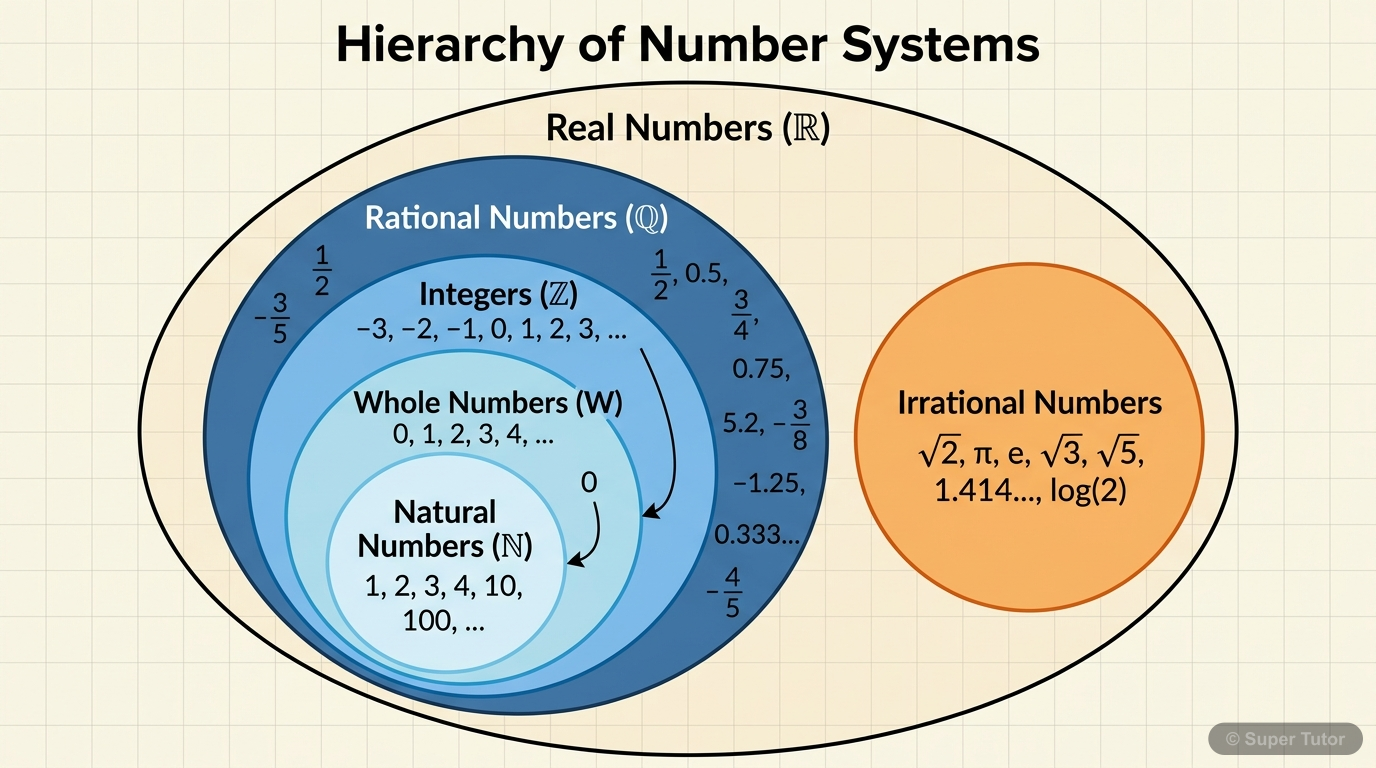
One of 6 illustrations for Real Numbers in Super Tutor — alongside flashcards, concept maps and practice questions.
The first 5 solutions are open to read. The other 5 are free with a Super Tutor account.
Exercise 1.1
1Express each number as a product of its prime factors:
(i) 140
(ii) 156
(iii) 3825
(iv) 5005
(v) 7429Show solution
Concept: Prime factorisation — divide the number successively by the smallest prime factor until the quotient is 1.
(i) 140
(ii) 156
(iii) 3825
(iv) 5005
(v) 7429
2Find the LCM and HCF of the following pairs of integers and verify that LCM × HCF = product of the two numbers.
(i) 26 and 91
(ii) 510 and 92
(iii) 336 and 54Show solution
Concept: Express each number as a product of prime factors. HCF = product of the smallest powers of common prime factors. LCM = product of the greatest powers of all prime factors. Verification: LCM × HCF = product of the two numbers.
(i) 26 and 91
Prime factorisations:
Common prime factor:
Verification:
(ii) 510 and 92
Prime factorisations:
Common prime factor: (smallest power )
Verification:
(iii) 336 and 54
Prime factorisations:
Common prime factors: and (smallest powers and )
Verification:
3Find the LCM and HCF of the following integers by applying the prime factorisation method.
(i) 12, 15 and 21
(ii) 17, 23 and 29
(iii) 8, 9 and 25Show solution
Concept: HCF = product of smallest powers of common prime factors; LCM = product of greatest powers of all prime factors present.
(i) 12, 15 and 21
Prime factorisations:
Common prime factor to all three: (smallest power )
Greatest powers of all prime factors:
(ii) 17, 23 and 29
All three numbers are prime, so they have no common factor other than 1.
(iii) 8, 9 and 25
Prime factorisations:
There is no prime factor common to all three numbers.
Greatest powers of all prime factors:
4Given that HCF(306, 657) = 9, find LCM(306, 657).Show solution
Given:
Formula used:
Calculation:
5Check whether can end with the digit 0 for any natural number .Show solution
Concept: A number ends with the digit 0 if and only if it has both 2 and 5 as prime factors (i.e., 10 is a factor of the number).
Prime factorisation of :
The only prime factors of are 2 and 3.
For to end in 0, it must be divisible by 10, which requires 5 as a prime factor. But 5 does not appear in the prime factorisation of for any natural number .
By the Fundamental Theorem of Arithmetic, the prime factorisation of a number is unique. Since 5 is never a factor of , it can never be divisible by 10.
Conclusion: cannot end with the digit 0 for any natural number .
Free with a Super Tutor account
Free with a Super Tutor account
Exercise 1.2
Free with a Super Tutor account
Free with a Super Tutor account
(i)
(ii)
(iii)
Free with a Super Tutor account
5 more solved questions in Real Numbers
They are free with a Super Tutor account, along with practice quizzes and flashcards for this chapter. Free to start, no card needed.
Frequently Asked Questions
What are the important topics in Real Numbers for CBSE Class 10 Mathematics?
Are these NCERT Solutions for Real Numbers free?
How should I revise Real Numbers for the CBSE Class 10 board exam?
Sources & Official References
- NCERT Official — ncert.nic.in
- CBSE Academic — cbseacademic.nic.in
- CBSE Official — cbse.gov.in
- National Education Policy 2020 — education.gov.in
Content is aligned to the official syllabus. Refer to the board website for the latest curriculum.
More resources for Real Numbers
Practice Quiz
Test yourself with a quick quiz
Important Questions
Exam-style questions with answers
Revision Notes
Key points for last-minute revision
Formula Sheet
The chapter's formulas in one place
Chapter Summary
Understand the chapter at a glance
Concept Maps
See how topics connect
Study Plan
Step-by-step plan for this chapter
Flashcards
Quick-fire cards for active recall
Syllabus
What topics to cover
For serious students
Get the full Real Numbers chapter — start free.
Quizzes, flashcards, an AI doubt solver and a study plan for CBSE Class 10 Mathematics. Free to start, no card needed.