Chemical Reaction and Equations — Chapter Summary
CBSE · Class 10 · Science
Summary of Chemical Reaction and Equations for CBSE Class 10 Science. Part of the CBSE Class 10 Science syllabus.
Interactive on Super Tutor
Studying Chemical Reaction and Equations? Get the full interactive chapter.
Quizzes, flashcards, AI doubt-solver and a step-by-step study plan — built for chapter summary and more.
Free trial, no card needed.
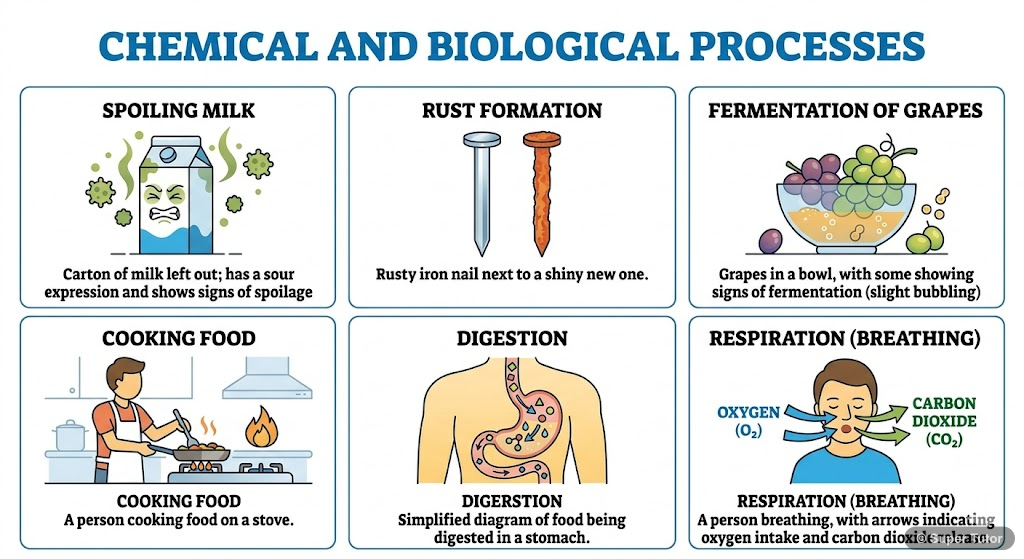
One of 23 illustrations for Chemical Reaction and Equations in Super Tutor — alongside flashcards, concept maps and practice questions.
Overview
Chemical reactions are changes in which new substances are formed and the identity of the original substances changes. Common signs of a reaction include change in colour, change in state, evolution of gas, and change in temperature. Chemical equations give a short symbolic way to write reactions. A
Key Concepts
A chemical reaction forms new substances
A chemical reaction forms new substances from old ones. It is often noticed through colour change, gas formation, change in state, or temperature chan
A chemical equation is the symbolic
A chemical equation is the symbolic form of a reaction. Reactants are written on the left-hand side and products on the right-hand side. The arrow sho
A balanced equation has the same
A balanced equation has the same number of atoms of each element on both sides. This follows the law of conservation of mass, which says mass can neit
The symbols (s)
The symbols (s), (l), (g), and (aq) stand for solid, liquid, gas, and aqueous solution. Reaction conditions such as heat, sunlight, pressure, or catal
A combination reaction is one
A combination reaction is one in which two or more reactants form a single product. Many combination reactions release heat, so they are exothermic.
Learning Objectives
- Identify signs that show a chemical reaction has taken place
- Write word equations and chemical equations correctly
- Balance chemical equations using the hit-and-trial method
- Use state symbols such as (s), (l), (g), and (aq) in equations
- Understand combination, decomposition, displacement, and double displacement reactions
Frequently Asked Questions
What are the important topics in Chemical Reaction and Equations for CBSE Class 10 Science?
How should I revise Chemical Reaction and Equations for the CBSE Class 10 board exam?
Sources & Official References
- NCERT Official — ncert.nic.in
- CBSE Academic — cbseacademic.nic.in
- CBSE Official — cbse.gov.in
- National Education Policy 2020 — education.gov.in
Content is aligned to the official syllabus. Refer to the board website for the latest curriculum.
More resources for Chemical Reaction and Equations
Practice Quiz
Test yourself with a quick quiz
Important Questions
Exam-style questions with answers
Revision Notes
Key points for last-minute revision
Formula Sheet
The chapter's formulas in one place
Concept Maps
See how topics connect
Study Plan
Step-by-step plan for this chapter
Flashcards
Quick-fire cards for active recall
Syllabus
What topics to cover
NCERT Solutions
Every textbook question solved step by step
For serious students
Get the full Chemical Reaction and Equations chapter — start free.
Quizzes, flashcards, an AI doubt solver and a study plan for CBSE Class 10 Science. Free to start, no card needed.