Chemical Reaction and Equations — NCERT Solutions
CBSE · Class 10 · Science
NCERT Solutions for Chemical Reaction and Equations, CBSE Class 10 Science: 25 textbook questions solved step by step.
Interactive on Super Tutor
Studying Chemical Reaction and Equations? Get the full interactive chapter.
Quizzes, flashcards, AI doubt-solver and a step-by-step study plan — built for NCERT solutions and more.
Free trial, no card needed.
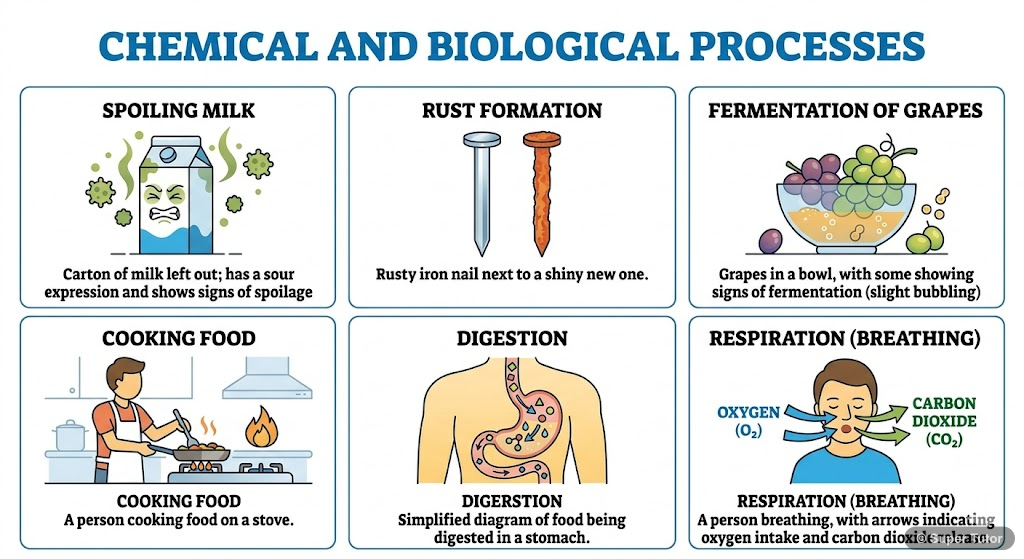
One of 23 illustrations for Chemical Reaction and Equations in Super Tutor — alongside flashcards, concept maps and practice questions.
The first 13 solutions are open to read. The other 12 are free with a Super Tutor account.
Questions
1A solution of a substance 'X' is used for whitewashing.
(i) Name the substance 'X' and write its formula.
(ii) Write the reaction of the substance 'X' named in (i) above with water.Show solution
(i) The substance is calcium oxide or quick lime; formula: CaO.
(ii) Its reaction with water is:
Intext Questions (Page – Oxidation/Reduction Section)
Recall Activity 1.1Recall Activity 1.1 where a magnesium ribbon burns with a dazzling flame in air (oxygen) and changes into a white substance, magnesium oxide. Is magnesium being oxidised or reduced in this reaction?Show solution
Given: Magnesium ribbon burns in air (oxygen) to form magnesium oxide.
Reaction:
Concept: A substance is said to be oxidised if it gains oxygen during a reaction.
Conclusion: Magnesium gains oxygen to form magnesium oxide. Therefore, magnesium is being oxidised in this reaction.
1Why does the colour of copper sulphate solution change when an iron nail is dipped in it?Show solution
Given: An iron nail is dipped in copper sulphate (CuSO₄) solution.
Concept: This is a displacement reaction. A more reactive metal displaces a less reactive metal from its salt solution. Iron is more reactive than copper.
Reaction:
Explanation: Iron displaces copper from copper sulphate solution. The blue colour of copper sulphate solution fades (or turns light green) because blue CuSO₄ is consumed and green FeSO₄ is formed. A reddish-brown deposit of copper metal appears on the iron nail.
Answer: The colour of copper sulphate solution changes because iron displaces copper from the solution, forming iron sulphate (FeSO₄) which is light green, and copper metal is deposited on the nail.
2Give an example of a double displacement reaction other than the one given in Activity 1.10.Show solution
Concept: In a double displacement reaction, two compounds react by exchanging their ions (or groups of atoms) to form two new compounds.
Example: Reaction between sodium sulphate and barium chloride:
Explanation: Here, and ions exchange their respective anions. Barium sulphate () is formed as a white insoluble precipitate. This is also a precipitation reaction.
3Identify the substances that are oxidised and the substances that are reduced in the following reactions.
(i)
(ii) Show solution
Concept:
- Oxidation = gain of oxygen OR loss of hydrogen.
- Reduction = loss of oxygen OR gain of hydrogen.
(i)
- Sodium (Na) gains oxygen to form sodium oxide (Na₂O). Therefore, sodium (Na) is oxidised.
- Oxygen () itself is the oxidising agent; it is being used up to oxidise Na. (In this reaction, only oxidation occurs — there is no separate substance being reduced in the classical sense, but acts as the oxidising agent.)
Answer: Sodium (Na) is oxidised (gains oxygen).
(ii)
- CuO loses oxygen to form Cu. Therefore, CuO (copper oxide) is reduced.
- H₂ gains oxygen to form H₂O. Therefore, hydrogen (H₂) is oxidised.
Answer:
- Substance oxidised → (hydrogen gas gains oxygen).
- Substance reduced → (copper oxide loses oxygen).
Exercises
1Which of the statements about the reaction below are incorrect?
(a) Lead is getting reduced.
(b) Carbon dioxide is getting oxidised.
(c) Carbon is getting oxidised.
(d) Lead oxide is getting reduced.
(i) (a) and (b) (ii) (a) and (c) (iii) (a), (b) and (c) (iv) allShow solution
Correct Option: (i) (a) and (b)
Analysis of the reaction:
- PbO loses oxygen → PbO is reduced (statement (d) is correct).
- Pb is the product of reduction of PbO, so lead itself is not getting reduced — statement (a) is incorrect.
- Carbon (C) gains oxygen to form CO₂ → Carbon is oxidised (statement (c) is correct).
- CO₂ is the product of oxidation; it is not getting oxidised further — statement (b) is incorrect.
Incorrect statements: (a) and (b) → Option (i)
2
The above reaction is an example of a
(a) combination reaction.
(b) double displacement reaction.
(c) decomposition reaction.
(d) displacement reaction.Show solution
Correct Option: (d) displacement reaction.
Justification: Aluminium (Al) is more reactive than iron (Fe). It displaces iron from iron(III) oxide (Fe₂O₃), taking its place. A single more reactive element displaces a less reactive element from its compound — this is the definition of a displacement reaction. This reaction is also known as the thermite reaction.
3What happens when dilute hydrochloric acid is added to iron fillings? Tick the correct answer.
(a) Hydrogen gas and iron chloride are produced.
(b) Chlorine gas and iron hydroxide are produced.
(c) No reaction takes place.
(d) Iron salt and water are produced.Show solution
Correct Answer: (a) Hydrogen gas and iron chloride are produced.
Reaction:
Justification: Iron is more reactive than hydrogen. It displaces hydrogen from dilute hydrochloric acid, forming iron(II) chloride (FeCl₂) and hydrogen gas. This is a displacement reaction.
4What is a balanced chemical equation? Why should chemical equations be balanced?Show solution
Balanced Chemical Equation:
A balanced chemical equation is one in which the number of atoms of each element is equal on both the reactant side and the product side of the equation.
Example:
Here, H: 4 on each side; O: 2 on each side — the equation is balanced.
Why should chemical equations be balanced?
Chemical equations must be balanced to satisfy the Law of Conservation of Mass, which states that matter can neither be created nor destroyed in a chemical reaction. This means the total mass of reactants must equal the total mass of products. Since atoms are neither created nor destroyed during a reaction, the number of atoms of each element must be the same on both sides of the equation. An unbalanced equation violates this fundamental law.
5Translate the following statements into chemical equations and then balance them.
(a) Hydrogen gas combines with nitrogen to form ammonia.
(b) Hydrogen sulphide gas burns in air to give water and sulphur dioxide.
(c) Barium chloride reacts with aluminium sulphate to give aluminium chloride and a precipitate of barium sulphate.
(d) Potassium metal reacts with water to give potassium hydroxide and hydrogen gas.Show solution
(a) Hydrogen gas combines with nitrogen to form ammonia.
Unbalanced:
Balancing:
- N: 2 on left, 1 on right → put 2 before NH₃:
- H: 2 on left, 6 on right → put 3 before H₂:
Balanced equation:
(b) Hydrogen sulphide gas burns in air to give water and sulphur dioxide.
Unbalanced:
Balancing:
- S: 1 on each side ✓
- H: 2 on each side ✓
- O: 2 on left, 3 on right → Balance O by adjusting coefficients.
- Try:
- S: 2 = 2 ✓; H: 4 = 4 ✓; O: 6 = 6 ✓
Balanced equation:
(c) Barium chloride reacts with aluminium sulphate to give aluminium chloride and a precipitate of barium sulphate.
Unbalanced:
Balancing:
- Al: 2 on left → put 2 before AlCl₃
- SO₄: 3 on left → put 3 before BaSO₄
- Ba: 3 on right → put 3 before BaCl₂
- Cl: 6 on left (3×2) → 6 on right (2×3) ✓
Balanced equation:
Check: Ba=3, Cl=6, Al=2, S=3, O=12 — equal on both sides ✓
(d) Potassium metal reacts with water to give potassium hydroxide and hydrogen gas.
Unbalanced:
Balancing:
- K: 1 on each side ✓
- O: 1 on each side ✓
- H: 2 on left, 3 on right → multiply through:
- K: 2=2 ✓; O: 2=2 ✓; H: 4 left = 2+2=4 right ✓
Balanced equation:
6Balance the following chemical equations.
(a)
(b)
(c)
(d) Show solution
(a)
- has 2 NO₃ groups → need 2 HNO₃ on left.
- H on left: 2(from HNO₃) + 2(from Ca(OH)₂) = 4 → need 2 H₂O on right.
Balanced:
Check: H=4, N=2, O=8, Ca=1 — equal on both sides ✓
(b)
- Na₂SO₄ needs 2 Na → 2 NaOH on left.
- H on left: 2(NaOH) + 2(H₂SO₄) = 4 → 2 H₂O on right.
Balanced:
Check: Na=2, O=6, H=4, S=1 — equal on both sides ✓
(c)
- All atoms are already balanced: Na=1, Cl=1, Ag=1, N=1, O=3 on each side.
Balanced:
(Already balanced as written.)
(d)
- Cl: 2 on left → 2 HCl on right.
- H: 2 on left (H₂SO₄) → 2 HCl on right ✓
Balanced:
Check: Ba=1, Cl=2, H=2, S=1, O=4 — equal on both sides ✓
7Write the balanced chemical equations for the following reactions.
(a) Calcium hydroxide + Carbon dioxide → Calcium carbonate + Water
(b) Zinc + Silver nitrate → Zinc nitrate + Silver
(c) Aluminium + Copper chloride → Aluminium chloride + Copper
(d) Barium chloride + Potassium sulphate → Barium sulphate + Potassium chlorideShow solution
(a) Calcium hydroxide + Carbon dioxide → Calcium carbonate + Water
Unbalanced:
Check: Ca=1, C=1, O=4 left (2+2), O=4 right (3+1), H=2 on each side ✓
Balanced:
(b) Zinc + Silver nitrate → Zinc nitrate + Silver
Unbalanced:
- Zn(NO₃)₂ needs 2 NO₃ → 2 AgNO₃ on left → 2 Ag on right.
Balanced:
Check: Zn=1, Ag=2, N=2, O=6 — equal on both sides ✓
(c) Aluminium + Copper chloride → Aluminium chloride + Copper
Unbalanced:
- AlCl₃ needs 3 Cl; CuCl₂ provides 2 Cl each → LCM of 3 and 2 = 6
- 2 AlCl₃ needs 6 Cl → 3 CuCl₂ on left → 3 Cu on right → 2 Al on left.
Balanced:
Check: Al=2, Cu=3, Cl=6 — equal on both sides ✓
(d) Barium chloride + Potassium sulphate → Barium sulphate + Potassium chloride
Unbalanced:
- K: 2 on left → 2 KCl on right → Cl: 2 on right, 2 on left ✓
Balanced:
Check: Ba=1, Cl=2, K=2, S=1, O=4 — equal on both sides ✓
8Write the balanced chemical equation for the following and identify the type of reaction in each case.
(a) Potassium bromide(aq) + Barium iodide(aq) → Potassium iodide(aq) + Barium bromide(s)
(b) Zinc carbonate(s) → Zinc oxide(s) + Carbon dioxide(g)
(c) Hydrogen(g) + Chlorine(g) → Hydrogen chloride(g)
(d) Magnesium(s) + Hydrochloric acid(aq) → Magnesium chloride(aq) + Hydrogen(g)Show solution
(a) Potassium bromide + Barium iodide → Potassium iodide + Barium bromide
Unbalanced:
- Ba: 1 on each side ✓; BaBr₂ needs 2 Br → 2 KBr on left; 2 KI on right.
Balanced:
Check: K=2, Br=2, Ba=1, I=2 — equal on both sides ✓
Type of Reaction: Double Displacement Reaction (two compounds exchange their ions; BaBr₂ is precipitated).
(b) Zinc carbonate → Zinc oxide + Carbon dioxide
Check: Zn=1, C=1, O=3 on each side ✓ (Already balanced)
Type of Reaction: Decomposition Reaction (a single compound breaks down into two simpler substances on heating).
(c) Hydrogen + Chlorine → Hydrogen chloride
Check: H=2, Cl=2 on each side ✓
Type of Reaction: Combination Reaction (two elements combine to form a single product).
(d) Magnesium + Hydrochloric acid → Magnesium chloride + Hydrogen
Unbalanced:
- MgCl₂ needs 2 Cl → 2 HCl on left; H: 2 on left, 2 on right ✓
Balanced:
Check: Mg=1, H=2, Cl=2 — equal on both sides ✓
Type of Reaction: Displacement Reaction (magnesium, being more reactive, displaces hydrogen from hydrochloric acid).
Free with a Super Tutor account
Free with a Super Tutor account
Free with a Super Tutor account
Free with a Super Tutor account
Free with a Super Tutor account
Free with a Super Tutor account
Free with a Super Tutor account
(a) Oxidation
(b) Reduction
Free with a Super Tutor account
Free with a Super Tutor account
Free with a Super Tutor account
Free with a Super Tutor account
(a) Corrosion
(b) Rancidity
Free with a Super Tutor account
12 more solved questions in Chemical Reaction and Equations
They are free with a Super Tutor account, along with practice quizzes and flashcards for this chapter. Free to start, no card needed.
Frequently Asked Questions
What are the important topics in Chemical Reaction and Equations for CBSE Class 10 Science?
Are these NCERT Solutions for Chemical Reaction and Equations free?
How should I revise Chemical Reaction and Equations for the CBSE Class 10 board exam?
Sources & Official References
- NCERT Official — ncert.nic.in
- CBSE Academic — cbseacademic.nic.in
- CBSE Official — cbse.gov.in
- National Education Policy 2020 — education.gov.in
Content is aligned to the official syllabus. Refer to the board website for the latest curriculum.
More resources for Chemical Reaction and Equations
Practice Quiz
Test yourself with a quick quiz
Important Questions
Exam-style questions with answers
Revision Notes
Key points for last-minute revision
Formula Sheet
The chapter's formulas in one place
Chapter Summary
Understand the chapter at a glance
Concept Maps
See how topics connect
Study Plan
Step-by-step plan for this chapter
Flashcards
Quick-fire cards for active recall
Syllabus
What topics to cover
For serious students
Get the full Chemical Reaction and Equations chapter — start free.
Quizzes, flashcards, an AI doubt solver and a study plan for CBSE Class 10 Science. Free to start, no card needed.