Acids,Bases and Salts — Chapter Summary
CBSE · Class 10 · Science
Summary of Acids,Bases and Salts for CBSE Class 10 Science. Part of the CBSE Class 10 Science syllabus. Acids, bases and salts explain many common changes.
Interactive on Super Tutor
Studying Acids,Bases and Salts? Get the full interactive chapter.
Quizzes, flashcards, AI doubt-solver and a step-by-step study plan — built for chapter summary and more.
Free trial, no card needed.
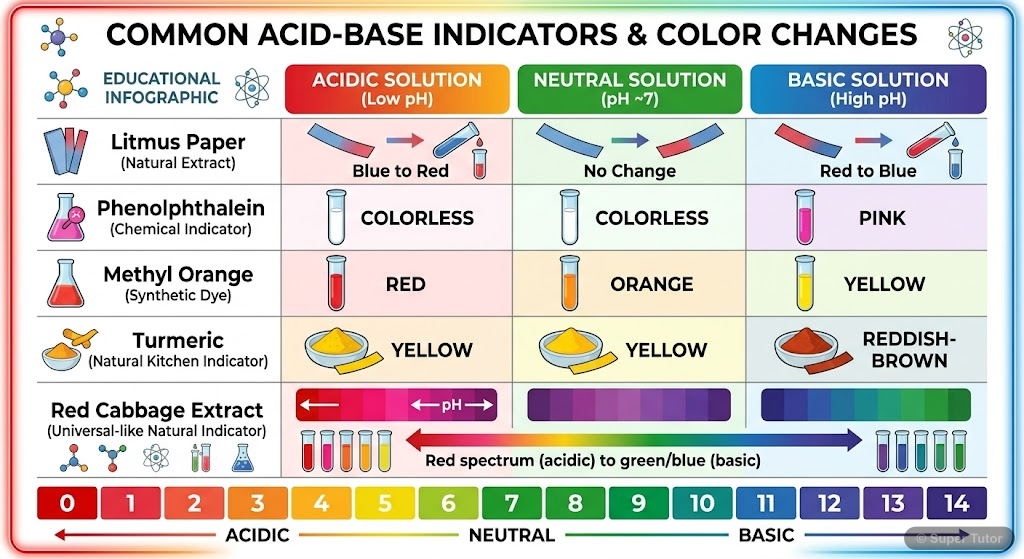
One of 14 illustrations for Acids,Bases and Salts in Super Tutor — alongside flashcards, concept maps and practice questions.
Overview
Acids, bases and salts explain many common changes seen in daily life, from sour taste and cleaning agents to digestion, tooth decay and neutralisation. Acids produce hydrogen ions in water, bases produce hydroxide ions in water, and salts are formed in reactions between acids and bases, metals, met
Key Concepts
Acids turn blue litmus red
Acids turn blue litmus red, while bases turn red litmus blue. Litmus is a natural indicator extracted from lichen. Turmeric is another natural indicat
A metal reacts with an acid
A metal reacts with an acid to form a salt and hydrogen gas. Zinc also reacts with sodium hydroxide to give sodium zincate and hydrogen gas, but such
Metal carbonates and metal hydrogencarbonates react
Metal carbonates and metal hydrogencarbonates react with acids to produce salt, carbon dioxide and water. Carbon dioxide turns lime water milky by for
The reaction between an acid
The reaction between an acid and a base to give a salt and water is called neutralisation. In ionic form, it is H+ plus OH- giving water.
Metal oxides react with acids
Metal oxides react with acids to give salt and water, so they are basic oxides. Non-metallic oxides react with bases and are acidic in nature.
Learning Objectives
- Identify acids, bases and salts using indicators and pH
- Understand reactions of acids and bases with metals, carbonates and each other
- Explain neutralisation as the formation of salt and water
- Describe why acids and bases conduct electricity in water
- Understand the pH scale and its importance in daily life
Frequently Asked Questions
What are the important topics in Acids,Bases and Salts for CBSE Class 10 Science?
How should I revise Acids,Bases and Salts for the CBSE Class 10 board exam?
Sources & Official References
- NCERT Official — ncert.nic.in
- CBSE Academic — cbseacademic.nic.in
- CBSE Official — cbse.gov.in
- National Education Policy 2020 — education.gov.in
Content is aligned to the official syllabus. Refer to the board website for the latest curriculum.
More resources for Acids,Bases and Salts
Practice Quiz
Test yourself with a quick quiz
Important Questions
Exam-style questions with answers
Revision Notes
Key points for last-minute revision
Formula Sheet
The chapter's formulas in one place
Concept Maps
See how topics connect
Study Plan
Step-by-step plan for this chapter
Flashcards
Quick-fire cards for active recall
Syllabus
What topics to cover
NCERT Solutions
Every textbook question solved step by step
For serious students
Get the full Acids,Bases and Salts chapter — start free.
Quizzes, flashcards, an AI doubt solver and a study plan for CBSE Class 10 Science. Free to start, no card needed.