Biomolecules
CBSE · Class 12 · Chemistry
NCERT Solutions for Biomolecules — CBSE Class 12 Chemistry.
Interactive on Super Tutor
Studying Biomolecules? Get the full interactive chapter.
Quizzes, flashcards, AI doubt-solver and a step-by-step study plan — built for ncert solutions and more.
1,000+ Class 12 students started this chapter today
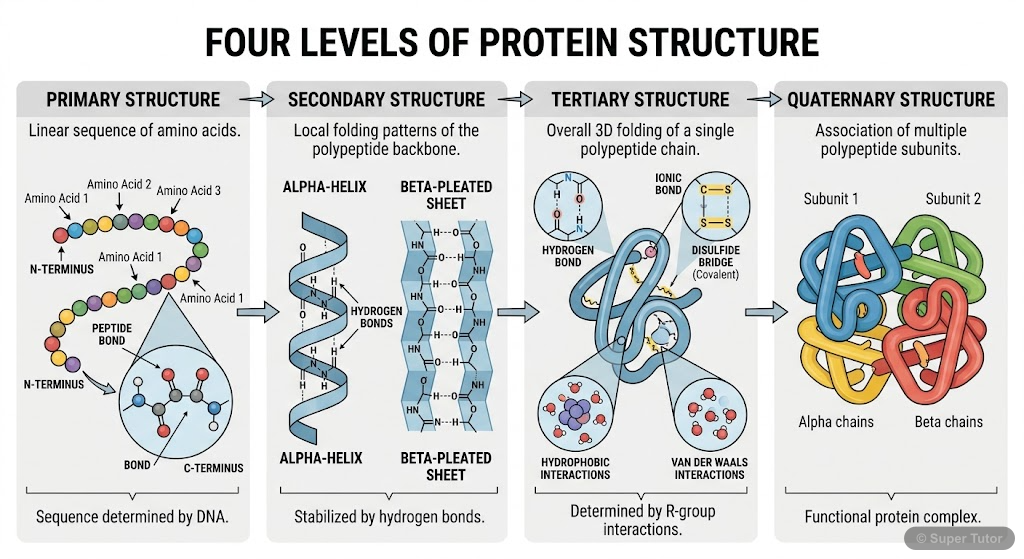
Super Tutor has 32+ illustrations like this for Biomolecules alone — flashcards, concept maps, and step-by-step visuals.
See them all13 worked solutions below. Unlock all 25 free in Super Tutor
Exercises
10.1What are monosaccharides?Show solution
Not sure why a step works? check your working in Super Tutor
10.2What are reducing sugars?Show solution
Not sure why a step works? check your working in Super Tutor
10.3Write two main functions of carbohydrates in plants.Show solution
1. They act as food storage molecules, mainly as starch.
2. They provide structural support, as in cellulose of the cell wall.
Not sure why a step works? check your working in Super Tutor
10.4Classify the following into monosaccharides and disaccharides. Ribose, 2-deoxyribose, maltose, galactose, fructose and lactose.Show solution
- Disaccharides: maltose, lactose
Not sure why a step works? check your working in Super Tutor
10.5What do you understand by the term glycosidic linkage?Show solution
Not sure why a step works? check your working in Super Tutor
10.6What is glycogen? How is it different from starch?Show solution
Difference from starch:
- Starch is the main storage polysaccharide of plants.
- Glycogen is the storage polysaccharide of animals.
- Glycogen is more highly branched than starch (its structure is similar to amylopectin but more branched).
Not sure why a step works? check your working in Super Tutor
10.7What are the hydrolysis products of (i) sucrose and (ii) lactose?Show solution
- Sucrose gives D-(+)-glucose and D-(-)-fructose.
- Lactose gives D-glucose and D-galactose.
Not sure why a step works? check your working in Super Tutor
10.8What is the basic structural difference between starch and cellulose?Show solution
- Starch is made of **-D-glucose units.
- Cellulose is made of -D-glucose units.
So, starch and cellulose differ in the kind of glucose unit and the linkage pattern** between them.
Not sure why a step works? check your working in Super Tutor
10.9What happens when D-glucose is treated with the following reagents?Show solution
1. HI: It gets reduced to n-hexane.
2. Bromine water: It is oxidised to gluconic acid.
3. **HNO: It is oxidised to the dicarboxylic acid saccharic acid**.
Not sure why a step works? check your working in Super Tutor
10.10Enumerate the reactions of D-glucose which cannot be explained by its open chain structure.Show solution
1. It does not give Schiff’s test and does not form the hydrogensulphite addition product with **NaHSO, although it has an aldehyde group in the open-chain formula.
2. Its pentaacetate does not react with hydroxylamine, showing the absence of a free –CHO group.
3. It exists in two crystalline forms, -glucose and -glucose**.
These facts led to the cyclic hemiacetal structure of glucose.
Not sure why a step works? check your working in Super Tutor
10.11What are essential and non-essential amino acids? Give two examples of each type.Show solution
Examples:
- Essential: valine, lysine
- Non-essential: glycine, alanine
Not sure why a step works? check your working in Super Tutor
10.12Define the following as related to proteinsShow solution
1. Peptide linkage: An amide bond, **, formed between the group of one amino acid and the group of another.
2. Primary structure: The specific sequence of amino acids in a polypeptide chain.
3. Denaturation: The process in which a protein loses its native structure and biological activity due to change in temperature or pH**; secondary and tertiary structures are destroyed while primary structure remains intact.
Not sure why a step works? check your working in Super Tutor
10.13What are the common types of secondary structure of proteins?Show solution
- **-helix
- -pleated sheet**
Not sure why a step works? check your working in Super Tutor
12 more solved questions in Biomolecules
Every remaining exercise is solved step by step in Super Tutor, plus practice quizzes and flashcards for this chapter. Free to start.
Stuck on a step?
Ask Super Tutor AI to explain any solution on this page in a simpler way — free, 24x7.
Ask a Doubt FreeFrequently Asked Questions
What are the important topics in Biomolecules for CBSE Class 12 Chemistry?
How to score full marks in Biomolecules — CBSE Class 12 Chemistry?
Where can I get free NCERT Solutions for Biomolecules Class 12 Chemistry?
Sources & Official References
- NCERT Official — ncert.nic.in
- CBSE Academic — cbseacademic.nic.in
- CBSE Official — cbse.gov.in
- National Education Policy 2020 — education.gov.in
Content is aligned to the official syllabus. Refer to the board website for the latest curriculum.
More resources for Biomolecules
Practice Quiz
Test yourself with a quick quiz
Important Questions
Practice with board exam-style questions
Revision Notes
Key points for last-minute revision
Formula Sheet
All formulas in one place
Chapter Summary
Understand the chapter at a glance
Concept Maps
See how topics connect visually
Study Plan
Step-by-step plan to ace this chapter
Flashcards
Quick-fire cards for active recall
Syllabus
What topics to cover
For serious students
Get the full Biomolecules chapter — for free.
Quizzes, flashcards, AI doubt-solver and a step-by-step study plan for CBSE Class 12 Chemistry.