Production and Costs
CBSE · Class 12 · Economics
Quick revision notes for Production and Costs — CBSE Class 12 Economics. Key concepts, formulas, and definitions for last-minute revision.
Interactive on Super Tutor
Studying Production and Costs? Get the full interactive chapter.
Quizzes, flashcards, AI doubt-solver and a step-by-step study plan — built for revision notes and more.
1,000+ Class 12 students started this chapter today
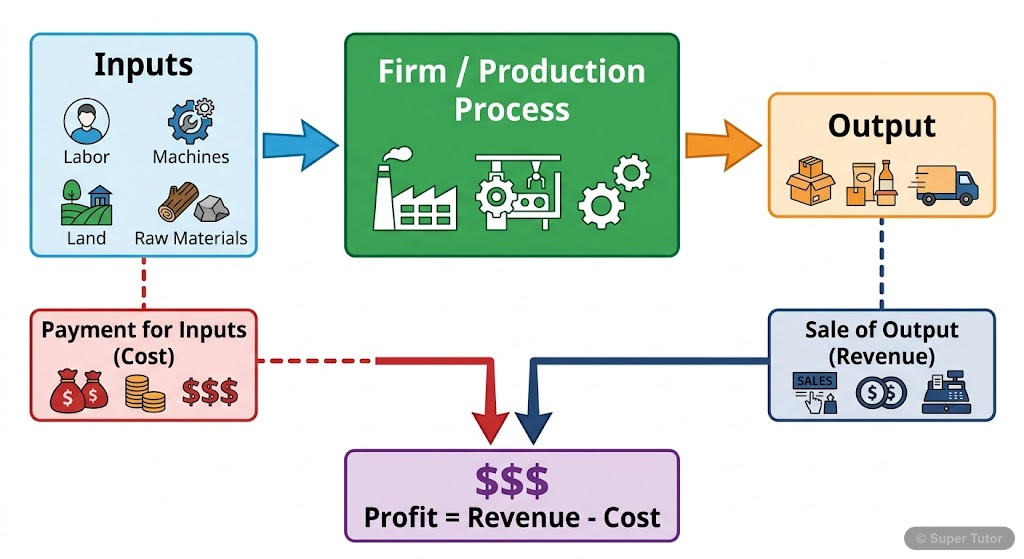
This is just one of 10+ visuals inside Super Tutor's Production and Costs chapter
Explore the full setKey Topics to Revise
1. Production Function and Isoquants
- Production function gives the maximum quantity of output for different combinations of inputs.
- It is defined for a given technology. If technology improves, a new production function comes into existence.
- A firm can produce only if both inputs are available. If either input is zero, output is zero.
2. Short Run, Long Run, TP, AP and MP
- In the short run, at least one factor of production cannot be varied and therefore remains fixed.
- In the long run, all factors of production can be varied. There is no fixed factor.
- Short run and long run are defined by whether all inputs can be varied, not by calendar time.
3. Law of Variable Proportions and Curve Shapes
- The law of variable proportions states that marginal product initially rises with employment level and then falls after a certain point.
- It is also called the law of diminishing marginal product.
- This happens because the ratio of fixed to variable factors changes as more of the variable input is added.
4. Returns to Scale and Cobb-Douglas Production Function
- Returns to scale apply only in the long run because both inputs must change together.
- When all inputs increase in the same proportion and output increases in the same proportion, the production function shows constant returns to scale.
- When output increases by a larger proportion than inputs, the production function shows increasing returns to scale.
Get complete notes with diagrams and examples
Full NotesKey Concepts
Frequently Asked Questions
What are the important topics in Production and Costs for CBSE Class 12 Economics?
How to score full marks in Production and Costs — CBSE Class 12 Economics?
Sources & Official References
- NCERT Official — ncert.nic.in
- CBSE Academic — cbseacademic.nic.in
- CBSE Official — cbse.gov.in
- National Education Policy 2020 — education.gov.in
Content is aligned to the official syllabus. Refer to the board website for the latest curriculum.
More resources for Production and Costs
Practice Quiz
Test yourself with a quick quiz
Important Questions
Practice with board exam-style questions
Formula Sheet
All formulas in one place
Chapter Summary
Understand the chapter at a glance
Concept Maps
See how topics connect visually
Study Plan
Step-by-step plan to ace this chapter
Flashcards
Quick-fire cards for active recall
Syllabus
What topics to cover
NCERT Solutions
Every textbook question solved step by step
For serious students
Get the full Production and Costs chapter — for free.
Quizzes, flashcards, AI doubt-solver and a step-by-step study plan for CBSE Class 12 Economics.