Chapter 5 of 12
NCERT Solutions

Production and Costs

CBSE · Class 12 · Economics

NCERT Solutions for Production and Costs — CBSE Class 12 Economics.

42 questions74 flashcards5 concepts

Interactive on Super Tutor

Studying Production and Costs? Get the full interactive chapter.

Quizzes, flashcards, AI doubt-solver and a step-by-step study plan — built for ncert solutions and more.

1,000+ Class 12 students started this chapter today
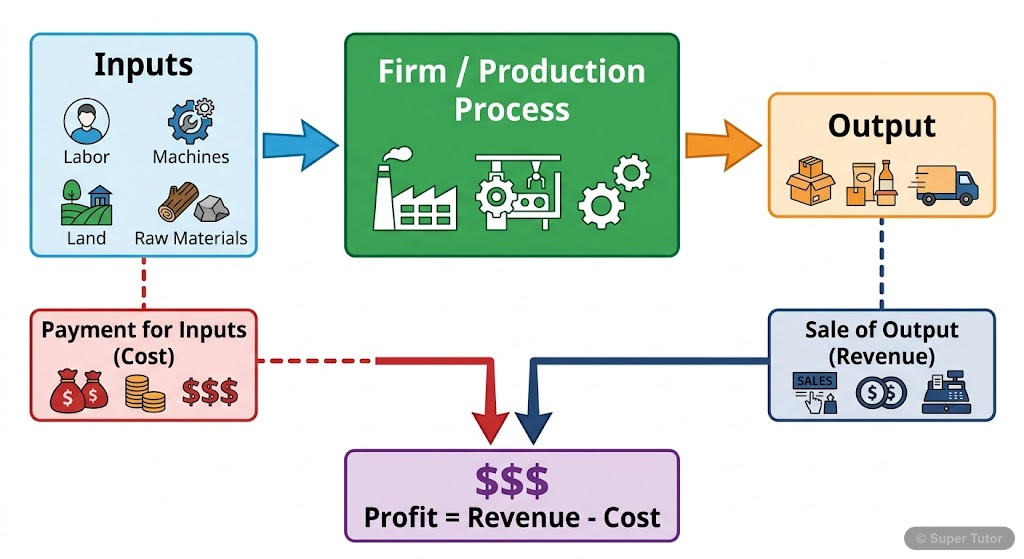
A flowchart illustrating the transformation of various inputs (labor, capital, raw materials) into an output by a firm, highlighting the payment for inputs (cost), sale of output (revenue), and the re
Super Tutor

This is just one of 10+ visuals inside Super Tutor's Production and Costs chapter

Explore the full set
30 Questions Solved · 1 Section

15 worked solutions below. Unlock all 30 free in Super Tutor

Exercises

1Explain the concept of a production function.Show solution
A production function is the relationship between the inputs used and the output produced by a firm. It shows the maximum quantity of output that can be produced from different combinations of inputs, given the technology. In short, it tells us how much a firm can produce with a given set of factors of production such as labour and capital.

Not sure why a step works? check your working in Super Tutor

2What is the total product of an input?Show solution
The total product (TP) of an input is the relationship between a variable input and output, when all other inputs are held constant. It shows the total amount of output produced at different levels of that input.

Not sure why a step works? check your working in Super Tutor

3What is the average product of an input?Show solution
Average product (AP) is defined as the output per unit of variable input. It is calculated as APL=TPLLAP_L = \frac{TP_L}{L} for labour.

Not sure why a step works? check your working in Super Tutor

4What is the marginal product of an input?Show solution
Marginal product (MP) of an input is the change in output per unit of change in the input, when all other inputs are held constant. For labour, MPL=ΔTPLΔLMP_L = \frac{\Delta TP_L}{\Delta L}.

Not sure why a step works? check your working in Super Tutor

5Explain the relationship between the marginal products and the total product of an input.Show solution
The total product is the sum of marginal products of all units of the variable input up to that level of employment. So, if we keep adding units of labour, each unit contributes its marginal product to total output.

- When MP rises, TP rises at an increasing rate.
- When MP is positive but falling, TP still rises, but at a decreasing rate.
- When MP becomes zero, TP reaches its maximum.
- If MP becomes negative, TP falls.

Thus, the shape of TP is determined by MP: TP increases as long as MP is positive, and the rate of increase depends on whether MP is rising or falling.

Not sure why a step works? check your working in Super Tutor

6Explain the concepts of the short run and the long run.Show solution
In the short run, at least one factor of production, such as labour or capital, cannot be varied and remains fixed. The other factor can be changed, so it is called the variable factor.

In the long run, all factors of production can be varied. There is no fixed factor in the long run. The distinction depends not on days or months, but on whether all inputs can be changed.

Not sure why a step works? check your working in Super Tutor

7What is the law of diminishing marginal product?Show solution
The law of diminishing marginal product says that the marginal product of a factor input initially rises as employment increases, but after reaching a certain level, it starts falling.

Not sure why a step works? check your working in Super Tutor

8What is the law of variable proportions?Show solution
The law of variable proportions says that when one factor is held constant and the other is increased, the marginal product of the variable input initially rises with employment and then, after a certain point, falls.

Not sure why a step works? check your working in Super Tutor

9When does a production function satisfy constant returns to scale?Show solution
A production function satisfies constant returns to scale (CRS) when a proportional increase in all inputs leads to an equal proportional increase in output. If all inputs are increased by a factor t>1t>1, output also increases by the same factor: f(tx1,tx2)=tf(x1,x2)f(tx_1, tx_2)=t\,f(x_1,x_2).

Not sure why a step works? check your working in Super Tutor

10When does a production function satisfy increasing returns to scale?Show solution
A production function satisfies increasing returns to scale (IRS) when a proportional increase in all inputs results in an increase in output by a larger proportion. Mathematically, if inputs are scaled up by t>1t>1, then f(tx1,tx2)>tf(x1,x2)f(tx_1,tx_2)>t\,f(x_1,x_2).

Not sure why a step works? check your working in Super Tutor

11When does a production function satisfy decreasing returns to scale?Show solution
A production function satisfies decreasing returns to scale (DRS) when a proportional increase in all inputs leads to an increase in output by a smaller proportion. That is, if inputs are increased by a factor t>1t>1, then f(tx1,tx2)<tf(x1,x2)f(tx_1,tx_2)<t\,f(x_1,x_2).

Not sure why a step works? check your working in Super Tutor

12Briefly explain the concept of the cost function.Show solution
The cost function describes the least cost of producing each level of output, given the prices of factors of production and the technology. Since a given output can usually be produced in more than one way, the firm chooses the least expensive input combination for each output level.

Not sure why a step works? check your working in Super Tutor

13What are the total fixed cost, total variable cost and total cost of a firm? How are they related?Show solution
- Total fixed cost (TFC) is the cost of employing fixed inputs in the short run. It does not change with output.
- Total variable cost (TVC) is the cost of employing variable inputs. It changes with output.
- Total cost (TC) is the sum of the two:

TC=TVC+TFCTC = TVC + TFC

So, for any level of output, total cost = fixed cost + variable cost.

Not sure why a step works? check your working in Super Tutor

14What are the average fixed cost, average variable cost and average cost of a firm? How are they related?Show solution
- Average fixed cost (AFC) is fixed cost per unit of output: AFC=TFCqAFC = \frac{TFC}{q}.
- Average variable cost (AVC) is variable cost per unit of output: AVC=TVCqAVC = \frac{TVC}{q}.
- Average cost (AC or SAC in short run) is total cost per unit of output: SAC=TCqSAC = \frac{TC}{q}.

They are related by:

SAC=AVC+AFCSAC = AVC + AFC

Not sure why a step works? check your working in Super Tutor

15Can there be some fixed cost in the long run? If not, why?Show solution
No, there cannot be any fixed cost in the long run. In the long run, all inputs are variable, so there are no fixed factors. Therefore, the cost of employing fixed inputs does not arise; total cost and total variable cost become the same in the long run.

Not sure why a step works? check your working in Super Tutor

16What does the average fixed cost curve look like? Why does it look so?
17What do the short run marginal cost, average variable cost and short run average cost curves look like?
18Why does the SMC curve cut the AVC curve at the minimum point of the AVC curve?
19At which point does the SMC curve cut the SAC curve? Give reason in support of your answer.
20Why is the short run marginal cost curve 'U'-shaped?
21What do the long run marginal cost and the average cost curves look like?
22The following table gives the total product schedule of labour. Find the corresponding average product and marginal product schedules of labour.
23The following table gives the average product schedule of labour. Find the total product and marginal product schedules. It is given that the total product is zero at zero level of labour employment.
24The following table gives the marginal product schedule of labour. It is also given that total product of labour is zero at zero level of employment. Calculate the total and average product schedules of labour.
25The following table shows the total cost schedule of a firm. What is the total fixed cost schedule of this firm? Calculate the TVC, AFC, AVC, SAC and SMC schedules of the firm.
26The following table gives the total cost schedule of a firm. It is also given that the average fixed cost at 4 units of output is Rs 5. Find the TVC, TFC, AVC, AFC, SAC and SMC schedules of the firm for the corresponding values of output.
27A firm's SMC schedule is shown in the following table. The total fixed cost of the firm is Rs 100. Find the TVC, TC, AVC and SAC schedules of the firm.
28Let the production function of a firm be
29Let the production function of a firm be
30Find out the maximum possible output for a firm with zero unit of LL and 10 units of KK when its production function is

15 more solved questions in Production and Costs

Every remaining exercise is solved step by step in Super Tutor, plus practice quizzes and flashcards for this chapter. Free to start.

Stuck on a step?

Ask Super Tutor AI to explain any solution on this page in a simpler way — free, 24x7.

Ask a Doubt Free

Frequently Asked Questions

What are the important topics in Production and Costs for CBSE Class 12 Economics?
Key topics in Production and Costs include Production and Costs - Complete Concept Map, Relationship Between MP and TP: Correcting the Most Critical Misconception, Production and Costs – Complete Concept Map. These are the concepts CBSE Class 12 examiners draw on most — study them first, then practise related questions.
How to score full marks in Production and Costs — CBSE Class 12 Economics?
Understand the core concepts first, then work through the 42 practice questions available for this chapter. Revise formulas and definitions regularly, and use flashcards for quick recall before the exam.
Where can I get free NCERT Solutions for Production and Costs Class 12 Economics?
This page has free step-by-step NCERT Solutions for every exercise question in Production and Costs (CBSE Class 12 Economics) — written the way examiners award marks: given, formula, working, answer.

Sources & Official References

Content is aligned to the official syllabus. Refer to the board website for the latest curriculum.

For serious students

Get the full Production and Costs chapter — for free.

Quizzes, flashcards, AI doubt-solver and a step-by-step study plan for CBSE Class 12 Economics.