Government Budget and the Economy
CBSE · Class 12 · Economics
Quick revision notes for Government Budget and the Economy — CBSE Class 12 Economics. Key concepts, formulas, and definitions for last-minute revision.
Interactive on Super Tutor
Studying Government Budget and the Economy? Get the full interactive chapter.
Quizzes, flashcards, AI doubt-solver and a step-by-step study plan — built for revision notes and more.
1,000+ Class 12 students started this chapter today
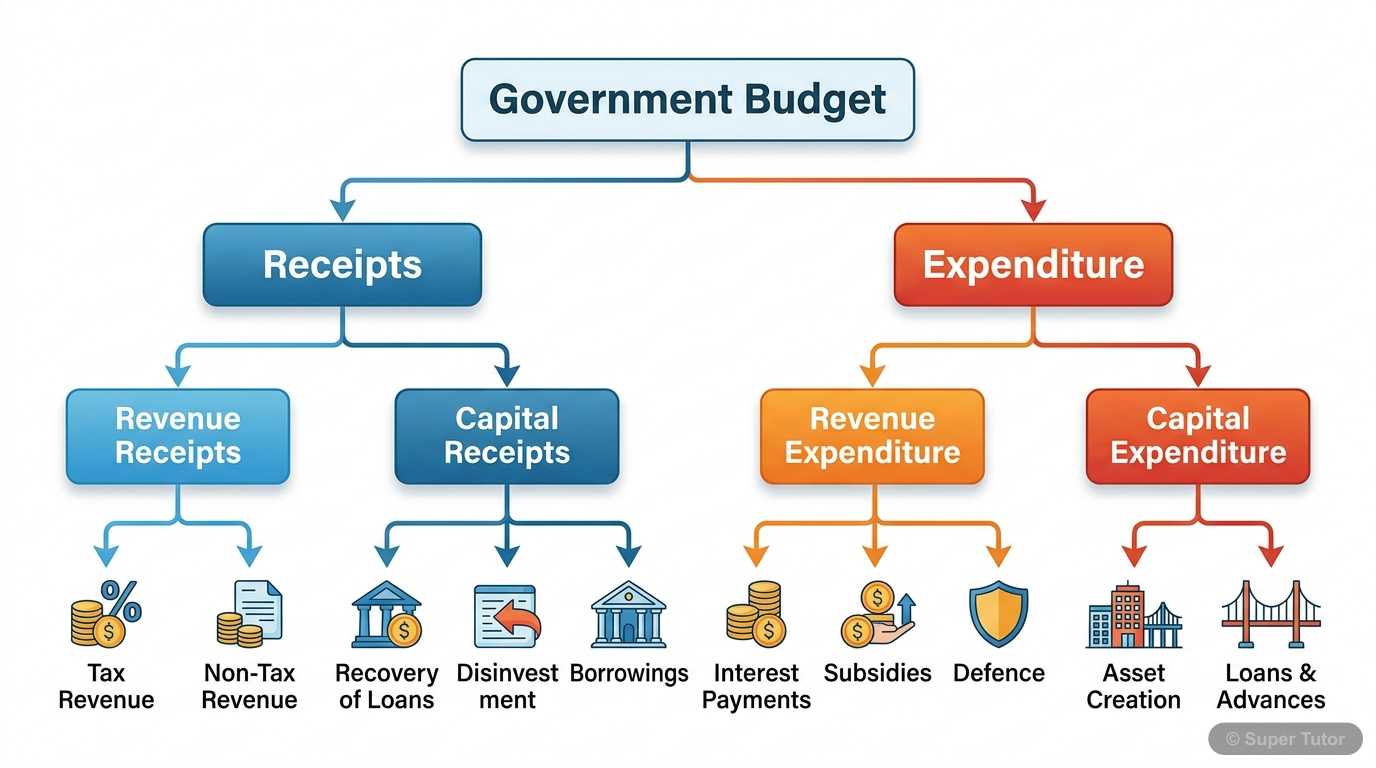
Super Tutor has 11+ illustrations like this for Government Budget and the Economy alone — flashcards, concept maps, and step-by-step visuals.
See them allKey Topics to Revise
1. Meaning of Government Budget and Its Components
- A budget is the statement of estimated receipts and expenditures of the government for a financial year.
- In India, the financial year runs from 1 April to 31 March.
- The main budget document is the Annual Financial Statement.
2. Objectives of Government Budget
- The Government budget has three main objectives: allocation, redistribution, and stabilisation.
- Allocation means the Government provides goods and services that the market mechanism cannot provide efficiently.
- Public goods are non-rivalrous and non-excludable.
3. Classification of Receipts
- Government receipts are divided into revenue receipts and capital receipts.
- Revenue receipts do not create a claim on the Government.
- Revenue receipts are of two types: tax revenue and non-tax revenue.
4. Classification of Expenditure
- Government expenditure is divided into revenue expenditure and capital expenditure.
- Revenue expenditure is spending for normal functioning and does not create physical or financial assets.
- Revenue expenditure includes interest payments and grants to states and other parties.
Get complete notes with diagrams and examples
Full NotesKey Concepts
Frequently Asked Questions
What are the important topics in Government Budget and the Economy for CBSE Class 12 Economics?
How to score full marks in Government Budget and the Economy — CBSE Class 12 Economics?
Sources & Official References
- NCERT Official — ncert.nic.in
- CBSE Academic — cbseacademic.nic.in
- CBSE Official — cbse.gov.in
- National Education Policy 2020 — education.gov.in
Content is aligned to the official syllabus. Refer to the board website for the latest curriculum.
More resources for Government Budget and the Economy
Practice Quiz
Test yourself with a quick quiz
Important Questions
Practice with board exam-style questions
Formula Sheet
All formulas in one place
Chapter Summary
Understand the chapter at a glance
Concept Maps
See how topics connect visually
Study Plan
Step-by-step plan to ace this chapter
Flashcards
Quick-fire cards for active recall
Syllabus
What topics to cover
NCERT Solutions
Every textbook question solved step by step
For serious students
Get the full Government Budget and the Economy chapter — for free.
Quizzes, flashcards, AI doubt-solver and a step-by-step study plan for CBSE Class 12 Economics.