Open Economy Macroeconomics
CBSE · Class 12 · Economics
Complete topic list for Open Economy Macroeconomics in CBSE Class 12 Economics. Key concepts, sub-topics, and what to focus on for board exams.
Interactive on Super Tutor
Studying Open Economy Macroeconomics? Get the full interactive chapter.
Quizzes, flashcards, AI doubt-solver and a step-by-step study plan — built for syllabus and more.
1,000+ Class 12 students started this chapter today
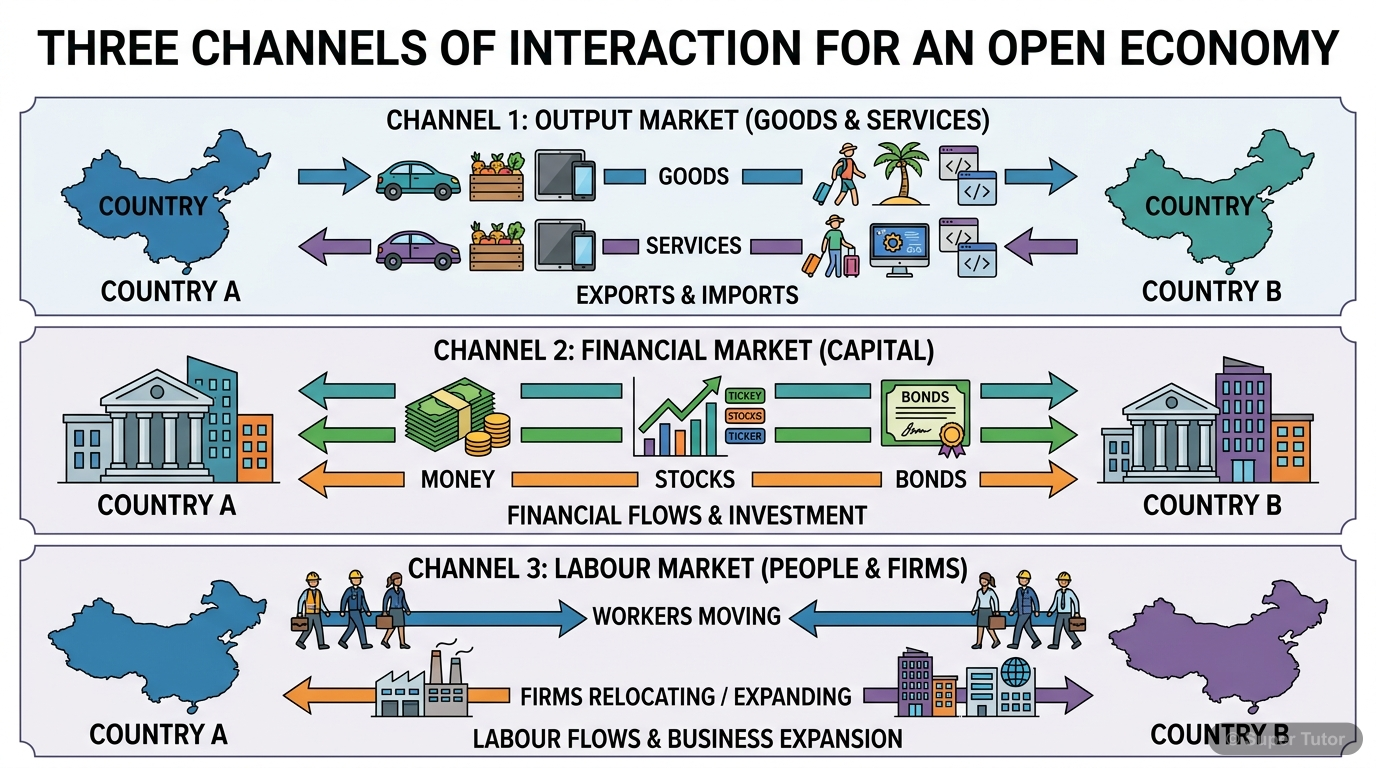
Learn better with visuals Super Tutor has hundreds of illustrations like this across every chapter — all free to try.
Get startedTopics in Open Economy Macroeconomics
1. Meaning of an Open Economy
- An open economy interacts with other countries through goods, services, financial assets, and labour movement.
- Three linkages connect an open economy with the rest of the world: output market, financial market, and labour market.
- Trade in goods and services allows consumers and producers to choose between domestic and foreign products.
2. Balance of Payments and Current Account
- Balance of Payments records transactions in goods, services, and assets between residents of a country and the rest of the world for a specified time period, usually a year.
- In the older classification, BoP has two main accounts: current account and capital account.
- In the newer BPM6 classification, BoP has three accounts: current account, financial account, and capital account.
3. Capital Account and BoP Balance
- Capital Account records all international transactions of assets.
- Assets include money, stocks, bonds, and government debt.
- Items in the capital account include FDIs, FIIs, external borrowings, and assistance.
4. Foreign Exchange Market and Demand-Supply of Currency
- The foreign exchange market is the market in which national currencies are traded for one another.
- Participants include commercial banks, foreign exchange brokers, other authorised dealers, and monetary authorities.
- The market itself is worldwide.
Key Concepts
Central concept: Open Economy Macroeconomics
Frequently Asked Questions
What are the important topics in Open Economy Macroeconomics for CBSE Class 12 Economics?
How to score full marks in Open Economy Macroeconomics — CBSE Class 12 Economics?
Sources & Official References
- NCERT Official — ncert.nic.in
- CBSE Academic — cbseacademic.nic.in
- CBSE Official — cbse.gov.in
- National Education Policy 2020 — education.gov.in
Content is aligned to the official syllabus. Refer to the board website for the latest curriculum.
More resources for Open Economy Macroeconomics
Practice Quiz
Test yourself with a quick quiz
Important Questions
Practice with board exam-style questions
Revision Notes
Key points for last-minute revision
Formula Sheet
All formulas in one place
Chapter Summary
Understand the chapter at a glance
Concept Maps
See how topics connect visually
Study Plan
Step-by-step plan to ace this chapter
Flashcards
Quick-fire cards for active recall
NCERT Solutions
Every textbook question solved step by step
For serious students
Get the full Open Economy Macroeconomics chapter — for free.
Quizzes, flashcards, AI doubt-solver and a step-by-step study plan for CBSE Class 12 Economics.