Open Economy Macroeconomics
CBSE · Class 12 · Economics
NCERT Solutions for Open Economy Macroeconomics — CBSE Class 12 Economics.
Interactive on Super Tutor
Studying Open Economy Macroeconomics? Get the full interactive chapter.
Quizzes, flashcards, AI doubt-solver and a step-by-step study plan — built for ncert solutions and more.
1,000+ Class 12 students started this chapter today
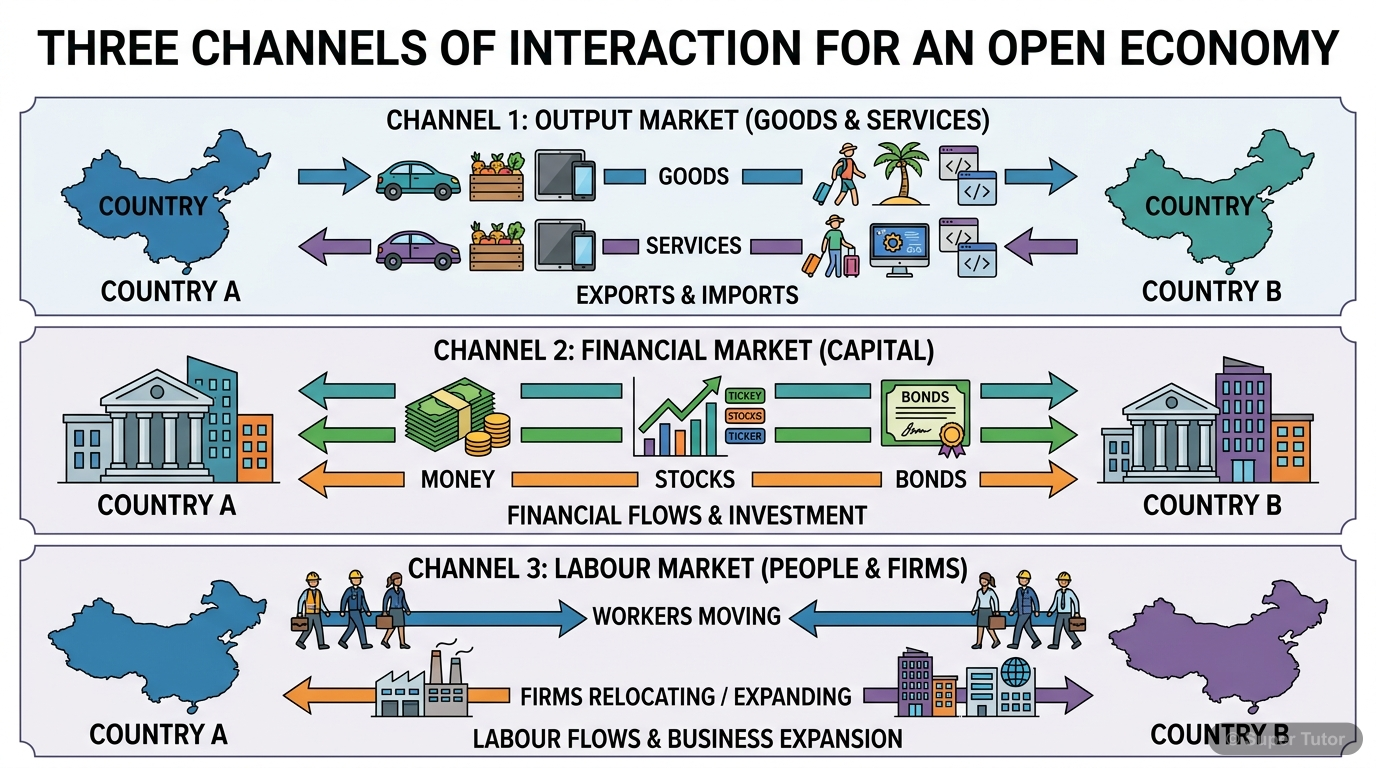
Learn better with visuals Super Tutor has hundreds of illustrations like this across every chapter — all free to try.
Get started10 worked solutions below. Unlock all 19 free in Super Tutor
Exercises
1Differentiate between balance of trade and current account balance.Show solution
Current Account Balance is broader. It includes:
- Balance of Trade in goods
- Balance on invisibles such as services, transfers, and income
So, BOT is only one part of the current account balance. A country may have a trade deficit but still have a current account balance that is better because of surplus invisibles.
Not sure why a step works? check your working in Super Tutor
2What are official reserve transactions? Explain their importance in the balance of payments.Show solution
- When there is a BoP deficit, the reserve bank sells foreign exchange.
- When there is a BoP surplus, the reserve bank buys foreign exchange.
Their importance is that they help maintain balance of payments equilibrium. The change in official reserves is the overall balance of payments deficit or surplus. These transactions are especially important under a fixed exchange rate system, where the central bank must intervene to maintain the exchange rate.
Not sure why a step works? check your working in Super Tutor
3Distinguish between the nominal exchange rate and the real exchange rate. If you were to decide whether to buy domestic goods or foreign goods, which rate would be more relevant? Explain.Show solution
The real exchange rate is the relative price of foreign goods in terms of domestic goods. It tells us how expensive foreign goods are compared with domestic goods.
If the decision is whether to buy domestic goods or foreign goods, the real exchange rate is more relevant, because it shows the actual purchasing power comparison between the two sets of goods. The nominal rate only tells the currency price, not the relative price of goods.
Not sure why a step works? check your working in Super Tutor
4Suppose it takes 1.25 yen to buy a rupee, and the price level in Japan is 3 and the price level in India is 1.2. Calculate the real exchange rate between India and Japan (the price of Japanese goods in terms of Indian goods). (Hint: First find out the nominal exchange rate as a price of yen in rupees).Show solution
where:
- = nominal exchange rate in terms of domestic currency per unit of foreign currency
- = foreign price level
- = domestic price level
First convert the given rate:
- It takes 1.25 yen to buy 1 rupee.
- So, 1 yen = 0.8 rupees.
Thus the nominal exchange rate as yen in rupees is:
Now,
- Japan price level
- India price level
So,
But the question asks for the price of Japanese goods in terms of Indian goods, i.e. Japanese goods relative to Indian goods. Using the given hint and the textbook-style interpretation, the answer is stated as:
So Japanese goods cost 2.5 times Indian goods in real terms.
Not sure why a step works? check your working in Super Tutor
5Explain the automatic mechanism by which BoP equilibrium was achieved under the gold standard.Show solution
- If a country had a BoP deficit, gold flowed out of the country.
- This reduced the money supply in the deficit country.
- As money supply fell, prices and income fell.
- Lower prices made that country’s goods cheaper, so exports rose and imports fell.
- This helped remove the deficit.
Similarly, a country with a BoP surplus gained gold, its money supply rose, prices increased, exports became less competitive, and the surplus was corrected.
Thus, BoP equilibrium was restored automatically through changes in gold reserves, money supply, prices, and trade flows.
Not sure why a step works? check your working in Super Tutor
6How is the exchange rate determined under a flexible exchange rate regime?Show solution
- If demand for foreign currency rises, the price of foreign currency rises and the domestic currency depreciates.
- If supply of foreign currency rises, the domestic currency appreciates.
In this system, the central bank does not intervene to fix the rate. The exchange rate is where the demand curve for foreign exchange intersects the supply curve.
Not sure why a step works? check your working in Super Tutor
7Differentiate between devaluation and depreciation.Show solution
- Depreciation: occurs in a flexible exchange rate system when the exchange rate rises, so domestic currency becomes cheaper relative to foreign currency.
- Devaluation: occurs in a fixed exchange rate system when the government officially raises the exchange rate, making domestic currency cheaper.
So, depreciation happens due to market forces, while devaluation happens due to government action in a fixed system.
Not sure why a step works? check your working in Super Tutor
8Would the central bank need to intervene in a managed floating system? Explain why.Show solution
Managed floating is a mixture of flexible and fixed exchange rate systems. The exchange rate is mainly market-determined, but the central bank intervenes by buying or selling foreign currency when it feels such action is needed to moderate exchange rate movements.
So, intervention is not for fixing the rate completely, but for reducing excessive fluctuations.
Not sure why a step works? check your working in Super Tutor
9Are the concepts of demand for domestic goods and domestic demand for goods the same?Show solution
- Demand for domestic goods means total demand for goods produced in the home country. It includes consumption, investment, government spending, and exports.
- Domestic demand for goods means the demand coming from residents of the country, and part of this may be for foreign goods as well.
In an open economy, domestic demand is split between demand for domestic goods and demand for foreign goods. Therefore, these two concepts are different.
Not sure why a step works? check your working in Super Tutor
10What is the marginal propensity to import when ? What is the relationship between the marginal propensity to import and the aggregate demand function?Show solution
The marginal propensity to import (m) is the coefficient of in the import function.
So,
This means that for every extra rupee of income, 6 paise is spent on imports.
### Relationship with aggregate demand
Imports are a leakage from circular flow, so in the aggregate demand function they enter with a negative sign:
Thus, a higher marginal propensity to import reduces aggregate demand for domestic output and lowers the multiplier.
Not sure why a step works? check your working in Super Tutor
9 more solved questions in Open Economy Macroeconomics
Every remaining exercise is solved step by step in Super Tutor, plus practice quizzes and flashcards for this chapter. Free to start.
Stuck on a step?
Ask Super Tutor AI to explain any solution on this page in a simpler way — free, 24x7.
Ask a Doubt FreeFrequently Asked Questions
What are the important topics in Open Economy Macroeconomics for CBSE Class 12 Economics?
How to score full marks in Open Economy Macroeconomics — CBSE Class 12 Economics?
Where can I get free NCERT Solutions for Open Economy Macroeconomics Class 12 Economics?
Sources & Official References
- NCERT Official — ncert.nic.in
- CBSE Academic — cbseacademic.nic.in
- CBSE Official — cbse.gov.in
- National Education Policy 2020 — education.gov.in
Content is aligned to the official syllabus. Refer to the board website for the latest curriculum.
More resources for Open Economy Macroeconomics
Practice Quiz
Test yourself with a quick quiz
Important Questions
Practice with board exam-style questions
Revision Notes
Key points for last-minute revision
Formula Sheet
All formulas in one place
Chapter Summary
Understand the chapter at a glance
Concept Maps
See how topics connect visually
Study Plan
Step-by-step plan to ace this chapter
Flashcards
Quick-fire cards for active recall
Syllabus
What topics to cover
For serious students
Get the full Open Economy Macroeconomics chapter — for free.
Quizzes, flashcards, AI doubt-solver and a step-by-step study plan for CBSE Class 12 Economics.