Entrepreneurial Opportunity — Chapter Summary
CBSE · Class 12 · Entrepreneurship
Summary of Entrepreneurial Opportunity for CBSE Class 12 Entrepreneurship. Part of the CBSE Class 12 Entrepreneurship syllabus.
Interactive on Super Tutor
Studying Entrepreneurial Opportunity? Get the full interactive chapter.
Quizzes, flashcards, AI doubt-solver and a step-by-step study plan — built for chapter summary and more.
Free trial, no card needed.
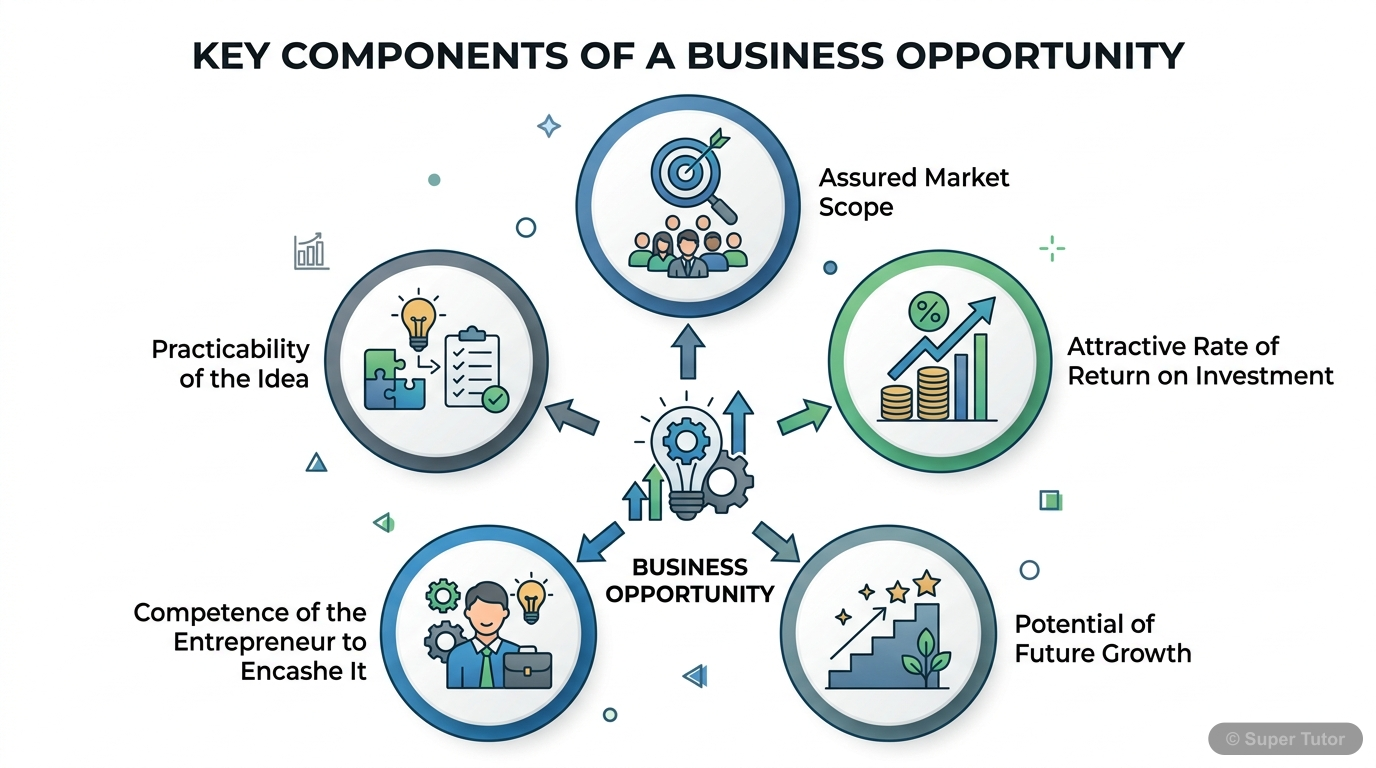
Learn better with visuals Super Tutor pairs illustrations like this with notes and quizzes for Entrepreneurial Opportunity.
Overview
Entrepreneurial opportunity represents the foundation of successful business ventures. As Peter Drucker stated, 'The best way to predict the future is to create it.' This chapter explores how entrepreneurs identify, evaluate, and convert ideas into viable business opportunities through systematic en
Key Concepts
An economic idea that can be
An economic idea that can be implemented to create a business enterprise and earn profits. It requires assured market scope, attractive return on inve
Careful monitoring of internal and external
Careful monitoring of internal and external organizational environment to detect early signs of opportunities and threats. Involves systematic collect
Framework analyzing Political
Framework analyzing Political, Economic, Social, Technological, Ecological, and Legal factors affecting business environment. Provides comprehensive e
Convenient frames of reference for streamlining
Convenient frames of reference for streamlining idea generation process. Include natural resources, existing products, market-driven ideas, trading op
Five
Five-stage process: Idea germination, Preparation, Incubation, Illumination, and Verification. Transforms initial concepts into viable business soluti
Learning Objectives
- Understand the concept and elements of business opportunity
- Identify factors involved in sensing entrepreneurial opportunities
- Master environment scanning techniques for opportunity identification
- Explore various sources of business ideas and idea fields
- Learn the transformation process from ideas to opportunities
Frequently Asked Questions
What are the important topics in Entrepreneurial Opportunity for CBSE Class 12 Entrepreneurship?
Sources & Official References
- NCERT Official — ncert.nic.in
- CBSE Academic — cbseacademic.nic.in
- CBSE Official — cbse.gov.in
- National Education Policy 2020 — education.gov.in
Content is aligned to the official syllabus. Refer to the board website for the latest curriculum.
More resources for Entrepreneurial Opportunity
For serious students
Get the full Entrepreneurial Opportunity chapter — start free.
Quizzes, flashcards, an AI doubt solver and a study plan for CBSE Class 12 Entrepreneurship. Free to start, no card needed.