Chapter 1 of 6
NCERT Solutions

Entrepreneurial Opportunity

CBSE · Class 12 · Entrepreneurship

NCERT Solutions for Entrepreneurial Opportunity — CBSE Class 12 Entrepreneurship.

5 concepts

Interactive on Super Tutor

Studying Entrepreneurial Opportunity? Get the full interactive chapter.

Quizzes, flashcards, AI doubt-solver and a step-by-step study plan — built for ncert solutions and more.

1,000+ Class 12 students started this chapter today

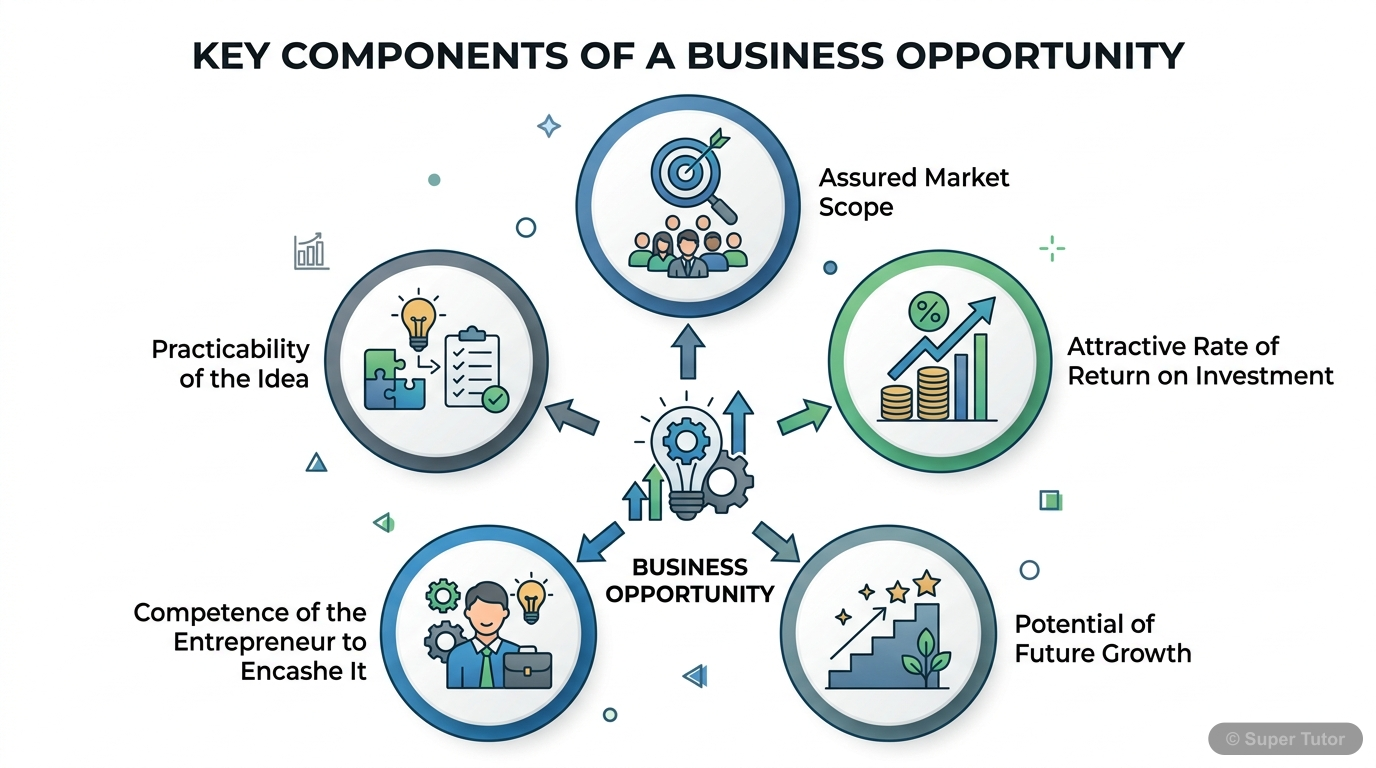
A diagram illustrating the five key elements that define a viable business opportunity: assured market scope, attractive rate of return, practicability, entrepreneur's competence, and potential for fu
Super Tutor

Learn better with visuals Super Tutor has hundreds of illustrations like this across every chapter — all free to try.

Get started
50 Questions Solved · 10 Sections

Review Crossword Puzzle

Across-1The recipient of a service/product obtained from a seller.Show solution
Answer: CUSTOMER
A customer is the person who receives a product or service from a seller in exchange for money or other consideration.
Across-3Someone who organizes a business venture and assumes the risk for it.Show solution
Answer: ENTREPRENEUR
An entrepreneur is an individual who organizes, manages, and assumes the risks of a business enterprise.
Across-6Set of circumstances that make it possible to do something.Show solution
Answer: OPPORTUNITY
An opportunity is a set of favourable circumstances that creates a need for a new product, service, or business.
Across-9Process through which something becomes different.Show solution
Answer: CHANGE
Change refers to the process through which something becomes different from what it was before.
Across-12Make changes in something established, especially by introducing new methods.Show solution
Answer: REFORM
To reform means to make changes in something established, especially by introducing new methods, ideas, or products.
Across-13Synonym for feasible.Show solution
Answer: VIABLE
Viable is a synonym for feasible, meaning something that is capable of working successfully.
Across-14The ability to plan the future with wisdom/imagination.Show solution
Answer: VISION
Vision is the ability to think about or plan the future with imagination or wisdom.
Down-2Synonym of inventiveness.Show solution
Answer: CREATIVITY
Creativity is the synonym of inventiveness — the use of imagination or original ideas to create something new.
Down-4An economic or productive factor required to accomplish an activity.Show solution
Answer: RESOURCE
A resource is an economic or productive factor required to accomplish an activity, such as land, labour, or capital.
Down-5A sum of money saved or made available for a particular purpose.Show solution
Answer: FUND
A fund is a sum of money saved or made available for a particular purpose.
Down-7Financial gain.Show solution
Answer: PROFIT
Profit is the financial gain obtained when the revenue earned exceeds the costs incurred in a business.
Down-8The ability to do something well; expertise.Show solution
Answer: SKILL
Skill refers to the ability to do something well, acquired through training or experience.
Down-9Synonym of rivalry.Show solution
Answer: COMPETITION
Competition is the synonym of rivalry — the activity of competing against others in the market.
Down-10Something that can be offered to a market that might satisfy a want or need.Show solution
Answer: PRODUCT
A product is anything that can be offered to a market to satisfy a want or need.
Down-11Amount invested in business.Show solution
Answer: CAPITAL
Capital refers to the amount of money or assets invested in a business to generate income.

Let's Revise — A. Very Short Answers

A1What is a business opportunity?Show solution
Given: We need to define business opportunity in not more than 15 words.

Answer: A business opportunity is a favourable set of circumstances that creates a need for a new product, service, or business, offering the potential for profit.
A2What factors are involved in the process of sensing an entrepreneurial opportunity?Show solution
Answer: The key factors involved in sensing an entrepreneurial opportunity are:
1. Ability to perceive and identify a need or problem.
2. Knowledge of the environment (market, technology, society).
3. Creativity and innovative thinking.
A3Define the term environment scanning.Show solution
Answer: Environment scanning is the process of gathering, analysing, and interpreting information about the external and internal environment to identify opportunities and threats that may affect a business.
A4List the environmental factors affecting external environment.Show solution
Answer: The environmental factors affecting the external environment are:
1. Political factors
2. Economic factors
3. Social factors
4. Technological factors
5. Environmental (ecological) factors
6. Legal factors

(These are collectively known as the PESTEL factors.)
A5What is the meaning of trend spotting?Show solution
Answer: Trend spotting means identifying and recognising emerging patterns or changes in the market, society, or technology that can be converted into a business opportunity before they become mainstream.
A6What is required to convert an idea into opportunity?Show solution
Answer: To convert an idea into an opportunity, an entrepreneur requires:
- A genuine market need or problem.
- Feasibility (technical and financial viability).
- Adequate resources and creative thinking to develop the idea into a viable business proposition.
A7What is Idea generation?Show solution
Answer: Idea generation is the creative process of identifying, developing, and communicating new concepts or solutions. It is the first step in entrepreneurship where potential business ideas are produced through observation, research, brainstorming, or experience.

Let's Revise — B. Short Answers (up to 50 words)

B1What is the purpose to scan the environment?Show solution
Purpose of Environment Scanning:

The purpose of environment scanning is to:
- Identify business opportunities and potential threats in the external environment.
- Help entrepreneurs make informed decisions.
- Understand market trends, customer needs, competition, and regulatory changes.
- Enable the entrepreneur to align business strategies with the changing environment for sustainable growth.
B2What are the factors involved in sensing opportunities?Show solution
Factors Involved in Sensing Opportunities:

1. Ability to perceive change – Recognising shifts in market, technology, or society.
2. Knowledge and experience – Prior industry knowledge helps spot gaps.
3. Creativity – Thinking of new solutions to existing problems.
4. Environment scanning – Systematic analysis of external factors (PESTEL).
5. Networking – Interactions with people reveal unmet needs.
B3Draw the enterprise process diagram.Show solution
Enterprise Process Diagram:

The enterprise process can be represented as follows:

Idea GenerationOpportunity SensingIdea Fields / FeasibilityBusiness PlanResource MobilisationEnterprise Launch\text{Idea Generation} \rightarrow \text{Opportunity Sensing} \rightarrow \text{Idea Fields / Feasibility} \rightarrow \text{Business Plan} \rightarrow \text{Resource Mobilisation} \rightarrow \text{Enterprise Launch}

Explanation of steps:
- Idea Generation: Creative thinking to produce new ideas.
- Opportunity Sensing: Evaluating which ideas represent real market opportunities.
- Feasibility Study: Checking technical, financial, and market viability.
- Business Plan: Detailed plan for execution.
- Resource Mobilisation: Arranging finance, manpower, and materials.
- Enterprise Launch: Starting the business.
B4What is PESTEL model? Explain it.Show solution
PESTEL Model:

PESTEL is a framework used for environment scanning. It stands for:

| Letter | Factor | Meaning |
|--------|--------|---------|
| P | Political | Government policies, stability, taxation |
| E | Economic | GDP, inflation, interest rates, income levels |
| S | Social | Demographics, culture, lifestyle changes |
| T | Technological | Innovation, R&D, automation |
| E | Environmental | Ecological concerns, sustainability |
| L | Legal | Laws, regulations, consumer protection |

Entrepreneurs use PESTEL to analyse the macro-environment and identify opportunities and threats before starting or expanding a business.

Let's Revise — C. Short Answers (up to 75 words)

C1Enlist the various sources which lead to the emergence of basic ideas.Show solution
Sources Leading to Emergence of Basic Ideas:

1. Personal experience – Problems faced in daily life inspire solutions.
2. Observation – Watching market gaps and consumer behaviour.
3. Existing products/services – Improving upon what already exists.
4. Research and Development (R&D) – Scientific discoveries leading to new products.
5. Trade fairs and exhibitions – Exposure to new products and technologies.
6. Brainstorming – Group discussions generating creative ideas.
7. Newspapers, magazines, internet – Keeping up with trends.
8. Feedback from customers – Identifying unmet needs.
C2Write the meaning of product identification in terms of business opportunity.Show solution
Product Identification:

Product identification refers to the process by which an entrepreneur identifies a product or service that can satisfy an existing market need or solve a problem. It involves:
- Recognising a gap in the market.
- Assessing whether the product is technically and financially feasible.
- Determining whether customers will pay for it.

It is a critical step in converting a business idea into a viable opportunity, ensuring the product has demand and profitability potential.
C3What are the factors an entrepreneur has to keep in mind whilst assessing the market?Show solution
Factors for Market Assessment:

While assessing the market, an entrepreneur must consider:
1. Market size – Total potential customers available.
2. Competition – Number and strength of existing competitors.
3. Customer needs – What the target customers want.
4. Pricing – Willingness of customers to pay.
5. Market trends – Growth or decline of the market.
6. Distribution channels – How the product will reach customers.
7. Entry barriers – Legal, financial, or technological obstacles.
C4What are the various ways in which an entrepreneur spots trends?Show solution
Ways to Spot Trends:

An entrepreneur can spot trends through:
1. Reading trade journals, newspapers, and magazines – Staying updated with industry news.
2. Attending trade fairs and exhibitions – Observing new products and technologies.
3. Networking – Interacting with industry experts and customers.
4. Market research – Conducting surveys and analysing data.
5. Social media monitoring – Tracking popular topics and consumer discussions.
6. Observing lifestyle changes – Noticing shifts in consumer behaviour and preferences.
7. Consulting trend-spotting agencies – Professional firms that analyse market movements.

Let's Revise — D. Long Answers (up to 150 words)

D1"An opportunity may be derived from the needs and problems of the society." Comment.Show solution
Introduction:
Every society has needs, problems, and challenges. An alert entrepreneur observes these and converts them into business opportunities.

Explanation:

1. Needs of Society:
Society constantly needs goods and services — food, clothing, healthcare, education, entertainment. Entrepreneurs who identify these needs and provide solutions create successful businesses. For example, the need for affordable healthcare led to the growth of generic medicine companies.

2. Problems of Society:
Problems such as pollution, traffic congestion, unemployment, and lack of clean water present opportunities. For instance, the problem of plastic waste gave rise to eco-friendly packaging businesses.

3. Changing Needs:
As society evolves, new needs emerge. Urbanisation created demand for ready-to-eat food; digitalisation created demand for cybersecurity services.

4. Gap Between Demand and Supply:
When existing products/services fail to meet needs adequately, entrepreneurs fill the gap.

Conclusion:
Thus, societal needs and problems are fertile ground for entrepreneurial opportunities. A sensitive and observant entrepreneur can always find an opportunity hidden within a problem.
D2"Sensitivity to environmental factors is essential for an entrepreneur." In light of above statement explain the importance of environment scanning.Show solution
Introduction:
Environment scanning is the systematic process of monitoring and analysing the external environment to identify opportunities and threats. Sensitivity to environmental factors is crucial for entrepreneurial success.

Importance of Environment Scanning:

1. Identifying Opportunities:
Scanning helps entrepreneurs spot emerging trends, new markets, and unmet needs before competitors do.

2. Recognising Threats:
It helps identify potential threats such as new competitors, changing regulations, or economic downturns, allowing timely action.

3. Informed Decision-Making:
With accurate environmental information, entrepreneurs make better strategic decisions regarding investment, product development, and market entry.

4. Adapting to Change:
Rapid changes in technology, consumer preferences, and laws require constant monitoring. Environment scanning ensures the entrepreneur adapts proactively.

5. Competitive Advantage:
Entrepreneurs who scan the environment regularly stay ahead of competitors by anticipating changes.

6. Resource Allocation:
It helps in efficient allocation of resources by focusing on high-potential areas.

Conclusion:
Thus, environment scanning is not merely useful but essential for entrepreneurial survival and growth in a dynamic business world.
D3Entrepreneurship does not emerge and grow spontaneously. Rather it is dependent upon several various environmental factors. Explain them.Show solution
Introduction:
Entrepreneurship is shaped by the environment in which it operates. Various environmental factors either encourage or hinder entrepreneurial activity.

Environmental Factors Affecting Entrepreneurship:

1. Political Factors:
Government stability, policies, taxation, and support schemes (like Startup India) directly influence entrepreneurship. A supportive political environment encourages new ventures.

2. Economic Factors:
Availability of capital, interest rates, inflation, and purchasing power affect business viability. A growing economy provides more opportunities.

3. Social Factors:
Cultural attitudes towards risk-taking, education levels, urbanisation, and demographic changes influence entrepreneurial activity. Societies that respect entrepreneurs produce more of them.

4. Technological Factors:
Advancements in technology create new industries and disrupt old ones. Internet and mobile technology have spawned thousands of startups.

5. Environmental/Ecological Factors:
Growing awareness of sustainability has created opportunities in green energy, organic farming, and eco-friendly products.

6. Legal Factors:
Ease of doing business, intellectual property laws, and labour regulations affect how easily entrepreneurs can start and run businesses.

Conclusion:
All these factors are interrelated and collectively shape the entrepreneurial ecosystem. A favourable environment accelerates entrepreneurship while an unfavourable one suppresses it.
D4Explain creative process.Show solution
Introduction:
Creativity is the foundation of entrepreneurship. The creative process is the sequence of steps through which a new idea is born and developed.

Stages of the Creative Process:

1. Preparation:
The entrepreneur gathers information, studies the problem, and acquires relevant knowledge. This stage involves research, observation, and learning.

2. Investigation:
The entrepreneur deeply investigates the problem or opportunity. He/she analyses existing solutions and identifies gaps.

3. Transformation:
The collected information is processed mentally. The entrepreneur looks for patterns, connections, and possible solutions.

4. Incubation:
The idea is allowed to develop subconsciously. The entrepreneur steps back and lets the mind work on the problem without direct effort. Insights often emerge unexpectedly.

5. Illumination (Eureka Moment):
A sudden flash of insight occurs — the creative idea emerges clearly.

6. Verification:
The idea is tested, evaluated, and refined to check its feasibility and practicality.

7. Implementation:
The verified idea is put into action and converted into a product, service, or business.

Conclusion:
The creative process is not always linear; it may involve going back and forth between stages. However, following this process systematically increases the chances of generating viable entrepreneurial ideas.
D5What is Innovation and explain the elements of innovation process?Show solution
Innovation — Meaning:
Innovation is the process of translating an idea or invention into a product or service that creates value for which customers will pay. It involves introducing something new or significantly improved — a product, process, service, or business model.

Innovation ≠ Invention: Invention is creating something new; innovation is making it commercially useful.

Elements of the Innovation Process:

1. Idea Generation:
The starting point — generating creative ideas through observation, R&D, customer feedback, or brainstorming.

2. Opportunity Recognition:
Evaluating which ideas represent genuine market opportunities with commercial potential.

3. Feasibility Analysis:
Assessing technical, financial, and market feasibility of the idea.

4. Development:
Converting the idea into a prototype or pilot model. Testing and refining the concept.

5. Commercialisation:
Launching the innovation in the market — production, marketing, and distribution.

6. Diffusion:
The innovation spreads and is adopted widely by the market.

Conclusion:
Innovation is the engine of entrepreneurship. Entrepreneurs who innovate continuously create sustainable competitive advantages and drive economic growth.

Let's Revise — E. Very Long Answers (up to 250 words)

E1Elaborate the factors involved in sensing opportunities.Show solution
Introduction:
Sensing an entrepreneurial opportunity is the ability to identify a gap between what is currently available in the market and what could be offered. Several factors enable an entrepreneur to sense opportunities effectively.

Factors Involved in Sensing Opportunities:

1. Ability to Perceive and Observe:
An entrepreneur must be observant of the environment — watching consumer behaviour, market trends, and societal changes. Many opportunities are visible to those who look carefully.

2. Knowledge and Prior Experience:
Deep knowledge of an industry or domain helps an entrepreneur recognise gaps and inefficiencies. Prior experience provides a foundation for spotting what others miss.

3. Creativity and Innovative Thinking:
Creative entrepreneurs can connect unrelated ideas and see possibilities where others see problems. Creativity transforms observations into actionable opportunities.

4. Environment Scanning:
Systematic analysis of Political, Economic, Social, Technological, Environmental, and Legal (PESTEL) factors helps identify macro-level opportunities and threats.

5. Market Research:
Conducting surveys, focus groups, and data analysis reveals unmet customer needs and market gaps.

6. Networking:
Interacting with customers, suppliers, industry experts, and other entrepreneurs provides insights into emerging needs and trends.

7. Trend Spotting:
Monitoring social, technological, and economic trends helps entrepreneurs anticipate future demand. Reading trade journals, attending exhibitions, and following social media are useful methods.

8. Problem Identification:
Every problem in society is a potential business opportunity. Entrepreneurs who identify problems and offer solutions create successful ventures.

9. Customer Feedback:
Listening to customer complaints and suggestions reveals areas where existing products/services are inadequate.

10. Sensitivity to Change:
Changes in demographics, technology, regulations, or lifestyles create new opportunities. Entrepreneurs who are sensitive to change can capitalise on these shifts early.

Conclusion:
Sensing opportunities is a combination of skill, knowledge, creativity, and environmental awareness. Entrepreneurs who develop these capabilities are better positioned to identify and exploit profitable business opportunities before their competitors.
E2Examine the sources from where business ideas emerge.Show solution
Introduction:
Business ideas are the seeds of entrepreneurship. They can emerge from a wide variety of sources. A successful entrepreneur is always alert to these sources.

Sources of Business Ideas:

1. Personal Experience and Observation:
Many entrepreneurs get ideas from their own life experiences. A problem faced personally often inspires a solution that becomes a business. For example, a person frustrated with slow internet in rural areas may start an internet service provider.

2. Existing Products and Services:
Improving upon existing products or services is a rich source of ideas. Entrepreneurs identify weaknesses in current offerings and create better alternatives.

3. Market Research:
Systematic research into consumer needs, preferences, and buying behaviour reveals unmet demands that can be addressed through new products or services.

4. Trade Fairs and Exhibitions:
Attending trade fairs exposes entrepreneurs to new technologies, products, and market trends from around the world.

5. Research and Development (R&D):
Scientific research often leads to new inventions that can be commercialised. Pharmaceutical, biotechnology, and technology industries heavily rely on R&D for new ideas.

6. Newspapers, Magazines, and Internet:
Reading widely keeps entrepreneurs informed about trends, new technologies, and market developments that can spark ideas.

7. Brainstorming:
Group brainstorming sessions encourage free thinking and generate a large number of ideas in a short time.

8. Social Problems and Needs:
Problems in society — pollution, healthcare gaps, unemployment — present opportunities for entrepreneurs to create solutions.

9. Government Policies and Schemes:
New government policies, subsidies, and schemes often open up new sectors for entrepreneurship (e.g., renewable energy, digital services).

10. Franchising:
Adopting a proven business model from another country or region is another source of business ideas.

11. Networking:
Conversations with customers, suppliers, and industry peers often reveal unmet needs and new opportunities.

12. Hobbies and Interests:
Many successful businesses have grown from personal hobbies — cooking, photography, crafts — that were turned into commercial ventures.

Conclusion:
Business ideas can emerge from virtually anywhere. The key is for the entrepreneur to remain curious, observant, and open-minded. A good idea, when combined with proper planning and execution, can become a highly successful enterprise.
E3Discuss the steps involved in the investigation of ideas.Show solution
Introduction:
Once a business idea is generated, it must be thoroughly investigated before it can be converted into a viable business opportunity. The investigation of ideas involves a systematic process of evaluation and analysis.

Steps Involved in the Investigation of Ideas:

Step 1: Idea Generation
The process begins with generating a pool of ideas through brainstorming, observation, market research, or personal experience. The entrepreneur collects as many ideas as possible without filtering.

Step 2: Preliminary Screening
The generated ideas are screened to eliminate those that are clearly impractical, illegal, or beyond the entrepreneur's capabilities. This narrows the list to a few promising ideas.

Step 3: Concept Development
The shortlisted ideas are developed into clear concepts. The entrepreneur defines what the product/service will be, who the target customers are, and what problem it solves.

Step 4: Market Feasibility Analysis
The entrepreneur analyses the market to determine:
- Size of the target market.
- Existing competition.
- Customer willingness to pay.
- Potential market share.

Step 5: Technical Feasibility Analysis
This step examines whether the idea can be technically implemented:
- Is the technology available?
- Can the product be manufactured?
- What are the production requirements?

Step 6: Financial Feasibility Analysis
The entrepreneur estimates:
- Total investment required (capital expenditure).
- Expected revenues and profits.
- Break-even point.
- Sources of funding.

Step 7: SWOT Analysis
A SWOT (Strengths, Weaknesses, Opportunities, Threats) analysis is conducted to evaluate the idea's internal strengths and weaknesses and external opportunities and threats.

Step 8: Prototype/Pilot Testing
A prototype or pilot version of the product/service is developed and tested with a small group of customers to gather feedback.

Step 9: Final Evaluation and Decision
Based on all the above analyses, the entrepreneur makes a final decision on whether to proceed with the idea, modify it, or abandon it.

Step 10: Business Plan Preparation
If the idea passes all feasibility tests, a detailed business plan is prepared covering marketing, operations, finance, and human resources.

Conclusion:
The investigation of ideas is a rigorous but essential process. It reduces the risk of failure by ensuring that only viable, well-researched ideas are pursued. A thorough investigation increases the probability of entrepreneurial success significantly.
E4What do you understand by Trend Spotting? What are the ways by which entrepreneurs can spot trends?Show solution
Trend Spotting — Meaning:
Trend spotting refers to the process of identifying emerging patterns, changes, or shifts in the market, society, technology, or consumer behaviour before they become mainstream. It is a proactive activity that helps entrepreneurs anticipate future demand and position their businesses accordingly.

Trend spotting is important because:
- It helps entrepreneurs enter markets early (first-mover advantage).
- It reduces the risk of investing in declining markets.
- It enables innovation by aligning products with future needs.

Ways by Which Entrepreneurs Can Spot Trends:

1. Reading Trade Journals, Magazines, and Newspapers:
Regularly reading industry publications, business newspapers, and magazines keeps entrepreneurs informed about the latest developments in their sector and the broader economy.

2. Attending Trade Fairs and Exhibitions:
Trade fairs showcase new products, technologies, and innovations. They provide a platform to observe what competitors and innovators are doing globally.

3. Social Media Monitoring:
Platforms like Twitter, Instagram, LinkedIn, and YouTube reflect real-time consumer interests and conversations. Trending hashtags and viral content often signal emerging consumer preferences.

4. Market Research and Surveys:
Conducting primary research through surveys, interviews, and focus groups provides direct insights into changing customer needs and preferences.

5. Networking:
Interacting with industry experts, customers, suppliers, and fellow entrepreneurs provides informal but valuable intelligence about emerging trends.

6. Observing Lifestyle Changes:
Changes in how people live, work, eat, travel, and communicate signal new business opportunities. For example, the rise of remote work created demand for home office equipment.

7. Consulting Trend-Spotting Agencies:
Professional agencies specialise in analysing macro and micro trends across industries. Entrepreneurs can use their reports to make informed decisions.

8. Analysing Government Reports and Data:
Census data, economic surveys, and government policy documents reveal demographic and economic trends that can shape future markets.

9. Studying Global Markets:
Trends often appear in developed markets before reaching developing ones. Studying international markets helps entrepreneurs anticipate what will become popular locally.

Conclusion:
Trend spotting is a vital entrepreneurial skill. Entrepreneurs who consistently monitor and analyse trends are better equipped to innovate, adapt, and build businesses that remain relevant and competitive in a rapidly changing world.
E5Explain in detail Idea Fields.Show solution
Introduction:
Idea Fields are convenient frames of reference or broad categories that help entrepreneurs systematically generate and organise business ideas. They serve as structured domains within which an entrepreneur can explore opportunities.

Meaning of Idea Fields:
Idea Fields are broad areas or sectors that act as starting points for idea generation. Instead of thinking randomly, an entrepreneur can focus on specific fields to generate relevant and practical business ideas.

Major Idea Fields:

1. Products:
This field involves creating new physical products or improving existing ones. Entrepreneurs look for gaps in the product market — what is missing, what can be made better, cheaper, or more convenient.
*Example:* Developing biodegradable packaging as an alternative to plastic.

2. Services:
Service-based ideas involve providing intangible value to customers. With increasing urbanisation and busy lifestyles, demand for services like home delivery, healthcare, education, and financial advisory is growing.
*Example:* Online tutoring platforms, home cleaning services.

3. Technology:
Technology is one of the most dynamic idea fields. Innovations in artificial intelligence, mobile applications, biotechnology, and renewable energy constantly create new entrepreneurial opportunities.
*Example:* Developing a mobile app for farmers to get real-time crop prices.

4. Markets:
This field involves identifying new or underserved markets — geographic areas, demographic groups, or customer segments that are not being adequately served.
*Example:* Providing affordable financial services to rural populations.

5. Processes:
Improving existing business processes — making them faster, cheaper, or more efficient — is another idea field. Process innovation can create significant competitive advantages.
*Example:* Automating inventory management for small retailers.

6. Social Entrepreneurship:
Addressing social problems through business models is a growing idea field. Social entrepreneurs create ventures that generate both social impact and financial returns.
*Example:* Providing affordable solar energy to off-grid villages.

Importance of Idea Fields:
- They provide a structured approach to idea generation.
- They prevent random, unfocused thinking.
- They help entrepreneurs match their skills and interests with market opportunities.
- They ensure comprehensive coverage of potential opportunity areas.

Conclusion:
Idea Fields are powerful tools for entrepreneurial thinking. By systematically exploring different fields, entrepreneurs can generate a rich pipeline of business ideas and identify the most promising opportunities for their ventures.

Let's Revise — F. Higher Order Thinking Skills (HOTS)

F1Aditi started her boutique business near an industrial area and she was not getting clients as she had expected. What are the factors which have been ignored before starting the boutique? Suggest the various factors that she has to look into before venturing into business.Show solution
Analysis of Aditi's Situation:
Aditi's boutique is not performing well because she failed to conduct proper market research and environment scanning before starting her business.

Factors Ignored by Aditi:

1. Market Research:
Aditi did not assess whether the target customers (boutique clients) exist near an industrial area. Industrial areas are typically populated by workers and factories, not the typical boutique clientele.

2. Customer Profile:
She did not identify her target customers — boutiques typically cater to women seeking fashion clothing, which may not be the dominant demographic in an industrial area.

3. Location Analysis:
Location is critical for a boutique. She should have chosen a location near residential colonies, shopping complexes, or commercial areas with higher footfall of her target customers.

4. Competition Analysis:
She did not assess the existing competition in the area.

5. Demand Assessment:
No feasibility study was conducted to determine whether there is sufficient demand for boutique services in that location.

Factors Aditi Should Look Into Before Venturing:

1. Market Feasibility: Is there sufficient demand for boutique services in the chosen area?
2. Target Customer Analysis: Who are the potential customers? What are their income levels and fashion preferences?
3. Location Selection: Choose a location with high footfall of target customers — near malls, residential areas, or colleges.
4. Competition: How many boutiques already exist? What is their pricing and quality?
5. Financial Planning: Estimate startup costs, monthly expenses, and expected revenue.
6. PESTEL Analysis: Consider social trends (fashion preferences), economic conditions (disposable income), and legal requirements (shop registration, GST).
7. Pricing Strategy: Set prices that are competitive and acceptable to the target market.

Conclusion:
Aditi's failure highlights the importance of thorough market research and environment scanning before starting a business. A well-researched business plan could have prevented this situation.
F2Mr. Raghav had always wanted to manufacture an innovative, energy efficient fan. He was looking into various options and has finally narrowed it down to one option. He understands that the entire idea would have to follow a process. Identify and explain the process.Show solution
Identification of the Process:
Mr. Raghav's idea of manufacturing an innovative, energy-efficient fan needs to go through the Creative Process (also linked to the Innovation Process).

The Creative Process — Explained:

Stage 1: Preparation
Mr. Raghav gathers all relevant information about fan manufacturing, energy efficiency technologies, existing products in the market, and customer preferences. He studies competitors and researches materials and technologies.

Stage 2: Investigation
He deeply investigates the problem — why existing fans are energy-inefficient, what technologies can improve efficiency (e.g., BLDC motors), and what customers want.

Stage 3: Transformation
He processes all the gathered information and begins to connect ideas — combining knowledge of motor technology, aerodynamics, and design to conceptualise the innovative fan.

Stage 4: Incubation
He allows the idea to develop subconsciously. During this period, he may not actively work on it but his mind continues to process the information.

Stage 5: Illumination
A breakthrough moment occurs — Mr. Raghav arrives at a clear, specific idea for the energy-efficient fan design.

Stage 6: Verification
The idea is tested for feasibility:
- Technical feasibility: Can it be manufactured?
- Financial feasibility: Is it cost-effective?
- Market feasibility: Will customers buy it?

Stage 7: Implementation
The verified idea is put into action — a prototype is built, tested, refined, and finally manufactured for the market.

Conclusion:
Mr. Raghav's journey from idea to product follows the creative process. By systematically following each stage, he increases the likelihood of successfully bringing his innovative fan to market.
F3These are 'convenient frames of reference for streamlining the process of generation of ideas.' Identify them and explain any three briefly.Show solution
Identification:
The statement refers to Idea Fields — broad categories or domains that serve as convenient frames of reference for systematically generating business ideas.

Explanation of Any Three Idea Fields:

1. Products:
This idea field focuses on creating new physical products or improving existing ones. Entrepreneurs explore what products are missing in the market, what existing products have flaws, and how they can be made better, cheaper, or more sustainable.

*Example:* An entrepreneur noticing the problem of plastic waste may develop biodegradable packaging products.

2. Services:
This field involves providing intangible value to customers. With changing lifestyles and urbanisation, there is growing demand for services such as online education, healthcare delivery, home maintenance, and financial planning.

*Example:* An entrepreneur may start an app-based home cleaning service to address the need of busy urban professionals.

3. Technology:
Technology is one of the most rapidly evolving idea fields. Innovations in artificial intelligence, mobile technology, biotechnology, and renewable energy continuously create new entrepreneurial opportunities.

*Example:* Developing a mobile application that connects farmers directly with buyers, eliminating middlemen and improving farmer income.

Conclusion:
Idea Fields provide a structured approach to idea generation. By focusing on specific fields, entrepreneurs can generate targeted, relevant, and commercially viable business ideas more efficiently.
F4Varun decided to start his own venture and was looking into various ideas. Explain to him various sources from where he can get some good business ideas.Show solution
Introduction:
Varun can find good business ideas from a variety of sources. The key is to remain observant, curious, and open to possibilities.

Sources of Business Ideas for Varun:

1. Personal Experience:
Varun should reflect on problems he has personally faced. Personal frustrations often inspire the best business ideas because the entrepreneur deeply understands the problem.

2. Observation of Market Gaps:
By observing daily life — shopping, commuting, eating — Varun can identify services or products that are missing or inadequate.

3. Existing Products and Services:
Varun can look at existing products and think about how to improve them — better quality, lower price, more convenience, or eco-friendliness.

4. Trade Fairs and Exhibitions:
Attending trade fairs will expose Varun to new products, technologies, and business models from across the country and world.

5. Market Research:
Conducting surveys and interviews with potential customers will reveal unmet needs and preferences.

6. Newspapers, Magazines, and Internet:
Reading business publications and following industry news will keep Varun informed about emerging trends and opportunities.

7. Social Problems:
Problems in society — waste management, healthcare access, education quality — are potential business opportunities for Varun.

8. Government Policies:
New government schemes and policies (e.g., renewable energy subsidies, digital India initiatives) open up new sectors for entrepreneurship.

9. Networking:
Talking to customers, suppliers, and other entrepreneurs will provide informal but valuable insights into market needs.

10. Hobbies and Interests:
Varun's personal hobbies or passions can be turned into a business — cooking, photography, fitness, or technology.

Conclusion:
Business ideas are everywhere. Varun needs to be observant, proactive, and willing to explore multiple sources. Once he has a list of ideas, he should evaluate them for feasibility and market potential before making a final decision.

Let's Revise — G. Evaluation and Multi-Disciplinary Questions

G1'Environmental factors exert influence upon each other and do not operate in isolation.' Discuss.Show solution
Introduction:
The business environment is a complex web of interrelated factors. No single environmental factor operates independently — each influences and is influenced by others.

Discussion:

1. Political and Economic Factors:
Government policies (political) directly affect the economy. For example, a government decision to reduce corporate tax (political) stimulates investment and economic growth (economic). Similarly, economic recession may force governments to change fiscal policies.

2. Economic and Social Factors:
Economic growth increases disposable income, which changes social behaviour — people spend more on lifestyle, education, and entertainment. Conversely, social trends (like preference for organic food) create new economic markets.

3. Technological and Economic Factors:
Technological innovation drives economic growth by creating new industries and improving productivity. The rise of e-commerce (technology) transformed retail economics globally.

4. Social and Legal Factors:
Changing social attitudes (e.g., growing awareness of gender equality) lead to new laws (e.g., maternity benefit laws, anti-discrimination legislation). Legal changes in turn shape social norms.

5. Environmental and Political Factors:
Growing environmental concerns (ecological) pressure governments to enact environmental laws (legal/political), which in turn affect industries and economic activity.

6. Technological and Legal Factors:
New technologies (like cryptocurrency or drones) require new legal frameworks. Laws then shape how technology is developed and used.

Real-Life Example:
The COVID-19 pandemic illustrates this interconnection perfectly:
- A health (social/environmental) crisis led to economic recession (economic).
- Governments imposed lockdowns (political/legal).
- Technology (video conferencing, e-commerce) became critical (technological).
- New laws on remote work and data privacy emerged (legal).

Conclusion:
Environmental factors form an integrated system. Entrepreneurs must adopt a holistic approach to environment scanning, understanding how changes in one factor ripple through others. Ignoring this interconnectedness can lead to poor strategic decisions and business failure.
G2"If you don't adapt, you don't endure." Evaluate the validity of the statement.Show solution
Introduction:
The statement 'If you don't adapt, you don't endure' captures a fundamental truth about business survival. In a rapidly changing world, adaptability is not optional — it is essential.

Evaluation of the Statement:

1. Changing Consumer Preferences:
Consumer tastes and preferences change continuously. Businesses that fail to adapt their products and services to evolving customer needs lose market share. *Example:* Kodak failed to adapt to digital photography and went bankrupt, while companies like Canon adapted and survived.

2. Technological Disruption:
Technology changes industries rapidly. Companies that embrace new technologies thrive; those that resist them perish. *Example:* Taxi companies that adopted app-based booking (like Ola and Uber) survived the digital disruption, while traditional taxi services declined.

3. Regulatory Changes:
Governments regularly change laws and regulations. Businesses must adapt their operations to comply with new rules or face penalties and closure.

4. Economic Fluctuations:
Economic cycles bring periods of growth and recession. Businesses that adapt their cost structures, pricing, and strategies during downturns survive, while rigid businesses fail.

5. Competition:
New competitors constantly enter markets with better products, lower prices, or innovative business models. Businesses must continuously innovate and improve to remain competitive.

6. Social and Cultural Changes:
Shifts in social values (e.g., sustainability, health consciousness) require businesses to adapt their offerings. *Example:* Food companies that introduced healthier options adapted to changing consumer health awareness.

Historical Evidence:
Charles Darwin's principle of 'survival of the fittest' applies equally to business — it is not the strongest or most intelligent that survive, but those most responsive to change.

Conclusion:
The statement is entirely valid. In today's VUCA (Volatile, Uncertain, Complex, Ambiguous) world, adaptability is the most critical trait for entrepreneurial and business survival. Entrepreneurs who continuously scan the environment, embrace change, and innovate are the ones who endure and prosper. Those who resist change are eventually rendered obsolete.

Let's Revise — H. Application-Based Questions

H1Vinay was a young entrepreneur who wanted to start a new business with an initial investment of 25 lakhs. He was not sure of what business he has to undertake. His friend suggested seeking the help of professionals who would spot the latest trends in the market and give him an idea, but Vinay decided to do it by himself. Suggest the various ways by which he can do it.Show solution
Introduction:
Vinay wants to identify the latest market trends on his own. This is a commendable approach as it will also help him develop entrepreneurial skills. Here are the various ways Vinay can spot trends by himself:

Ways Vinay Can Spot Trends:

1. Reading Trade Journals, Newspapers, and Business Magazines:
Vinay should regularly read publications like Economic Times, Business Today, Forbes India, and industry-specific journals. These provide up-to-date information on market trends, new technologies, and emerging sectors.

2. Social Media Monitoring:
Vinay can follow trending topics on Twitter, Instagram, LinkedIn, and YouTube. Consumer discussions, viral products, and popular content often signal emerging trends. He can use tools like Google Trends to track what people are searching for.

3. Attending Trade Fairs and Exhibitions:
Vinay should attend industry trade fairs, startup expos, and business exhibitions. These events showcase the latest products, technologies, and innovations, giving him a clear picture of where markets are heading.

4. Market Research and Surveys:
Vinay can conduct his own surveys in his target market to understand what consumers need, what problems they face, and what they are willing to pay for. This primary research is highly valuable.

5. Networking:
Vinay should actively network with other entrepreneurs, industry professionals, customers, and suppliers. Conversations often reveal unmet needs and emerging opportunities that are not yet publicly visible.

6. Observing Lifestyle Changes:
By simply observing how people around him live, shop, eat, and communicate, Vinay can identify changing preferences. For example, the growing preference for healthy food, online shopping, or sustainable products.

7. Analysing Government Reports and Policies:
Government economic surveys, census data, and new policy announcements (like PLI schemes, Digital India, Green Energy Mission) indicate sectors that are likely to grow.

8. Studying Successful Startups:
Vinay can study recently successful startups in India and globally to understand what problems they solved and what trends they capitalised on.

9. Visiting Retail Stores and Online Marketplaces:
Browsing popular e-commerce platforms like Amazon, Flipkart, and Meesho reveals what products are trending, what customers are reviewing positively, and what gaps exist.

Conclusion:
With an investment of ₹25 lakhs, Vinay has a good foundation to start a business. By using the above methods to spot trends himself, he will not only save the cost of professional consultants but also develop a deeper understanding of the market, which will be invaluable for running his business successfully.

Let's Revise — I. Activities

I1Interview an entrepreneur, ask him/her the keys to successful entrepreneurship. Also ask him/her whether he/she attributes the success of his business to luck or hard work.Show solution
Activity Guidelines:

Objective: To understand real-world entrepreneurial experience and the factors behind business success.

Suggested Interview Questions:
1. What motivated you to become an entrepreneur?
2. What do you consider the most important qualities of a successful entrepreneur?
3. What were the biggest challenges you faced when starting your business?
4. How did you identify your business opportunity?
5. Do you attribute your success more to luck, hard work, or a combination of both? Please explain.
6. What advice would you give to young aspiring entrepreneurs?

Expected Findings (Sample):
Most successful entrepreneurs are likely to say that while luck may play a small role (being in the right place at the right time), sustained success is primarily the result of:
- Hard work and perseverance.
- Continuous learning and adaptation.
- Strong customer focus.
- Effective planning and execution.
- Building a good team.

Conclusion:
This activity helps students understand that entrepreneurship is not about luck — it is about preparation, hard work, creativity, and resilience. As the saying goes: 'Luck is what happens when preparation meets opportunity.'
I2Conduct a survey in your colony by asking people if they face any particular problem and see if you can find a solution to that problem.Show solution
Activity Guidelines:

Objective: To identify real problems in the community and develop entrepreneurial solutions.

Steps to Conduct the Survey:

Step 1: Design a Questionnaire
Prepare 5–8 simple questions such as:
- What daily problems do you face in the colony?
- Are you satisfied with waste disposal/water supply/transportation?
- What service do you wish was available in the colony?
- Would you pay for a solution to this problem?

Step 2: Conduct the Survey
Interview at least 20–30 residents of the colony. Record their responses carefully.

Step 3: Analyse the Data
Identify the most commonly mentioned problems. Rank them by frequency and severity.

Step 4: Identify a Solution
For the top problem identified, brainstorm possible solutions. Evaluate each solution for:
- Feasibility (can it be done?)
- Cost (is it affordable?)
- Demand (will people pay for it?)

Sample Finding:
*Problem identified:* Irregular garbage collection leading to waste accumulation.
*Proposed Solution:* Start a door-to-door waste collection and segregation service, charging a small monthly fee per household.

Conclusion:
This activity demonstrates that entrepreneurial opportunities exist in everyday community problems. A simple survey can reveal genuine market needs that can be addressed through a viable business venture.
I3Think of an innovative product and conduct a survey in your colony and analyse whether it will be accepted in your neighbourhood. (For example, new Idea for waste disposal)Show solution
Activity Guidelines:

Objective: To test the market acceptance of an innovative product idea through primary research.

Step 1: Identify an Innovative Product
*Example Product:* A Smart Compost Bin — a compact, odour-free bin for households to convert kitchen waste into compost at home, which can be used for gardening.

Step 2: Design a Survey Questionnaire
Prepare questions such as:
1. Do you currently segregate your household waste?
2. Are you aware of composting?
3. Would you be interested in a compact home composting bin?
4. How much would you be willing to pay for it? (₹500 / ₹1000 / ₹1500)
5. Would you use the compost for home gardening?

Step 3: Conduct the Survey
Survey at least 25–30 households in the colony. Record responses systematically.

Step 4: Analyse the Results
Calculate the percentage of respondents who:
- Are aware of composting.
- Are interested in the product.
- Are willing to pay a specific price.

Step 5: Draw Conclusions
*Sample Analysis:*
- 70% of respondents were interested in the product.
- 60% were willing to pay ₹1000.
- 80% had a home garden and would use the compost.

*Conclusion:* The Smart Compost Bin has strong market acceptance in the colony. There is a viable business opportunity.

Learning Outcome:
This activity teaches students how to conduct market research, analyse data, and evaluate the commercial viability of a new product idea — core entrepreneurial skills.

Stuck on a step?

Ask Super Tutor AI to explain any solution on this page in a simpler way — free, 24x7.

Ask a Doubt Free

Frequently Asked Questions

What are the important topics in Entrepreneurial Opportunity for CBSE Class 12 Entrepreneurship?
Key topics in Entrepreneurial Opportunity include Entrepreneurial Opportunity - Complete Concept Map, Entrepreneurial Opportunity Framework, Entrepreneurial Opportunity Concept Map. These are the concepts CBSE Class 12 examiners draw on most — study them first, then practise related questions.
How to score full marks in Entrepreneurial Opportunity — CBSE Class 12 Entrepreneurship?
Start by understanding all key concepts. Practise previous year questions from this chapter. Revise formulas and definitions regularly. Use flashcards for quick revision before the exam.
Where can I get free NCERT Solutions for Entrepreneurial Opportunity Class 12 Entrepreneurship?
This page has free step-by-step NCERT Solutions for every exercise question in Entrepreneurial Opportunity (CBSE Class 12 Entrepreneurship) — written the way examiners award marks: given, formula, working, answer.

Sources & Official References

Content is aligned to the official syllabus. Refer to the board website for the latest curriculum.

For serious students

Get the full Entrepreneurial Opportunity chapter — for free.

Quizzes, flashcards, AI doubt-solver and a step-by-step study plan for CBSE Class 12 Entrepreneurship.