Entrepreneurial Opportunity — Syllabus
CBSE · Class 12 · Entrepreneurship
What Entrepreneurial Opportunity covers in CBSE Class 12 Entrepreneurship: 4 topics, for the 2026-27 session. Topics include Understanding Business.
Interactive on Super Tutor
Studying Entrepreneurial Opportunity? Get the full interactive chapter.
Quizzes, flashcards, AI doubt-solver and a step-by-step study plan — built for syllabus and more.
Free trial, no card needed.
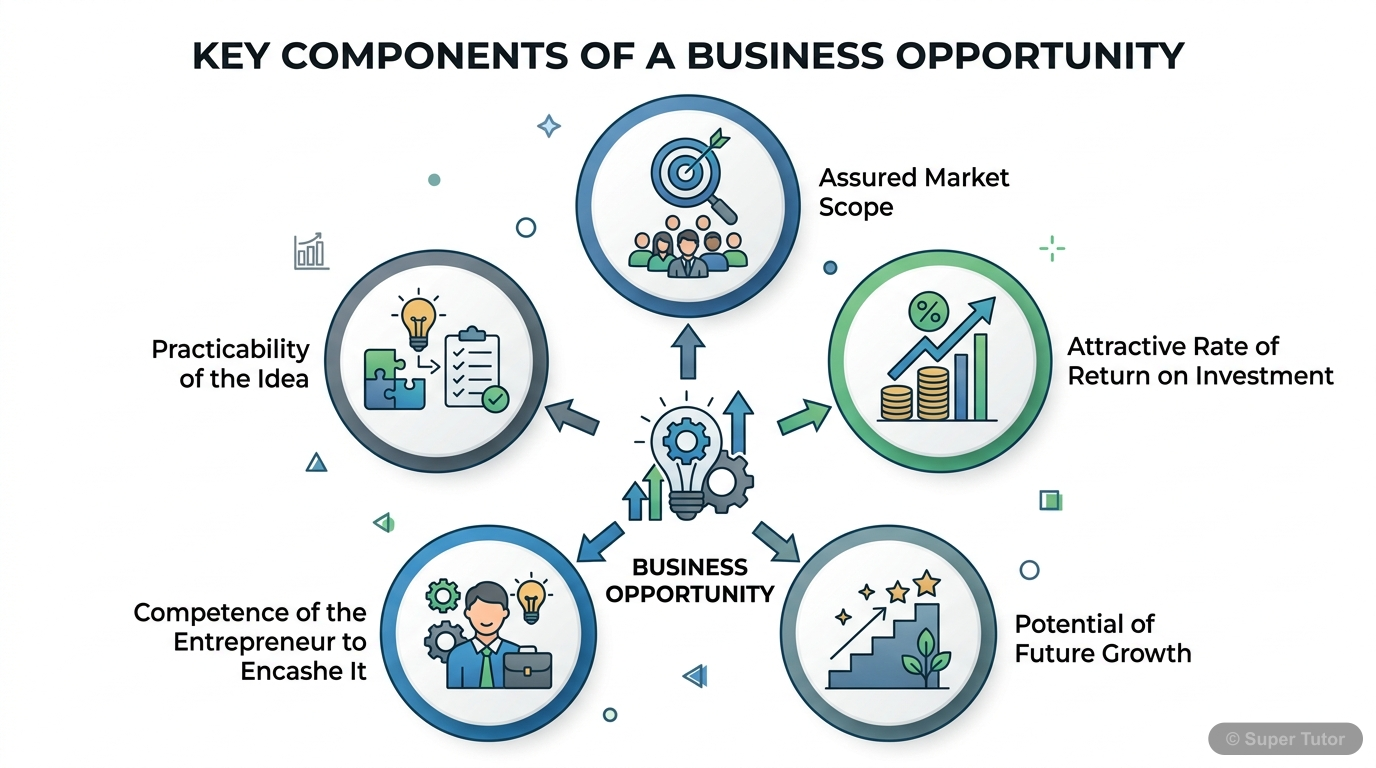
Learn better with visuals Super Tutor pairs illustrations like this with notes and quizzes for Entrepreneurial Opportunity.
Topics in Entrepreneurial Opportunity
Understanding Business Opportunities
- Business opportunity is an economic idea that can be implemented to create a business enterprise and earn profits
- Must satisfy two criteria: good market demand and attractive rate of return
- Not all ideas can be converted into opportunities - requires market analysis
Sensing and Perceiving Opportunities
- Three key factors: ability to perceive basic ideas, harness information sources, vision and creativity
- Basic ideas emerge from: problems, changes, inventions, competition, innovation
- Information sources include magazines, journals, seminars, customers, trade shows
Environment Scanning and Analysis
- Environment consists of micro (internal) and macro (external) factors
- PESTEL model: Political, Economic, Social, Technological, Ecological, Legal factors
- Benefits include: first mover advantage, strategy formulation, resource optimization, better performance
Idea Generation and Idea Fields
- Idea generation is the process of creating, developing, and communicating abstract, concrete, or visual ideas
- Six major idea fields: natural resources, existing products, market-driven ideas, trading-related ideas, service sector, creative efforts
- Natural resources can be exploited for new products (lumber to furniture, herbs to medicines)
Key Concepts
Central concept: Entrepreneurial Opportunity
Work through every topic in Entrepreneurial Opportunity with notes and quizzes
Start This ChapterFrequently Asked Questions
What are the important topics in Entrepreneurial Opportunity for CBSE Class 12 Entrepreneurship?
Sources & Official References
- NCERT Official — ncert.nic.in
- CBSE Academic — cbseacademic.nic.in
- CBSE Official — cbse.gov.in
- National Education Policy 2020 — education.gov.in
Content is aligned to the official syllabus. Refer to the board website for the latest curriculum.
More resources for Entrepreneurial Opportunity
For serious students
Get the full Entrepreneurial Opportunity chapter — start free.
Quizzes, flashcards, an AI doubt solver and a study plan for CBSE Class 12 Entrepreneurship. Free to start, no card needed.