Resource Mobilization
CBSE · Class 12 · Entrepreneurship
NCERT Solutions for Resource Mobilization — CBSE Class 12 Entrepreneurship.
Interactive on Super Tutor
Studying Resource Mobilization? Get the full interactive chapter.
Quizzes, flashcards, AI doubt-solver and a step-by-step study plan — built for ncert solutions and more.
1,000+ Class 12 students started this chapter today

Super Tutor has 25+ illustrations like this for Resource Mobilization alone — flashcards, concept maps, and step-by-step visuals.
See them allReview Crossword Puzzle
CrosswordSolve the crossword puzzle with Across and Down clues related to Resource Mobilization.Show solution
2. FLOTATION COSTS – The costs that a company incurs when it makes a new issue of either stocks or bonds.
4. BROKER – An individual or party that arranges transactions between a buyer and a seller for a commission when the deal is executed.
7. LIQUIDITY – A measure of the ability of a debtor to pay their debts as and when they fall due.
8. DEFICIT – An excess of expenditures over revenue.
9. NIFTY – An Index computed from performance of top stocks from different sectors listed on NSE.
10. SHARE CAPITAL – It constitutes the equity stake of its owners.
11. SURPLUS – Excess of revenue over expenditure.
12. ANGEL INVESTOR – Affluent individual who provides capital for business start-ups and early stage companies using a high-risk, high-return matrix usually in exchange for convertible debt or ownership equity.
DOWN:
1. INCENTIVE – Something that motivates an individual to perform an action.
3. SEED CAPITAL – The initial capital used to start a business.
5. EXPANSION – The action of becoming larger or more extensive.
6. FINANCE – The science of money management.
11. STOCK – A form of ownership that can be easily traded on a secondary market.
Section-A: Finance — Q.1 (Answer in about fifteen words)
1aWhat do you understand by finance?Show solution
Answer: Finance refers to the science of managing money, including activities of investing, borrowing, lending, budgeting, saving, and forecasting. It is the lifeblood of any business enterprise.
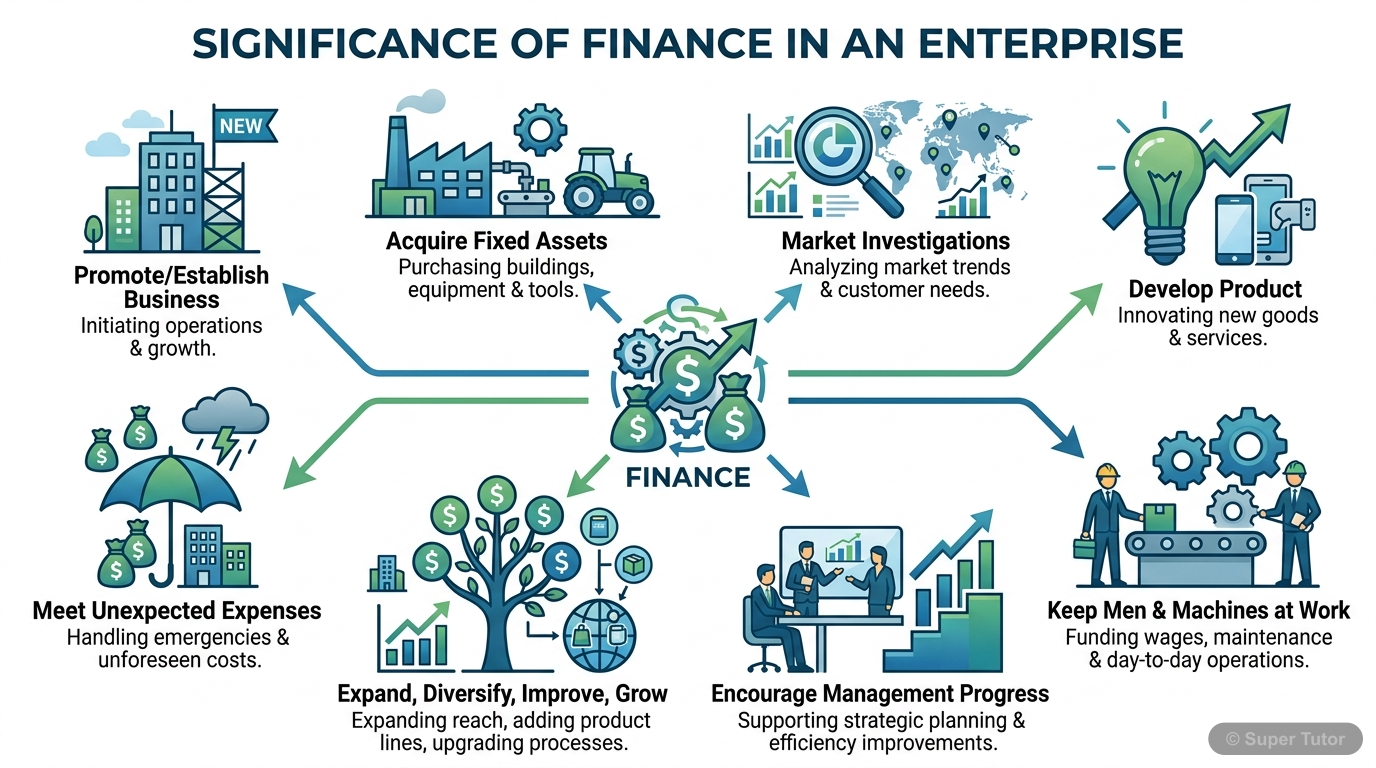
1bGive the significance of finance in an enterprise.Show solution
1cName the most important pre-requisite to start an enterprise.Show solution
1dState the most important factors for the survival of any business enterprise.Show solution
1eState how sources can broadly be classified into 2 major categories.Show solution
1. Internal Sources – funds generated from within the business (e.g., retained earnings).
2. External Sources – funds raised from outside the business (e.g., loans, equity).
1fWhat do you understand by internal sources of finance?Show solution
1gHow will you differentiate between financial market with other market? Give one difference.Show solution
1h'Production', 'Marketing', and 'Financing' – deemed as the most important factors for any business's survival rates. Among these name the most critical element and why?Show solution
Section-A: Finance — Q.2 (Answer in about fifty words)
2aWhich sources provide the supply for long-term funds?Show solution
Answer: The supply for long-term funds comes from:
1. Individual savings – personal savings of households.
2. Institutional investors – insurance companies, mutual funds, pension funds.
3. Corporate savings – retained earnings of companies.
4. Foreign investments – FDI and FII.
5. Capital markets – through issue of shares and debentures.
These sources collectively channel savings into productive long-term investments.
2bName the sources of demand for capital comes from.Show solution
1. Business enterprises – for setting up and expanding operations.
2. Government – for infrastructure and public welfare projects.
3. Individuals – for housing, education, and personal needs.
4. Entrepreneurs – for starting new ventures and innovations.
These entities require capital to fund their various short-term and long-term requirements.
2cEntrepreneur can use the capital raised for a variety of purposes, what are they?Show solution
1. Purchase of fixed assets – land, machinery, equipment.
2. Working capital – day-to-day operational expenses.
3. Research and Development – innovation and product development.
4. Expansion and diversification – entering new markets.
5. Repayment of debts – clearing existing liabilities.
6. Marketing and promotion – advertising and brand building.
2dHow can an entrepreneur raise funds by selling the issue mainly to the institutional investors?Show solution
2eHow do stock options lead to enable employees to become shareholders and share the profits of the company?Show solution
Section-A: Finance — Q.3 (Answer in about two hundred and fifty words)
3aExplain some important sources of raising finance in business.Show solution
Concept: Sources of finance can be classified as internal and external, short-term and long-term.
Important Sources of Raising Finance:
1. Retained Earnings (Internal Source):
Profits retained within the business after paying dividends. It is the cheapest and most convenient source as it does not involve any flotation cost or repayment obligation.
2. Equity Shares:
Funds raised by issuing ownership shares to the public. Shareholders become part-owners and receive dividends. It is a permanent source of capital with no repayment obligation.
3. Preference Shares:
Shares that carry a fixed dividend and have priority over equity shareholders in dividend payment and repayment of capital. They are a hybrid between equity and debt.
4. Debentures and Bonds:
Debt instruments issued to the public or institutions. The company pays a fixed rate of interest. These are long-term borrowings and must be repaid after a specified period.
5. Bank Loans and Overdrafts:
Commercial banks provide short-term and medium-term loans. Overdraft facilities help manage working capital needs.
6. Venture Capital:
Funds provided by venture capitalists to high-risk, high-growth start-ups in exchange for equity. Suitable for innovative businesses.
7. Angel Investors:
Affluent individuals who invest in early-stage companies in exchange for equity or convertible debt. They also provide mentorship.
8. Government Grants and Subsidies:
Government provides financial assistance through specialized institutions like SIDBI, NABARD, IDBI for specific sectors.
9. Microfinance and Self-Help Groups:
Small loans provided to micro-entrepreneurs, especially in rural areas.
10. Public Deposits:
Companies accept deposits from the public for a fixed period at a fixed rate of interest.
Conclusion: The choice of source depends on the nature of business, cost of funds, risk appetite, and the stage of the enterprise.
Section-B: Financial Markets — Q.1 (Answer in about fifteen words)
1aDefine capital market.Show solution
1bName the two players in the capital market.Show solution
1. Suppliers of funds – individuals, institutions, and investors who provide capital.
2. Demanders of funds – businesses, governments, and entrepreneurs who require capital.
1cIdentify the reward IPO investors seek as an appreciation of their investment.Show solution
1dIdentify the method of raising additional finance from existing shareholders by offering securities to them on pro-rata basis.Show solution
1eWhat do you understand by pro-rata allotment of securities?Show solution
1fWhat is Right Issue?Show solution
1gWhen the right issue are proposed to the existing shareholders and if they are not ready to subscribe what is the next step taken by an entrepreneur?Show solution
1hWhy right issue method of issuing securities is considered to be inexpensive?Show solution
1iWhat do you understand by private placement?Show solution
1jWhat is meant by Stock options or offering shares to the employees?Show solution
1kName the method which enables employees to become shareholders and share the profits of the company.Show solution
1lWhat is a secondary market?Show solution
1mWhat is the need of secondary market?Show solution
1nIn what forms can a company raise capital through primary market?Show solution
1. Initial Public Offer (IPO)
2. Follow-on Public Offer (FPO)
3. Rights Issue
4. Private Placement
5. Preferential Allotment
6. Employee Stock Options (ESOPs)
Section-B: Financial Markets — Q.2 (Answer in about fifty words)
2aFor what purpose is finance required right from the very beginning i.e. conceiving an idea?Show solution
1. Conceptualisation – conducting feasibility studies and market research.
2. Setting up – purchasing land, machinery, and equipment.
3. Operations – meeting day-to-day working capital needs.
4. Marketing – advertising and distribution.
5. Expansion – scaling up the business.
6. Research & Development – innovation and product improvement.
Thus, finance is needed at every stage of business.
2bWhat is the need of finance?Show solution
1. Starting a business – acquiring assets and resources.
2. Day-to-day operations – paying salaries, purchasing raw materials.
3. Expansion – entering new markets and increasing capacity.
4. Research and Development – innovation.
5. Meeting obligations – repaying loans and paying taxes.
Without finance, no business activity can be initiated, sustained, or grown.
2cAn entrepreneur is a person who bears the risks, unites various factors of production and carries out a creative innovation, and for doing all these, what is the basic requirement to be reached to this extent?Show solution
2dState some mushrooming sources of raising finance in the business.Show solution
1. Venture Capital – for high-growth start-ups.
2. Angel Investors – affluent individuals funding early-stage companies.
3. Crowdfunding – raising small amounts from a large number of people online.
4. Microfinance – small loans for micro-entrepreneurs.
5. Peer-to-Peer (P2P) Lending – online lending platforms.
6. Government Schemes – Start-up India, MUDRA loans.
Section-B: Financial Markets — Q.3 (Answer in about one hundred and fifty words)
3aState the nature of money market. Who are the major participants in the money market?Show solution
Nature of Money Market:
The money market is a component of the financial market where short-term borrowing and lending of funds takes place, typically for periods ranging from overnight to one year. It deals in highly liquid, low-risk instruments such as Treasury Bills, Commercial Papers, Certificates of Deposit, and Call Money. It is not a physical place but a mechanism for short-term fund management. The Reserve Bank of India (RBI) regulates the money market in India.
Key Characteristics:
- Deals in short-term instruments (maturity up to 1 year).
- High liquidity and safety.
- No fixed geographical location.
- Instruments are not traded on stock exchanges.
Major Participants in the Money Market:
1. Reserve Bank of India (RBI) – regulator and participant.
2. Commercial Banks – major borrowers and lenders.
3. Non-Banking Financial Companies (NBFCs).
4. Mutual Funds – invest in money market instruments.
5. Insurance Companies – invest surplus funds.
6. Primary Dealers – deal in government securities.
7. Corporate Houses – issue commercial papers.
8. Government – issues Treasury Bills.
Conclusion: The money market plays a vital role in maintaining liquidity in the economy and implementing monetary policy.
3bExplain how Capital markets are the most important source of raising finance for an entrepreneur.Show solution
Answer:
Capital markets are the most important source of raising finance for an entrepreneur because they provide access to large amounts of long-term funds required for setting up and expanding a business.
Reasons why Capital Markets are Important:
1. Access to Long-term Capital: Entrepreneurs can raise funds for periods exceeding one year through equity shares, preference shares, and debentures.
2. Variety of Instruments: Capital markets offer multiple instruments — equity, debt, hybrid — allowing entrepreneurs to choose as per their needs.
3. Large Pool of Investors: Capital markets connect entrepreneurs with millions of investors, enabling mobilisation of large sums.
4. Lower Cost of Capital: Compared to private borrowings, capital market funds can be raised at competitive rates.
5. Enhances Credibility: A company listed on the stock exchange gains credibility and visibility, attracting further investment.
6. Liquidity to Investors: Since securities are tradeable, investors are willing to invest, making it easier for entrepreneurs to raise funds.
7. Supports Growth and Expansion: Entrepreneurs can use capital market funds for R&D, expansion, and diversification.
Conclusion: Capital markets serve as the backbone of entrepreneurial finance by efficiently channelling savings into productive investments.
3cWhat do you understand by capital market? How can the capital market in India be broadly classified into different categories?Show solution
Capital Market:
Capital market is a financial market where long-term financial instruments such as equity shares, preference shares, debentures, and bonds are issued and traded. It channels the savings of individuals and institutions into long-term productive investments. It is regulated by SEBI (Securities and Exchange Board of India).
Classification of Capital Market in India:
1. Primary Market (New Issue Market):
- Where new securities are issued for the first time.
- Companies raise fresh capital directly from investors.
- Methods: IPO, FPO, Rights Issue, Private Placement.
- Money flows from investors to the company.
2. Secondary Market (Stock Exchange):
- Where previously issued securities are bought and sold.
- Examples: BSE (Bombay Stock Exchange), NSE (National Stock Exchange).
- Provides liquidity to investors.
- Money flows between investors; company does not receive funds.
Further Classification:
- Organised Market – regulated by SEBI (BSE, NSE).
- Unorganised Market – informal lending and borrowing outside regulatory framework.
Conclusion: The capital market in India is well-structured and plays a crucial role in economic development by mobilising long-term funds.
3dWrite down the sectors of organised and unorganised market.Show solution
Organised Market:
The organised market operates under a well-defined legal and regulatory framework. It is supervised by regulatory bodies like RBI and SEBI.
Sectors of Organised Market:
1. Capital Market – BSE, NSE (equity and debt instruments).
2. Money Market – Treasury Bills, Commercial Papers, Call Money.
3. Banking Sector – Commercial banks, cooperative banks.
4. Insurance Sector – LIC, GIC and private insurers.
5. Mutual Funds – UTI, SBI Mutual Fund, etc.
6. Specialised Financial Institutions – IDBI, SIDBI, NABARD, IFCI.
Unorganised Market:
The unorganised market operates outside the formal regulatory framework. It is informal and lacks legal protection.
Sectors of Unorganised Market:
1. Moneylenders – local lenders charging high interest rates.
2. Indigenous Bankers – traditional bankers (Sahukars, Shroffs).
3. Chit Funds – informal savings and credit associations.
4. Self-Help Groups (SHGs) – community-based savings groups.
5. Friends and Family – informal borrowings.
6. Pawnbrokers – loans against pledged assets.
Conclusion: While the organised market offers security and regulation, the unorganised market fills gaps especially in rural and semi-urban areas.
3eWhat is meant by primary market? Briefly explain the concept of 'Right Issue for existing companies'.Show solution
Primary Market:
The primary market, also known as the New Issue Market, is that part of the capital market where new securities are issued for the first time by companies to raise fresh capital. The funds raised go directly to the issuing company. It includes IPOs, FPOs, Rights Issues, and Private Placements.
Rights Issue for Existing Companies:
A Rights Issue is a method by which an existing company raises additional capital by offering new shares to its existing shareholders in proportion to their current shareholding (pro-rata basis).
Key Features:
1. Shares are offered at a price lower than the current market price to make it attractive.
2. Shareholders have the right but not the obligation to subscribe.
3. If shareholders do not wish to subscribe, they can renounce their rights in favour of another person.
4. It is less expensive than a public issue as it avoids heavy flotation costs.
5. It protects existing shareholders from dilution of their ownership.
Example: If a company has 1,00,000 shares outstanding and announces a 1:5 rights issue, each shareholder gets the right to buy 1 new share for every 5 shares held.
Conclusion: Rights Issue is a cost-effective and shareholder-friendly method of raising additional capital for existing companies.
Section-B: Financial Markets — Q.4 (Answer in about two hundred and fifty words)
4aAn entrepreneur can raise the required capital in the primary market. Explain the various methods of raising the funds in the primary market by an entrepreneur.Show solution
Primary Market: The primary market is where new securities are issued for the first time to raise fresh capital. The following are the various methods:
1. Initial Public Offer (IPO):
When a private company offers its shares to the general public for the first time, it is called an IPO. The company gets listed on the stock exchange after the IPO. Investors apply for shares and are allotted on pro-rata basis if oversubscribed. IPO helps raise large amounts of capital and increases the company's visibility.
2. Follow-on Public Offer (FPO):
When an already listed company issues additional shares to the public to raise more capital, it is called an FPO. It is used for expansion, debt repayment, or working capital needs.
3. Rights Issue:
Existing shareholders are offered new shares in proportion to their current holdings at a price lower than market price. It is cost-effective and protects existing shareholders from dilution.
4. Private Placement:
Securities are sold directly to a select group of institutional investors (mutual funds, insurance companies, banks) without a public offer. It is faster, cheaper, and involves less regulatory compliance.
5. Preferential Allotment:
Shares are issued to a specific group of investors (promoters, strategic investors) at a price determined by SEBI guidelines. It is used for strategic partnerships.
6. Employee Stock Option Plan (ESOP):
Shares are offered to employees at a predetermined price after a vesting period. It motivates employees and reduces cash outflow for the company.
7. Offer for Sale:
Existing shareholders (promoters) sell their shares to the public through the stock exchange mechanism. The company does not receive fresh funds; only ownership changes.
Conclusion: Each method has its own advantages and is chosen based on the company's stage, cost considerations, regulatory requirements, and the target investor group.
4bWhen an entrepreneur decides to go public and become a public company, he/she tends to be in advantageous positions and get many benefits out of it. Explain the benefits.Show solution
Benefits of Going Public (IPO):
1. Access to Large Capital:
Going public allows the company to raise large amounts of capital from a wide pool of investors. This capital can be used for expansion, R&D, debt repayment, and working capital.
2. Enhanced Credibility and Visibility:
A publicly listed company gains greater credibility in the market. It is perceived as more transparent and trustworthy by customers, suppliers, and lenders.
3. Liquidity for Existing Shareholders:
Promoters and early investors can liquidate their holdings by selling shares on the stock exchange, providing an exit route.
4. Improved Valuation:
Public companies typically receive higher valuations than private companies due to market-determined pricing and greater transparency.
5. Employee Attraction and Retention:
Public companies can offer ESOPs to attract and retain talented employees, as stock options become more valuable with listing.
6. Mergers and Acquisitions:
Listed shares can be used as currency for acquisitions, enabling the company to grow inorganically without cash outflow.
7. Brand Building:
The IPO process generates significant media attention and public awareness, acting as free marketing for the company.
8. Reduced Dependence on Debt:
By raising equity capital, the company can reduce its debt burden and improve its debt-equity ratio.
9. Better Bargaining Power:
A listed company has better negotiating power with banks, suppliers, and customers due to its public status.
10. Wealth Creation for Promoters:
Promoters' wealth increases as the market capitalisation of the company grows post-listing.
Conclusion: Going public is a significant milestone for an entrepreneur as it opens multiple avenues for growth, credibility, and wealth creation.
4cWhile there are benefits to going public, at the same time additional obligations and reporting requirements on the companies and its directors means disadvantages too. What are they? Explain.Show solution
Disadvantages of Going Public:
1. Loss of Control:
When shares are sold to the public, promoters' ownership percentage decreases. If a large number of shares are sold, promoters may lose majority control over the company's decisions.
2. Disclosure Requirements:
Public companies must disclose financial results, business strategies, and material information regularly to SEBI and stock exchanges. This reduces confidentiality and may benefit competitors.
3. High Cost of Going Public:
The IPO process involves heavy flotation costs — underwriting fees, legal fees, advertising, SEBI registration fees, and listing fees — which can be very expensive.
4. Regulatory Compliance:
Public companies must comply with SEBI regulations, Companies Act, and stock exchange listing requirements, which require significant time, effort, and resources.
5. Short-term Pressure:
Public shareholders and analysts expect quarterly results and short-term performance, which may force management to focus on short-term gains at the expense of long-term strategy.
6. Risk of Hostile Takeover:
Once shares are publicly traded, any investor can accumulate shares and attempt a hostile takeover, threatening the promoters' control.
7. Increased Accountability:
Directors and management are accountable to thousands of shareholders and must justify every major decision, limiting managerial flexibility.
8. Market Volatility:
The company's share price is subject to market fluctuations unrelated to its actual performance, which can affect the company's reputation and ability to raise further capital.
9. Time and Management Distraction:
Managing investor relations, attending AGMs, and complying with reporting requirements distracts management from core business activities.
10. Legal Liabilities:
Directors face personal legal liability for misstatements in the prospectus or non-compliance with regulations.
Conclusion: While going public offers significant benefits, entrepreneurs must carefully weigh these disadvantages before deciding to list their company.
Section-B: Financial Markets — Q.5 HOTS
5aWhy primary market is also known as new issue market? Give one reason.Show solution
Section-C: Stock Exchange — Q.1 (Answer in about fifteen words)
1aWhat are the responsibilities of governing body?Show solution
- Framing rules and regulations for trading.
- Admitting new members and securities for listing.
- Ensuring fair and transparent trading practices.
- Protecting investors' interests.
- Supervising and disciplining members.
1bName the stock exchanges where most of the stock trading in India is done.Show solution
1. BSE (Bombay Stock Exchange) – Asia's oldest stock exchange, located in Mumbai.
2. NSE (National Stock Exchange) – India's largest stock exchange by trading volume, also in Mumbai.
1cWhat is a secondary capital market?Show solution
Section-C: Stock Exchange — Q.2 (Answer in about fifty words)
2aWhat is the alternate name of stock used by different people?Show solution
1. Shares – most commonly used term in India.
2. Equity – refers to ownership stake.
3. Securities – a broader term used by regulators.
4. Scrip – used by traders on the stock exchange.
5. Holdings – used by investors to refer to their portfolio.
6. Equities – used by financial analysts and fund managers.
All these terms essentially refer to units of ownership in a company.
Section-C: Stock Exchange — Q.3 (Answer in about one hundred and fifty words)
3aExplain the importance of Stock Exchange from the viewpoint of companies.Show solution
Importance of Stock Exchange from the Viewpoint of Companies:
1. Facilitates Capital Raising:
Stock exchange provides companies a platform to raise long-term capital by issuing shares and debentures to the public through the primary market.
2. Enhances Credibility:
Listing on a recognised stock exchange enhances the company's reputation and credibility among investors, customers, and creditors.
3. Provides Liquidity:
The secondary market ensures that investors can sell their shares easily, making it easier for companies to attract investors for future capital raising.
4. Fair Valuation:
The stock exchange provides a market-determined price for the company's shares, reflecting its true value based on performance and prospects.
5. Mergers and Acquisitions:
Listed shares can be used as consideration for mergers and acquisitions, enabling companies to grow without cash outflow.
6. Improves Corporate Governance:
Listing requirements mandate disclosure and transparency, which improves the company's governance standards and management accountability.
7. Employee Motivation:
Companies can offer ESOPs to employees, whose value is determined by the stock exchange, motivating employees to perform better.
Conclusion: The stock exchange is indispensable for companies as it provides a regulated platform for capital raising, valuation, and growth.
3bExplain the importance of Stock Exchange from the viewpoint of investors.Show solution
Importance of Stock Exchange from the Viewpoint of Investors:
1. Liquidity:
The stock exchange provides investors with the ability to buy and sell securities easily, converting their investments into cash whenever needed.
2. Price Transparency:
All transactions are conducted at publicly known prices, ensuring fair dealing and preventing exploitation of investors.
3. Safety of Investment:
SEBI regulations and stock exchange rules ensure investor protection through disclosure requirements, grievance redressal, and prevention of fraudulent practices.
4. Capital Appreciation:
Investors can earn capital gains by buying shares at lower prices and selling at higher prices as the company grows.
5. Dividend Income:
Shareholders receive regular dividend income from profitable companies, providing a steady return on investment.
6. Diversification:
The stock exchange offers a wide variety of securities across sectors, enabling investors to diversify their portfolio and reduce risk.
7. Information Availability:
Listed companies are required to disclose financial results and material information, giving investors access to reliable information for decision-making.
8. Collateral Value:
Listed securities can be used as collateral for loans, providing investors additional financial flexibility.
Conclusion: The stock exchange empowers investors by providing a safe, transparent, and liquid platform for wealth creation.
3cExplain the importance of Stock Exchange from the viewpoint of society.Show solution
Importance of Stock Exchange from the Viewpoint of Society:
1. Mobilisation of Savings:
The stock exchange channels the idle savings of millions of individuals into productive investments, contributing to economic growth.
2. Capital Formation:
By facilitating investment in companies, the stock exchange promotes capital formation, which leads to industrial development and employment generation.
3. Economic Development:
Funds raised through stock exchanges are used for infrastructure, manufacturing, and services, driving overall economic development.
4. Promotes Entrepreneurship:
The availability of capital through stock markets encourages entrepreneurs to start and expand businesses, fostering innovation.
5. Employment Generation:
Companies that raise capital through stock exchanges expand their operations, creating employment opportunities for the society.
6. Indicator of Economic Health:
Stock market indices like Sensex and Nifty serve as barometers of the economy, reflecting investor confidence and economic conditions.
7. Equitable Distribution of Wealth:
By enabling ordinary citizens to invest in companies, the stock exchange promotes wider distribution of corporate wealth across society.
8. Government Revenue:
Transactions on stock exchanges generate tax revenue for the government through Securities Transaction Tax (STT) and capital gains tax.
Conclusion: The stock exchange plays a vital role in society by mobilising savings, promoting growth, and contributing to equitable wealth distribution.
3dRahil (Finance) and Anushk (HR) are doing MBA (IIM Indore). While reading the newspaper Anushk saw the heading 'Sensex goes up'. But last week the heading was different that 'Sensex goes down'. Now some confusion was going on his mind, immediately he asked his Friend Rahil the same. Now according to you how Rahil will clear the confusion of Anushk? Explain and give some value points.Show solution
How Rahil will explain to Anushk:
What is Sensex?
Rahil would first explain that Sensex (Sensitive Index) is the benchmark index of the Bombay Stock Exchange (BSE). It is computed from the performance of the top 30 companies listed on BSE from different sectors. It reflects the overall health and performance of the Indian stock market.
Why does Sensex go UP?
Sensex rises when:
1. Positive economic news – GDP growth, low inflation, good monsoon.
2. Strong corporate earnings – companies reporting higher profits.
3. Foreign Institutional Investment (FII) inflows – foreign investors buying Indian stocks.
4. Government policy announcements – tax cuts, infrastructure spending, reforms.
5. Global market rally – positive sentiment in international markets.
6. Low interest rates – making equity more attractive than debt.
Why does Sensex go DOWN?
Sensex falls when:
1. Negative economic data – high inflation, rising unemployment.
2. Poor corporate results – companies reporting losses.
3. FII outflows – foreign investors selling Indian stocks.
4. Political instability – elections, policy uncertainty.
5. Global market crash – recession fears, geopolitical tensions.
6. Rising interest rates – making debt more attractive than equity.
Value Points:
- Rahil demonstrates knowledge sharing and teamwork by helping his friend.
- Understanding financial markets is important for informed citizenship.
- Sensex is not just a number — it reflects the collective confidence of millions of investors in the Indian economy.
Conclusion: Rahil would conclude that Sensex is a dynamic indicator that moves based on a complex interplay of economic, political, and global factors, and understanding it helps in making better financial decisions.
Section-C: Stock Exchange — Q.4 (Answer in about two hundred and fifty words)
4aWrite down the features of stock exchanges.Show solution
Features of Stock Exchanges:
1. Organised Market:
A stock exchange is a well-organised and regulated market where securities are bought and sold under defined rules and regulations. It operates under the supervision of SEBI.
2. Deals in Listed Securities:
Only those securities that are officially listed on the stock exchange can be traded. Companies must meet listing requirements to get their securities listed.
3. Recognised Institution:
Stock exchanges are recognised by the government under the Securities Contracts (Regulation) Act, 1956. BSE and NSE are the two major recognised exchanges in India.
4. Presence of Intermediaries:
Trading on stock exchanges is done through licensed brokers and sub-brokers who act as intermediaries between buyers and sellers.
5. Continuous Market:
Stock exchanges provide a continuous and ready market for securities, enabling investors to buy and sell at any time during trading hours.
6. Price Determination:
Prices of securities are determined by the forces of demand and supply in a transparent manner, ensuring fair price discovery.
7. Liquidity:
Stock exchanges provide high liquidity to investors by ensuring that securities can be converted into cash quickly.
8. Safety and Transparency:
All transactions are conducted under strict regulatory oversight, ensuring safety of transactions and transparency in dealings.
9. Index as Barometer:
Stock exchanges maintain indices (Sensex, Nifty) that serve as indicators of market performance and economic health.
10. Electronic Trading:
Modern stock exchanges use electronic trading platforms (like NSE's NEAT system) that enable fast, efficient, and paperless transactions.
11. Clearing and Settlement:
Stock exchanges have a clearing house mechanism that ensures timely settlement of transactions, reducing counterparty risk.
Conclusion: These features make stock exchanges essential institutions for capital formation, investor protection, and economic development.
4bExplain the functions of stock exchange.Show solution
Functions of Stock Exchange:
1. Providing Liquidity and Marketability:
The stock exchange provides a ready market for buying and selling securities, ensuring that investors can convert their investments into cash at any time. This liquidity encourages more people to invest.
2. Price Discovery:
Through the continuous interaction of buyers and sellers, the stock exchange helps in determining the fair market price of securities based on demand and supply forces.
3. Mobilisation of Savings:
The stock exchange channels the idle savings of millions of investors into productive investments in companies, contributing to capital formation.
4. Capital Formation:
By facilitating investment in companies, the stock exchange promotes capital formation, which is essential for industrial and economic development.
5. Barometer of Economic Conditions:
Stock market indices like Sensex and Nifty reflect the overall health of the economy. A rising index indicates economic prosperity; a falling index signals economic slowdown.
6. Promoting Investment Habits:
The stock exchange encourages the habit of saving and investing among the public by providing a safe and regulated platform.
7. Facilitating Speculation:
Controlled speculation on the stock exchange helps in price stabilisation and provides liquidity to the market.
8. Ensuring Safety of Transactions:
SEBI regulations and stock exchange rules ensure investor protection through mandatory disclosures, grievance redressal, and prevention of fraud.
9. Facilitating Government Borrowing:
The government raises funds by issuing government securities that are traded on the stock exchange, facilitating public debt management.
10. Continuous Evaluation:
The stock exchange provides continuous valuation of listed companies, helping investors assess the worth of their investments.
Conclusion: The stock exchange performs multiple vital functions that benefit companies, investors, and the economy as a whole.
Section-C: Stock Exchange — Q.5 HOTS
5aStock exchange performs a number of functions in respect of marketability of different types of securities for investors and borrowing companies. Explain the important functions of stock exchanges.Show solution
Answer:
The stock exchange is a vital institution that performs several important functions for both investors and borrowing companies:
For Investors:
1. Liquidity and Marketability:
The most important function is providing liquidity — investors can sell their securities at any time during trading hours. This marketability makes securities attractive as investment instruments.
2. Fair Price Discovery:
Prices are determined by demand and supply forces transparently, ensuring investors get fair value for their securities.
3. Safety of Investment:
SEBI regulations ensure investor protection through mandatory disclosures, audit requirements, and grievance mechanisms.
4. Diversification Opportunity:
Investors can invest in multiple sectors and companies, spreading risk across their portfolio.
5. Collateral Value:
Listed securities can be pledged as collateral for bank loans, providing additional financial flexibility.
For Borrowing Companies:
6. Capital Raising Platform:
Companies can raise long-term capital through IPOs, FPOs, and rights issues on the stock exchange.
7. Enhanced Credibility:
Listing on a recognised exchange enhances the company's image and credibility among stakeholders.
8. Mergers and Acquisitions:
Listed shares serve as currency for M&A transactions, enabling growth without cash outflow.
9. Continuous Valuation:
The market provides real-time valuation of the company, helping management assess performance.
For the Economy:
10. Economic Barometer:
Indices like Sensex and Nifty serve as indicators of economic health and investor confidence.
11. Capital Formation:
By channelling savings into investments, the stock exchange promotes capital formation and economic growth.
Conclusion: The stock exchange is indispensable for the efficient functioning of the capital market and the overall economy.
Section-D: SEBI & Others — Q.1 (Answer in about fifteen words)
1aWhat do you mean by stock exchange?Show solution
1bWhat is SEBI?Show solution
1cState three functions of SEBI rolled into one body.Show solution
1. Quasi-Legislative – framing rules and regulations for the securities market.
2. Quasi-Executive – enforcing regulations and investigating violations.
3. Quasi-Judicial – adjudicating disputes and imposing penalties.
1d'Humorously, they were once given the acronym FFF for Angel Investors'. What does FFF stand for?Show solution
1eWhat do you understand by angel investors?Show solution
Section-D: SEBI & Others — Q.2 (Answer in about fifty words)
2aWhat is SEBI and what is its role?Show solution
Role of SEBI:
1. Protecting investors – ensuring fair practices and preventing fraud.
2. Regulating market intermediaries – brokers, merchant bankers, mutual funds.
3. Developing the market – promoting transparency and efficiency.
4. Preventing insider trading – monitoring and penalising illegal practices.
5. Registering and regulating – stock exchanges, depositories, and credit rating agencies.
2bWho manages SEBI?Show solution
1. Chairman – appointed by the Central Government (currently the head of SEBI).
2. Two members from the Central Government (Ministry of Finance).
3. One member from the Reserve Bank of India (RBI).
4. Five other members appointed by the Central Government.
The Chairman is the chief executive of SEBI and is responsible for its day-to-day functioning.
2cExplain briefly the three functions of SEBI rolled into one body.Show solution
1. Quasi-Legislative Function:
SEBI frames rules, regulations, and guidelines for the securities market. For example, SEBI (Prohibition of Insider Trading) Regulations, SEBI (ICDR) Regulations.
2. Quasi-Executive Function:
SEBI enforces its regulations, conducts investigations, inspects books of intermediaries, and takes action against violators. It can impose fines and cancel registrations.
3. Quasi-Judicial Function:
SEBI adjudicates disputes between market participants, hears appeals, and passes orders. It has the power to impose penalties and ban individuals from the market.
2dWhat do you understand by venture capital?Show solution
Key Features:
- Investment is made in exchange for equity stake in the company.
- Venture capitalists also provide managerial expertise and mentorship.
- Investment is typically for medium to long term (3–7 years).
- Exit is through IPO, merger, or buyback.
- Suitable for technology, innovation, and high-growth sectors.
2eEnlist several categories of financing possibilities in which smaller ventures sometimes rely on.Show solution
1. Personal Savings – entrepreneur's own funds.
2. Friends, Family, and Fools (FFF) – informal borrowings.
3. Angel Investors – affluent individuals providing seed capital.
4. Microfinance Institutions – small loans for micro-entrepreneurs.
5. Government Schemes – MUDRA loans, Start-up India grants.
6. Self-Help Groups (SHGs) – community-based savings.
7. Crowdfunding – raising small amounts from many people online.
8. Venture Capital – for high-growth start-ups.
2fWhy are Venture capitalists typically very selective in deciding while doing the investment?Show solution
1. High Risk – start-ups have a high failure rate; most investments may not yield returns.
2. Illiquid Investment – funds are locked in for several years with no easy exit.
3. Due Diligence – they invest only after thorough evaluation of the business model, team, and market potential.
4. Limited Funds – VCs have a finite pool of capital and must choose the best opportunities.
5. High Return Expectation – they seek companies with potential for 10x–100x returns to compensate for failures in their portfolio.
Section-D: SEBI & Others — Q.3 (Answer in about one hundred and fifty words)
3aExplain the powers SEBI has been vested with for discharging of its functions efficiently.Show solution
Powers of SEBI:
SEBI has been vested with wide-ranging powers under the SEBI Act, 1992, to regulate and develop the securities market effectively:
1. Power to Register and Regulate:
SEBI has the power to register and regulate all market intermediaries including stock brokers, sub-brokers, merchant bankers, mutual funds, depositories, and credit rating agencies.
2. Power to Investigate:
SEBI can conduct investigations into the affairs of any listed company, intermediary, or market participant suspected of violating securities laws.
3. Power to Inspect:
SEBI can inspect the books of accounts and records of stock exchanges, intermediaries, and listed companies.
4. Power to Issue Directions:
SEBI can issue binding directions to any person or entity in the securities market to protect investor interests.
5. Power to Impose Penalties:
SEBI can impose monetary penalties on violators. Under the SEBI Act, penalties can go up to ₹25 crore or three times the profit made from the violation.
6. Power to Prohibit:
SEBI can ban individuals or entities from accessing the securities market for a specified period.
7. Power to Adjudicate:
SEBI has adjudicating officers who can hear cases and pass orders on violations of securities laws.
8. Power to Make Regulations:
SEBI can frame regulations for the orderly functioning of the securities market.
9. Power to Approve Bye-Laws:
SEBI can approve or amend bye-laws of recognised stock exchanges.
Conclusion: These powers make SEBI a comprehensive regulatory authority capable of maintaining market integrity and investor confidence.
3bWhat are the features of venture capital finance?Show solution
Features of Venture Capital Finance:
1. High Risk, High Return:
Venture capital is invested in high-risk, high-growth businesses. The expectation is very high returns to compensate for the risk of failure.
2. Equity Participation:
Venture capitalists invest in exchange for an equity stake in the company, making them part-owners rather than lenders.
3. Long-term Investment:
VC investments are typically held for 3 to 7 years before exit through IPO, merger, or buyback.
4. Active Involvement:
Venture capitalists are not passive investors — they provide managerial expertise, mentorship, and networking support to the investee company.
5. Illiquid Investment:
VC investments are illiquid as there is no ready market to sell the stake before exit.
6. Focus on Innovation:
VC typically targets technology-driven, innovative, and scalable businesses with disruptive potential.
7. Staged Financing:
Funds are provided in stages (rounds) — Seed, Series A, Series B — based on the achievement of milestones.
8. Exit Strategy:
Venture capitalists plan their exit through IPO, strategic sale, or secondary sale to another investor.
9. Selective Investment:
VCs are very selective and invest in only a small percentage of proposals received after rigorous due diligence.
Conclusion: Venture capital is a unique form of financing that combines capital with expertise, making it ideal for innovative start-ups.
3cWhen can an entrepreneur seek venture capital financing?Show solution
An entrepreneur can seek venture capital financing at the following stages:
1. Seed Stage:
At the very beginning when the entrepreneur has an idea or concept but needs funds for research, prototype development, and feasibility studies. This is the highest risk stage.
2. Start-up Stage:
When the business is being set up and launched. Funds are needed for product development, hiring, and initial marketing.
3. Early Growth Stage:
When the business has started operations and needs funds to scale up production, expand the customer base, and increase market presence.
4. Expansion Stage:
When the business is growing rapidly and needs capital for entering new markets, launching new products, or increasing capacity.
5. Bridge/Pre-IPO Stage:
Just before the company plans to go public (IPO), it may seek VC funding to strengthen its balance sheet and improve valuation.
Conditions for Seeking VC:
- The business must have high growth potential.
- The entrepreneur must be willing to give up equity.
- The business should be in an innovative or technology-driven sector.
- The entrepreneur must have a clear exit strategy for the VC.
Conclusion: Venture capital is most suitable for entrepreneurs with innovative ideas and high-growth potential who are willing to share ownership and accept active investor involvement.
Section-D: SEBI & Others — Q.4 (Answer in about two hundred and fifty words)
4aExplain the characteristics of angel investors.Show solution
Angel Investors:
Angel investors are affluent individuals who provide capital to business start-ups and early-stage companies in exchange for convertible debt or ownership equity. They are often called the 'FFF' (Friends, Family, and Fools) humorously, though in reality they are experienced business people.
Characteristics of Angel Investors:
1. High Net Worth Individuals:
Angel investors are typically wealthy individuals with significant personal financial resources. They invest their own money, unlike venture capitalists who manage pooled funds.
2. Early Stage Investment:
They invest at the seed or early stage of a business when the risk is highest and institutional investors are not yet interested.
3. High Risk Tolerance:
Angel investors accept high risk in exchange for the potential of very high returns. They understand that many investments may fail.
4. Equity or Convertible Debt:
Investment is made in exchange for equity stake or convertible debt (debt that can be converted into equity at a later stage).
5. Mentorship and Expertise:
Beyond money, angel investors provide valuable business expertise, mentorship, and networking connections to the entrepreneur.
6. Smaller Investment Amounts:
Angel investments are typically smaller than VC investments, ranging from a few lakhs to a few crores of rupees.
7. Informal Investment Process:
The investment process is relatively informal and flexible compared to venture capital, with less rigorous due diligence.
8. Personal Interest:
Angel investors often invest in sectors they are personally passionate about or have expertise in.
9. Long-term Perspective:
They take a long-term view of their investment and are patient about returns.
10. Exit through IPO or Acquisition:
Angel investors typically exit through IPO, acquisition, or secondary sale when the company grows.
11. Network of Angels:
Angel investors often operate in networks or syndicates (e.g., Indian Angel Network) to pool resources and share due diligence.
12. Tax Benefits:
In many countries, angel investments qualify for tax incentives, encouraging more individuals to invest in start-ups.
Conclusion: Angel investors play a crucial role in the entrepreneurial ecosystem by providing not just capital but also guidance and connections to early-stage companies that cannot access formal financing.
Section-D: SEBI & Others — Q.5 HOTS
5aWhy it is said that 'A venture capitalist's investments are illiquid'. Give reason.Show solution
Answer:
It is said that a venture capitalist's investments are illiquid for the following reasons:
1. No Ready Secondary Market:
Unlike publicly listed shares that can be sold on the stock exchange at any time, venture capital investments are made in private, unlisted companies. There is no organised secondary market where these stakes can be easily sold.
2. Long Lock-in Period:
VC investments are typically held for 3 to 7 years before an exit opportunity arises. The investor cannot withdraw funds before the company reaches a stage suitable for exit.
3. Exit Depends on Company Performance:
The VC can only exit when the company achieves a milestone such as an IPO, acquisition, or secondary sale. If the company underperforms, the exit may be delayed indefinitely.
4. Limited Buyers:
Finding a buyer for a stake in a private start-up is difficult as there are limited interested parties willing to purchase such stakes.
5. Contractual Restrictions:
VC agreements often contain lock-in clauses and right of first refusal provisions that restrict the VC from selling its stake freely.
6. Valuation Uncertainty:
Private companies do not have a market-determined price, making it difficult to value and sell the stake.
Conclusion: Due to these reasons, venture capital investments are considered illiquid, and VCs must be prepared for a long-term commitment when investing in start-ups. This illiquidity is compensated by the expectation of very high returns upon successful exit.
Section-E: Specialised Financial Institutions — Q.1 (Answer in about fifteen words)
1aWhat is the role of Specialized Financial Institutions in India?Show solution
1bEnumerate the types of Specialised Financial Institutions from where entrepreneur can access capital according to their need and requirements.Show solution
National Level: IDBI, IFCI, ICICI, SIDBI, NABARD, IIBI, TFCI.
State Level: SFCs (State Financial Corporations), SIDCs (State Industrial Development Corporations).
1cWhen was SIDBI established?Show solution
Section-E: Specialised Financial Institutions — Q.2 (Answer in about fifty words)
2aExplain the need and importance of Specialized Financial Institutions in India.Show solution
1. Long-term Finance – Commercial banks provide only short-term loans; SFIs fill the gap by providing long-term capital.
2. Promoting Entrepreneurship – SFIs encourage new entrepreneurs by providing easy access to finance.
3. Industrial Development – They fund infrastructure, manufacturing, and service sectors.
4. Regional Balance – State-level SFIs promote industries in backward regions.
5. Employment Generation – By funding industries, SFIs create employment opportunities.
6. Technical Assistance – SFIs provide not just funds but also technical and managerial guidance.
2b_sidcExplain the objectives and functions of SIDC.Show solution
SIDC – State Industrial Development Corporation:
Objectives:
1. To promote and develop medium and large-scale industries in the state.
2. To provide financial assistance in the form of loans, equity, and guarantees.
3. To develop industrial infrastructure such as industrial estates and parks.
4. To attract investment into the state.
Functions:
1. Providing term loans for setting up industries.
2. Subscribing to equity and debentures of companies.
3. Developing and managing industrial areas and estates.
4. Providing technical and managerial assistance to entrepreneurs.
5. Promoting joint ventures with private sector companies.
2b_fullformsWrite the full form and when it was established: (i) SIDC (ii) TFCI (iii) SFC's (iv) NABARD (v) IFCI (vi) IDBI (vii) ICICIShow solution
| Abbreviation | Full Form | Established |
|---|---|---|
| (i) SIDC | State Industrial Development Corporation | Varies by state |
| (ii) TFCI | Tourism Finance Corporation of India | 1989 |
| (iii) SFCs | State Financial Corporations | 1951 (under SFC Act, 1951) |
| (iv) NABARD | National Bank for Agriculture and Rural Development | 12 July 1982 |
| (v) IFCI | Industrial Finance Corporation of India | 1948 |
| (vi) IDBI | Industrial Development Bank of India | 1964 |
| (vii) ICICI | Industrial Credit and Investment Corporation of India | 1955 |
Section-E: Specialised Financial Institutions — Q.3 (Answer in about one hundred and fifty words)
3aApoorva wants to start a new business near to her locality, for which she requires capital. State different types of national level and state level financial institutions from where Apoorva can access capital according to her needs and requirements.Show solution
National Level Financial Institutions:
1. IDBI (Industrial Development Bank of India) – Est. 1964:
Provides long-term loans, equity, and guarantees for industrial projects. Suitable for medium and large enterprises.
2. IFCI (Industrial Finance Corporation of India) – Est. 1948:
India's first development finance institution. Provides long-term loans for industrial projects.
3. ICICI (Industrial Credit and Investment Corporation of India) – Est. 1955:
Provides project finance, working capital, and equity for industrial ventures.
4. SIDBI (Small Industries Development Bank of India) – Est. 1990:
Best suited for Apoorva if she is starting a small-scale enterprise. Provides direct and indirect finance, equipment finance, and micro-credit.
5. NABARD (National Bank for Agriculture and Rural Development) – Est. 1982:
If Apoorva's business is related to agriculture, rural industries, or handicrafts, NABARD is the ideal institution.
6. TFCI (Tourism Finance Corporation of India) – Est. 1989:
If Apoorva's business is in the tourism and hospitality sector (hotel, resort, travel agency), TFCI provides specialised financing.
7. IIBI (Industrial Investment Bank of India):
Provides rehabilitation finance for sick industrial units.
State Level Financial Institutions:
8. SFCs (State Financial Corporations):
Provide medium and long-term loans to small and medium enterprises at the state level. Apoorva can approach the SFC of her state.
9. SIDCs (State Industrial Development Corporations):
Provide financial assistance and develop industrial infrastructure at the state level.
Recommendation for Apoorva:
If Apoorva is starting a small business, SIDBI at the national level and the SFC of her state would be the most appropriate institutions to approach.
Conclusion: India has a well-developed network of specialised financial institutions at both national and state levels to support entrepreneurs like Apoorva.
3bWrite down the objectives of IDBI.Show solution
IDBI (Industrial Development Bank of India) – Established 1964:
Objectives of IDBI:
1. Coordinating Activities: To coordinate the activities of other financial institutions and ensure a unified approach to industrial financing.
2. Providing Long-term Finance: To provide long-term loans and advances to industrial enterprises for setting up new projects or expanding existing ones.
3. Subscribing to Shares and Debentures: To subscribe to the shares and debentures of industrial companies, thereby providing equity and debt capital.
4. Underwriting: To underwrite the issue of shares, bonds, and debentures of industrial companies, ensuring successful capital raising.
5. Technical and Administrative Assistance: To provide technical, managerial, and administrative assistance to industrial enterprises.
6. Promoting New Institutions: To promote and develop new financial institutions to fill gaps in the industrial financing ecosystem.
7. Refinancing: To refinance loans granted by other financial institutions and banks to industrial enterprises.
8. Guaranteeing Loans: To guarantee loans raised by industrial enterprises from other sources.
9. Supporting Small Industries: To provide financial support to small and medium enterprises through SIDBI (which was a subsidiary of IDBI).
10. Balanced Regional Development: To promote balanced industrial development across different regions of India.
Conclusion: IDBI has been the apex development finance institution in India, playing a pivotal role in industrial and economic development.
3cWrite an explanatory note on the financing schemes of state level financial institutions and their importance in promotion of an entrepreneur in India.Show solution
State Level Financial Institutions:
State level financial institutions primarily include State Financial Corporations (SFCs) and State Industrial Development Corporations (SIDCs). They were established to provide financial assistance to small and medium enterprises at the state level.
Financing Schemes of State Level Financial Institutions:
1. Term Loans:
SFCs provide medium and long-term loans (up to 20 years) for purchasing land, constructing buildings, and buying machinery.
2. Equipment Finance:
Loans are provided for purchasing equipment and machinery for industrial use.
3. Working Capital Loans:
Some SFCs provide working capital assistance to meet day-to-day operational expenses.
4. Seed Capital Assistance:
SFCs provide seed capital to first-generation entrepreneurs who lack initial capital.
5. Equity Participation:
SIDCs subscribe to the equity shares of companies, providing risk capital.
6. Guarantee Schemes:
SFCs provide guarantees for loans taken from commercial banks, enabling entrepreneurs to access bank credit.
7. Composite Loans:
SFCs offer composite loans covering both fixed capital and working capital needs.
8. Concessional Loans:
Special concessional interest rates are offered to women entrepreneurs, SC/ST entrepreneurs, and those in backward areas.
Importance in Promotion of Entrepreneurship:
1. Accessibility – State-level institutions are closer to entrepreneurs and understand local needs.
2. Support for First-Generation Entrepreneurs – Provide finance to those without collateral or credit history.
3. Regional Development – Promote industries in backward and rural areas.
4. Employment Generation – Support MSMEs that are the largest employers.
5. Reduced Dependence on Informal Sources – Provide formal, regulated credit at reasonable rates.
Conclusion: State level financial institutions are crucial pillars of the entrepreneurial ecosystem in India, especially for small and medium enterprises.
3dWrite a short note on IIBI.Show solution
IIBI (Industrial Investment Bank of India):
Background:
IIBI was originally established as the Industrial Reconstruction Corporation of India (IRCI) in 1971 and was later renamed as the Industrial Reconstruction Bank of India (IRBI) in 1985. It was converted into a full-fledged development finance institution and renamed Industrial Investment Bank of India (IIBI) in 1997.
Objectives:
1. To provide rehabilitation finance to sick and weak industrial units.
2. To assist in the reconstruction and revival of closed or unviable industrial enterprises.
3. To provide financial assistance for modernisation and diversification.
Functions:
1. Rehabilitation of Sick Units – Providing loans and advances to revive sick industries.
2. Term Loans – Providing long-term loans for industrial projects.
3. Equity Participation – Subscribing to shares and debentures.
4. Guarantees – Providing guarantees for loans from other institutions.
5. Technical Assistance – Providing managerial and technical guidance.
Current Status:
IIBI has been largely wound down as its functions have been taken over by other institutions. The government decided to close IIBI due to its poor financial health.
Conclusion: IIBI played an important role in rehabilitating sick industries in India, though it has since been phased out.
3eDescribe the form of assistance provided by SIDBI to the industrial concern.Show solution
SIDBI (Small Industries Development Bank of India) – Established 2nd April 1990:
SIDBI is the principal financial institution for the promotion, financing, and development of small-scale industries in India. It provides the following forms of assistance:
1. Direct Finance:
- Term Loans – for purchase of land, building, and machinery.
- Working Capital Finance – for day-to-day operational needs.
- Equipment Finance – for purchasing modern equipment.
- Infrastructure Development Finance – for developing industrial infrastructure.
2. Indirect Finance:
- Refinancing – SIDBI refinances loans given by commercial banks, SFCs, and other institutions to small industries.
- Bills Rediscounting – SIDBI rediscounts bills of exchange of small industries.
3. Micro Finance:
- Providing micro-credit to tiny and micro enterprises through NGOs and MFIs.
4. Equity Support:
- SIDBI provides equity and quasi-equity support to small enterprises through venture capital funds.
5. Development and Support Services:
- Technology upgradation assistance.
- Marketing support for small industries.
- Entrepreneurship development programmes (EDPs).
- Cluster development initiatives.
6. Foreign Currency Loans:
- SIDBI provides foreign currency loans for importing machinery and equipment.
7. Guarantee Schemes:
- SIDBI operates the Credit Guarantee Fund Trust for Micro and Small Enterprises (CGTMSE) to provide collateral-free loans.
Conclusion: SIDBI provides comprehensive financial and developmental support to small industries, making it the most important institution for small-scale entrepreneurship in India.
Section-E: Specialised Financial Institutions — Q.4 (Answer in about two hundred and fifty words)
4aExplain the main objectives and functions of ICICI.Show solution
ICICI (Industrial Credit and Investment Corporation of India) – Established 1955:
ICICI was established in 1955 as a joint-stock company with the support of the World Bank, the Government of India, and Indian industry. It was later merged with ICICI Bank in 2002.
Main Objectives of ICICI:
1. Providing Long-term Finance: To provide long-term and medium-term loans to private sector industrial enterprises.
2. Equity Participation: To assist in the creation, expansion, and modernisation of industrial enterprises by subscribing to their shares and debentures.
3. Underwriting: To underwrite the issue of shares, bonds, and debentures of industrial companies.
4. Foreign Currency Loans: To provide foreign currency loans for importing capital goods and equipment.
5. Promoting Private Sector: To encourage and promote the private sector in India's industrial development.
6. Technical Assistance: To provide technical and managerial assistance to industrial enterprises.
Functions of ICICI:
1. Project Finance:
ICICI provided long-term project finance for setting up new industrial projects and expanding existing ones.
2. Underwriting:
ICICI underwrote the public issues of shares and debentures, ensuring successful capital raising by companies.
3. Direct Subscription:
ICICI directly subscribed to the equity and debentures of companies, providing risk capital.
4. Guarantees:
ICICI provided guarantees for loans raised by Indian companies from foreign sources.
5. Leasing:
ICICI provided leasing and hire-purchase facilities for acquiring capital assets.
6. Merchant Banking:
ICICI offered merchant banking services including issue management, portfolio management, and advisory services.
7. Deferred Credit:
ICICI provided deferred payment guarantees for purchase of capital goods.
8. Venture Capital:
ICICI promoted venture capital funding for technology-based enterprises.
9. Infrastructure Finance:
ICICI financed infrastructure projects in power, telecom, and roads.
10. Retail Banking (Post-merger):
After merging with ICICI Bank in 2002, it expanded into retail banking, insurance, and asset management.
Conclusion: ICICI played a pioneering role in India's industrial development and later transformed into a universal bank, becoming one of India's largest private sector banks.
4bExplain in detail objectives and three important Primary functions of NABARD.Show solution
NABARD (National Bank for Agriculture and Rural Development) – Established 12 July 1982:
NABARD was established on the recommendations of the Shivaraman Committee by merging the agricultural credit functions of RBI and ARDC (Agricultural Refinance and Development Corporation).
Objectives of NABARD:
1. To serve as an apex institution for all matters relating to policy, planning, and operations in the field of credit for agriculture and rural development.
2. To provide refinance to lending institutions in rural areas.
3. To promote integrated rural development and secure prosperity of rural areas.
4. To maintain liaison with the Government of India, State Governments, RBI, and other national-level institutions.
5. To provide training, research, and development support for rural financial institutions.
6. To support non-farm sector activities in rural areas.
7. To promote sustainable agriculture and rural development.
Three Important Primary Functions of NABARD:
1. Credit Functions (Refinancing):
NABARD's most important function is providing refinance to:
- Commercial Banks – for agricultural and rural lending.
- Regional Rural Banks (RRBs) – for rural credit.
- State Cooperative Banks – for cooperative credit.
- Land Development Banks – for long-term agricultural credit.
NABARD provides both short-term refinance (for crop loans) and long-term refinance (for agricultural investment, rural industries, and infrastructure).
2. Developmental Functions:
NABARD undertakes various developmental activities:
- Promoting Self-Help Groups (SHGs) – NABARD pioneered the SHG-Bank Linkage Programme, which has connected millions of rural poor to formal banking.
- Watershed Development – funding projects for soil and water conservation.
- Tribal Development – special programmes for tribal communities.
- Farmers' Clubs – promoting financial literacy among farmers.
- Rural Infrastructure Development Fund (RIDF) – providing loans to state governments for rural infrastructure.
3. Supervisory Functions:
NABARD has supervisory powers over:
- Regional Rural Banks (RRBs) – conducting inspections and audits.
- Cooperative Banks – supervising their functioning and financial health.
- State Cooperative Agriculture and Rural Development Banks – ensuring compliance with regulations.
NABARD conducts annual inspections of RRBs and cooperative banks and provides guidance for improving their performance.
Conclusion: NABARD is the backbone of rural and agricultural finance in India. Its credit, developmental, and supervisory functions have transformed rural India by improving access to finance, promoting self-help groups, and developing rural infrastructure.
Section-E: Specialised Financial Institutions — Q.5 HOTS
5aTFCI is playing vital role in the development of entrepreneurship in modern economy. Comment.Show solution
TFCI (Tourism Finance Corporation of India) – Established 1989:
TFCI was established in 1989 as a specialised financial institution to provide financial assistance to the tourism industry in India.
Comment on TFCI's Vital Role:
1. Financing Tourism Infrastructure:
TFCI provides long-term loans for setting up hotels, resorts, amusement parks, ropeways, cultural centres, and other tourism-related infrastructure. This encourages entrepreneurs to invest in the tourism sector.
2. Promoting Entrepreneurship in Tourism:
TFCI has opened up the tourism sector as an entrepreneurial opportunity by making finance accessible to those who want to start tourism-related businesses.
3. Employment Generation:
By financing tourism projects, TFCI indirectly creates employment for millions of people in hospitality, travel, and related services.
4. Foreign Exchange Earnings:
Tourism is a major source of foreign exchange for India. TFCI's financing of tourism infrastructure attracts more foreign tourists, boosting forex earnings.
5. Regional Development:
TFCI finances projects in remote and underdeveloped regions that have tourism potential, promoting balanced regional development.
6. Modernisation of Tourism:
TFCI encourages modernisation and upgradation of existing tourism facilities, improving the quality of tourist experience.
7. Multiplier Effect:
Investment in tourism has a multiplier effect on the economy — it stimulates demand for food, transport, handicrafts, and other sectors.
Conclusion: TFCI plays a vital role in the modern economy by channelling finance into the tourism sector, which is one of the fastest-growing industries globally. It has been instrumental in making India a preferred tourist destination and in promoting tourism entrepreneurship.
5bHari is an entrepreneur who wants to start an amusement park in Indore. He knows that he needs a huge amount of initial capital. According to you which of the financial institution will be more suitable to him? Suggest and Explain why?Show solution
Suggested Financial Institution: TFCI (Tourism Finance Corporation of India)
Reason:
TFCI is the most suitable financial institution for Hari because:
1. Specialisation in Tourism Sector: TFCI is specifically established to provide financial assistance to tourism-related projects, and an amusement park falls squarely within this category.
2. Long-term Finance: Amusement parks require huge capital investment in land, rides, infrastructure, and facilities. TFCI provides long-term loans suitable for such large-scale projects.
3. Understanding of Tourism Business: TFCI has domain expertise in evaluating tourism projects, making the appraisal process more efficient and entrepreneur-friendly.
4. Concessional Terms: TFCI may offer concessional interest rates and flexible repayment terms for tourism projects.
5. Technical Assistance: TFCI provides technical and advisory support to tourism entrepreneurs, which is valuable for a first-time amusement park developer.
Additional Suggestions:
- IDBI or ICICI – for additional long-term project finance if the project size is very large.
- State Bank of India or other commercial banks – for working capital requirements.
- SIDC (State Industrial Development Corporation of MP) – for state-level financial support and land allocation in industrial/tourism zones.
Conclusion: TFCI is the ideal institution for Hari as it specialises in tourism financing, understands the sector's needs, and provides comprehensive financial and technical support for tourism infrastructure projects like amusement parks.
5cAssuming that you wish to start a small scale industry for manufacturing and selling detergent powder, discuss how would you seek support of financial institutions.Show solution
Step-by-Step Approach to Seeking Financial Support:
Step 1: Prepare a Business Plan:
Before approaching any financial institution, prepare a detailed business plan including:
- Project cost and means of financing.
- Market analysis and demand projections.
- Technical details of manufacturing process.
- Financial projections (profit & loss, cash flow, balance sheet).
Step 2: Approach SIDBI (Primary Institution):
Since this is a small-scale industry, SIDBI is the most appropriate institution. I would:
- Apply for a term loan for purchasing machinery and equipment.
- Apply for working capital finance for raw materials and operations.
- Explore the CGTMSE scheme for collateral-free loans.
Step 3: Approach State Financial Corporation (SFC):
The SFC of my state can provide medium-term loans for fixed assets at competitive interest rates.
Step 4: Explore Government Schemes:
- MUDRA Loan (Pradhan Mantri MUDRA Yojana) – for micro and small enterprises.
- Start-up India – for innovative ventures.
- PMEGP (Prime Minister's Employment Generation Programme) – for manufacturing units.
Step 5: Commercial Bank Loan:
Approach a commercial bank (SBI, Bank of Baroda) for working capital credit facility (cash credit or overdraft).
Step 6: NABARD (if rural location):
If the unit is in a rural area, NABARD can provide refinance support through rural banks.
Step 7: Angel Investors or Venture Capital:
If the business has a unique formulation or brand, approach angel investors for equity funding.
Conclusion: A combination of SIDBI, SFC, MUDRA loans, and commercial bank credit would provide comprehensive financial support for starting a detergent powder manufacturing unit.
5dDiscuss the advantages and disadvantages of financial institutions for an entrepreneur.Show solution
Advantages of Financial Institutions for Entrepreneurs:
1. Access to Long-term Capital:
Financial institutions provide long-term loans that commercial banks typically do not offer, enabling entrepreneurs to fund large projects.
2. Lower Interest Rates:
Development finance institutions often charge lower interest rates than commercial banks, reducing the cost of capital.
3. Technical and Managerial Assistance:
Many SFIs provide technical guidance, project appraisal, and managerial support, which is invaluable for first-generation entrepreneurs.
4. Collateral-free Loans:
Schemes like CGTMSE (SIDBI) provide collateral-free loans, enabling entrepreneurs without assets to access finance.
5. Concessional Finance:
Special schemes for women, SC/ST, and backward region entrepreneurs offer concessional rates and terms.
6. Credibility:
A loan from a reputed financial institution enhances the entrepreneur's credibility with suppliers, customers, and other lenders.
7. Refinancing Support:
SFIs refinance loans of commercial banks, increasing the availability of credit for entrepreneurs.
Disadvantages of Financial Institutions for Entrepreneurs:
1. Lengthy and Complex Process:
The loan application and appraisal process is time-consuming and bureaucratic, often taking months to complete.
2. Strict Eligibility Criteria:
Financial institutions have stringent eligibility requirements regarding project viability, promoter's contribution, and collateral.
3. Collateral Requirements:
Despite some collateral-free schemes, most loans require significant collateral, which many entrepreneurs lack.
4. Interference in Management:
SFIs may nominate directors on the board and interfere in management decisions as a condition of lending.
5. Penalty for Default:
Strict penalty clauses for default can put the entrepreneur's assets at risk.
6. Limited Flexibility:
Loan terms and repayment schedules are rigid, with little flexibility for businesses facing temporary difficulties.
7. Sector Restrictions:
Some SFIs are sector-specific (e.g., TFCI for tourism, NABARD for agriculture), limiting their usefulness for entrepreneurs in other sectors.
Conclusion: While financial institutions offer significant advantages in terms of long-term capital and support, entrepreneurs must be prepared for the procedural requirements and obligations that come with institutional financing.
5eDistinguish between ICICI and SIDBI.Show solution
| Basis | ICICI | SIDBI |
|---|---|---|
| Full Form | Industrial Credit and Investment Corporation of India | Small Industries Development Bank of India |
| Established | 1955 | 2nd April 1990 |
| Focus | Medium and large-scale private sector industries | Small and micro enterprises |
| Nature | Originally a development finance institution; merged with ICICI Bank in 2002 | Apex development bank for small industries |
| Type of Finance | Long-term project finance, equity, debentures | Term loans, working capital, micro-credit, refinancing |
| Target Sector | All industrial sectors | Small-scale, micro, and cottage industries |
| Ownership | Private sector (after merger with ICICI Bank) | Government of India (majority stake) |
| Refinancing | Did not primarily focus on refinancing | Major function is refinancing banks and SFCs |
| Collateral-free Loans | Not a primary feature | Operates CGTMSE for collateral-free loans |
| Micro Finance | Not a focus area | Actively promotes micro-finance through MFIs |
| Current Status | Merged into ICICI Bank (universal bank) | Continues as a standalone development bank |
5fHow NABARD is different from TFCI.Show solution
| Basis | NABARD | TFCI |
|---|---|---|
| Full Form | National Bank for Agriculture and Rural Development | Tourism Finance Corporation of India |
| Established | 12 July 1982 | 1989 |
| Focus Sector | Agriculture, rural development, and rural industries | Tourism and hospitality industry |
| Primary Function | Refinancing, development, and supervision of rural credit | Providing long-term finance for tourism projects |
| Target Beneficiaries | Farmers, rural artisans, SHGs, rural entrepreneurs | Hotel owners, resort developers, amusement park operators |
| Refinancing | Major function — refinances commercial banks, RRBs, cooperative banks | Does not primarily refinance other institutions |
| Supervisory Role | Supervises RRBs and cooperative banks | No supervisory role |
| Scale of Operations | Pan-India, very large scale | Smaller, sector-specific |
| Government Backing | Established by Act of Parliament; RBI and Government of India are shareholders | Promoted by IFCI and other financial institutions |
| Rural Focus | Exclusively focused on rural and agricultural development | Urban and semi-urban tourism infrastructure |
| SHG Promotion | Pioneer of SHG-Bank Linkage Programme | No role in SHG promotion |
5gCompany A goes for public issue of 10,000 shares @ ₹10 each. Applications were received for only 5,000 shares. Can the company proceed with the process of issuing shares?Show solution
- Public issue: 10,000 shares @ ₹10 each.
- Applications received: 5,000 shares only.
- Issue is under-subscribed (only 50% subscribed).
Concept: As per SEBI guidelines, a public issue must receive a minimum subscription of 90% of the issue size. If the minimum subscription is not received, the company cannot proceed with the allotment and must refund all application money.
Calculation:
Answer:
No, Company A cannot proceed with the process of issuing shares.
Since applications were received for only 5,000 shares (50% of the issue), which is less than the minimum subscription requirement of 90% (9,000 shares), the company must:
1. Cancel the public issue.
2. Refund all application money to the applicants within the stipulated time.
3. If the company had underwriters, the underwriters must subscribe to the unsubscribed portion.
Conclusion: The company cannot proceed with allotment as the minimum subscription threshold of 90% has not been met. This is a mandatory SEBI requirement to protect investor interests.
Value Based Questions
VBQ1Harish is working as the chief accountant in ABC infrastructure Ltd. He came to know that the company is planning to announce an interim dividend. He purchased 2000 shares of the Co. at the market price of ₹215 with the expectation of an appreciation in the market price. When the price increased to ₹537 he sold his holdings and made a handsome profit. Name the related concept which social values have been affected here?Show solution
- Harish is the chief accountant of ABC Infrastructure Ltd.
- He used insider information (knowledge of upcoming dividend announcement) to buy shares.
- He bought 2000 shares at ₹215 and sold at ₹537, making a profit.
Related Concept: INSIDER TRADING
Harish's action is a classic example of Insider Trading, which is defined as the buying or selling of a company's securities by a person who has access to material, non-public information about the company.
Social Values Affected:
1. Fairness and Equality: Insider trading violates the principle of a level playing field in the stock market. Ordinary investors who do not have access to insider information are at a disadvantage.
2. Integrity and Honesty: Harish violated his fiduciary duty as an employee by misusing confidential company information for personal gain.
3. Trust in Financial Markets: Insider trading erodes investor confidence in the fairness of the stock market, discouraging genuine investment.
4. Corporate Governance: It reflects poor corporate governance and breach of professional ethics.
Legal Consequence:
Insider trading is prohibited under SEBI (Prohibition of Insider Trading) Regulations, 2015. Harish can face:
- Heavy monetary penalties.
- Imprisonment.
- Ban from the securities market.
Conclusion: Harish's action is unethical, illegal, and harmful to society. It undermines the integrity of financial markets and violates the trust placed in him as a professional.
VBQ2By offering shares to its employees what values are promoted by a company?Show solution
Values Promoted by Offering Shares to Employees:
1. Sense of Ownership and Belonging:
When employees become shareholders, they develop a sense of ownership in the company. They feel they are working for themselves, not just for a salary.
2. Motivation and Commitment:
ESOPs motivate employees to work harder and smarter as their personal wealth is linked to the company's performance.
3. Loyalty and Retention:
Offering shares promotes employee loyalty and reduces attrition, as employees are reluctant to leave before their options vest.
4. Teamwork and Collaboration:
Since all employees benefit from the company's success, ESOPs promote a collaborative team culture where everyone works towards common goals.
5. Transparency and Trust:
Sharing ownership with employees promotes transparency in company affairs and builds mutual trust between management and employees.
6. Wealth Creation and Financial Inclusion:
ESOPs enable employees to create wealth and participate in the company's growth, promoting financial inclusion.
7. Entrepreneurial Spirit:
Employee shareholders develop an entrepreneurial mindset, taking initiative and being innovative.
8. Social Equity:
By distributing ownership more widely, ESOPs promote equitable distribution of corporate wealth among those who contribute to creating it.
Conclusion: ESOPs are not just a financial instrument — they promote a culture of ownership, motivation, fairness, and shared prosperity within an organisation.
VBQ3Mr. B the financial Manager of ABC Company purchases 100 shares of the Company just before the rights issue was announced. Is the behaviour of the manager ethical? What would you do as a legal advisor of the company?Show solution
- Mr. B is the Financial Manager of ABC Company.
- He purchased 100 shares just before the rights issue was announced.
- As Financial Manager, he had prior knowledge of the upcoming rights issue.
Is Mr. B's Behaviour Ethical?
No, Mr. B's behaviour is NOT ethical. His action constitutes Insider Trading because:
1. As Financial Manager, he had access to material, non-public information about the upcoming rights issue.
2. A rights issue announcement typically causes the share price to move, and Mr. B purchased shares to benefit from this price movement.
3. He used confidential company information for personal financial gain, which is a breach of his fiduciary duty.
4. This violates SEBI (Prohibition of Insider Trading) Regulations, 2015.
What I Would Do as Legal Advisor:
1. Immediate Reporting:
I would report the matter to SEBI as required under the Insider Trading Regulations. Listed companies are required to maintain a Code of Conduct and report violations.
2. Internal Investigation:
I would recommend an internal investigation to determine the extent of the violation and whether others were involved.
3. Disciplinary Action:
I would advise the company to take disciplinary action against Mr. B, including suspension or termination of employment.
4. Legal Proceedings:
I would advise filing a complaint with SEBI and cooperating with any regulatory investigation. SEBI can impose penalties up to ₹25 crore or three times the profit made.
5. Strengthening Internal Controls:
I would recommend strengthening the company's Code of Conduct for Insider Trading, including:
- Maintaining a list of designated persons with access to sensitive information.
- Implementing trading window restrictions.
- Mandatory pre-clearance for trades by insiders.
Values Violated:
- Integrity – misuse of position for personal gain.
- Fairness – other investors were disadvantaged.
- Professional Ethics – breach of fiduciary duty.
Conclusion: Mr. B's behaviour is both unethical and illegal. As a legal advisor, I would ensure that the matter is reported to SEBI, appropriate action is taken against Mr. B, and the company strengthens its internal controls to prevent such violations in the future.
Stuck on a step?
Ask Super Tutor AI to explain any solution on this page in a simpler way — free, 24x7.
Ask a Doubt FreeFrequently Asked Questions
What are the important topics in Resource Mobilization for CBSE Class 12 Entrepreneurship?
How to score full marks in Resource Mobilization — CBSE Class 12 Entrepreneurship?
Where can I get free NCERT Solutions for Resource Mobilization Class 12 Entrepreneurship?
Sources & Official References
- NCERT Official — ncert.nic.in
- CBSE Academic — cbseacademic.nic.in
- CBSE Official — cbse.gov.in
- National Education Policy 2020 — education.gov.in
Content is aligned to the official syllabus. Refer to the board website for the latest curriculum.
More resources for Resource Mobilization
Important Questions
Practice with board exam-style questions
Syllabus
What topics to cover
Revision Notes
Key points for last-minute revision
Study Plan
Step-by-step plan to ace this chapter
Flashcards
Quick-fire cards for active recall
Formula Sheet
All formulas in one place
Chapter Summary
Understand the chapter at a glance
Practice Quiz
Test yourself with a quick quiz
Concept Maps
See how topics connect visually
For serious students
Get the full Resource Mobilization chapter — for free.
Quizzes, flashcards, AI doubt-solver and a step-by-step study plan for CBSE Class 12 Entrepreneurship.