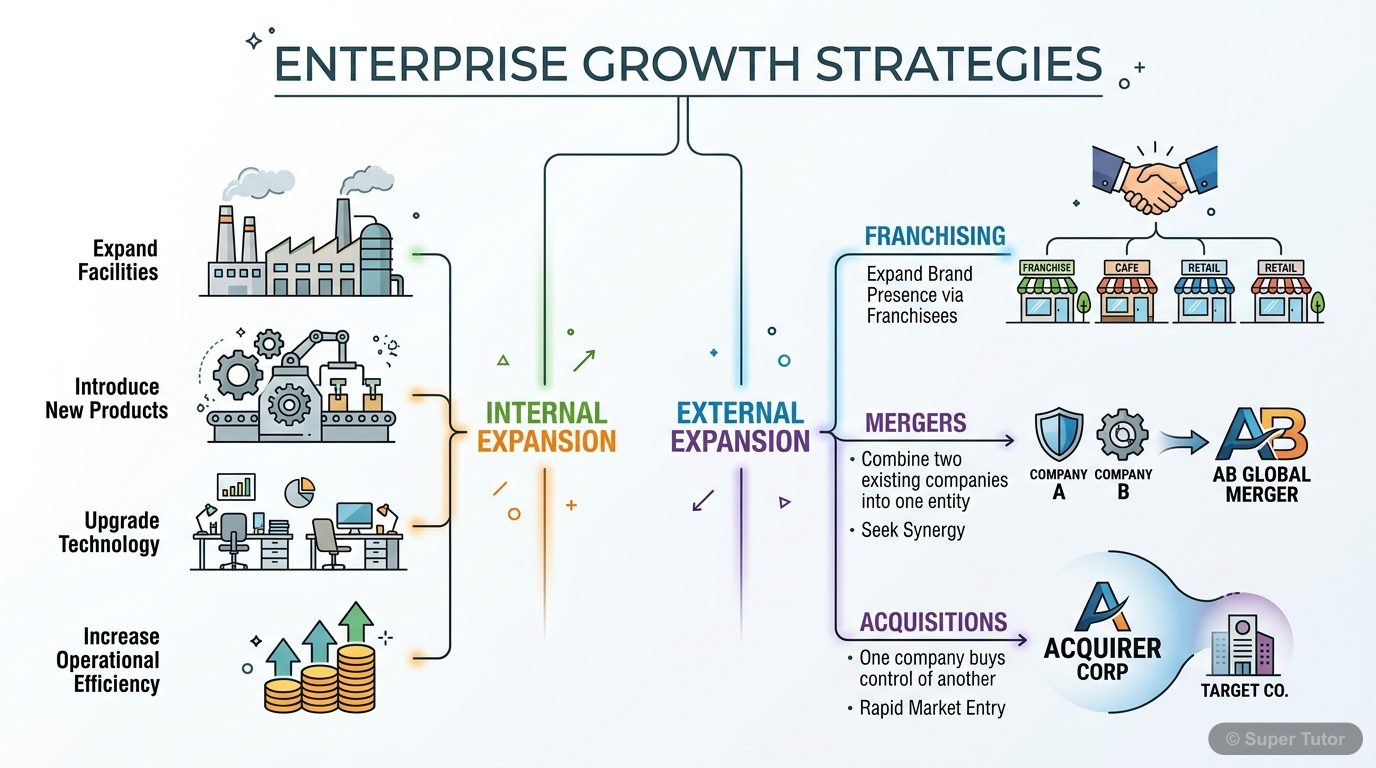
Enterprise Growth Strategies
CBSE · Class 12 · Entrepreneurship
NCERT Solutions for Enterprise Growth Strategies — CBSE Class 12 Entrepreneurship.
Interactive on Super Tutor
Studying Enterprise Growth Strategies? Get the full interactive chapter.
Quizzes, flashcards, AI doubt-solver and a step-by-step study plan — built for ncert solutions and more.
1,000+ Class 12 students started this chapter today

Super Tutor has 12+ illustrations like this for Enterprise Growth Strategies alone — flashcards, concept maps, and step-by-step visuals.
See them allReview Crossword Puzzle
Across-2A corporate action in which a company buys most, if not all, of the target company's ownership stakes in order to assume control of the target firm.Show solution
When one company purchases a controlling interest (most or all ownership stakes) in another company (the target firm) to gain control over it, the action is called an Acquisition.
Across-3The way of life of the people.Show solution
Culture refers to the customs, beliefs, arts, and way of life of a particular society or group of people.
Across-4The management of the flow of goods between the point of origin and the point of consumption in order to meet some requirements.Show solution
Logistics is the detailed coordination and management of the flow of goods, services, and information from the point of origin to the point of consumption.
Across-6A combination of two companies into one larger company.Show solution
A merger is a corporate strategy in which two companies combine to form one larger, single company, usually to gain competitive advantages, expand market share, or achieve synergies.
Across-8The company that allows an individual (known as the franchisee) to run a location of their business.Show solution
A franchisor is the parent company or individual that grants the franchisee the right to operate a business using its brand name, business model, and support systems.
Across-9The basic physical and organizational structures and facilities.Show solution
Infrastructure refers to the fundamental physical and organizational structures (such as roads, buildings, power supply, communication systems) needed for the operation of a society or enterprise.
Across-10It refers to the difference between the value of the combined firm and the value of the sum of the participants.Show solution
Synergy is the concept that the combined value and performance of two companies merged together will be greater than the sum of the separate individual parts. It is expressed as: Synergy = Value of Combined Firm − Sum of Values of Individual Firms.
Down-1McDonald's works under this arrangement.Show solution
McDonald's operates under the franchise arrangement, where individual franchisees pay fees and royalties to McDonald's (the franchisor) to run outlets using its brand, menu, and operational systems.
Down-4The action of leading a group of people.Show solution
Leadership is the action or skill of guiding, directing, and motivating a group of people towards achieving a common goal.
Down-5The action of working with someone to get something done.Show solution
Collaboration is the process of two or more individuals or organizations working together to achieve a shared objective.
Down-7The action of becoming larger or more extensive.Show solution
Expansion refers to the process by which a business grows in size, scale, market reach, or product range to increase its operations and profitability.
Down-11A company that comprises multiple different corporations.Show solution
A conglomerate is a large corporation that is made up of several different, often unrelated, businesses or corporations operating under one parent company.
Down-12The use of various financial instruments or borrowed capital, such as margin, to increase the potential return of an investment.Show solution
Leverage refers to the use of borrowed capital or financial instruments to amplify the potential return (or loss) on an investment. It increases both the risk and the reward of a financial position.
Let's Revise — Section A (Answer in about fifteen words)
A.1What are the two ways in which an organization can expand?Show solution
Answer: An organization can expand in two ways:
1. Internal (Organic) Expansion – growing by using its own resources.
2. External (Inorganic) Expansion – growing through mergers, acquisitions, or franchising.
A.2Who is a franchisor?Show solution
A.3Who is a franchisee?Show solution
A.4What is franchising?Show solution
A.5Which is the most popular form of franchising?Show solution
A.6What is acquisition?Show solution
Let's Revise — Section B (Answer in about fifty words)
B.1Explain in brief the three ways in which an organization can expand externally.Show solution
Answer: An organization can expand externally through three ways:
1. Merger: Two or more companies combine to form a single, larger company. Both entities lose their individual identities.
2. Acquisition/Takeover: One company purchases a controlling interest in another company. The acquired company may or may not retain its identity.
3. Franchising: The franchisor grants the franchisee the right to operate a business using its brand name and business model in exchange for fees or royalties.
B.2Enumerate the importance of franchising.Show solution
Answer: The importance of franchising includes:
- It allows rapid business expansion without heavy capital investment by the franchisor.
- It provides the franchisee with an established brand and proven business model, reducing risk.
- It creates employment opportunities in local markets.
- It ensures standardized quality of products and services across all outlets.
- It facilitates market penetration in new geographic areas quickly.
- It is a low-risk method of starting a business for the franchisee.
B.3Differentiate between consolidation and merger.Show solution
| Basis | Merger | Consolidation |
|---|---|---|
| Meaning | Two companies combine; one company absorbs the other. | Two companies combine to form an entirely new company. |
| Identity | One company retains its identity; the other ceases to exist. | Both original companies cease to exist; a new entity is formed. |
| Example | Company A absorbs Company B; Company A continues. | Company A + Company B = Company C (new entity). |
In short, in a merger one firm survives, while in a consolidation both firms dissolve and a brand-new firm is created.
B.4Name the two forms that merger can take place.Show solution
Answer: A merger can take place in two forms:
1. Merger through Absorption: One company absorbs another company. The acquiring company retains its identity while the acquired company ceases to exist.
*Example:* Company A absorbs Company B; only Company A survives.
2. Merger through Consolidation: Two or more companies combine to form a completely new company. Both original companies cease to exist.
*Example:* Company A + Company B = Company C (new entity).
B.5Explain the types of acquisition.Show solution
Answer: Acquisitions can be of two types:
1. Friendly Acquisition (Friendly Takeover): The target company's management and board of directors agree to and support the acquisition. Both parties negotiate terms mutually.
*Example:* One company willingly sells its majority stake to another.
2. Hostile Acquisition (Hostile Takeover): The acquiring company attempts to take over the target company without the consent or against the wishes of the target company's management. The acquirer may directly approach shareholders or use other tactics to gain control.
B.6What is value addition? Explain by giving examples.Show solution
Answer: Value addition refers to the enhancement of a product or service at each stage of production or distribution before it reaches the final consumer. It is the extra value created over and above the original value of the raw material or input.
Examples:
- A carpenter buys wood (raw material) and converts it into furniture — the furniture has more value than the raw wood.
- A baker buys flour, sugar, and eggs and bakes a cake — the cake has more value than the individual ingredients.
- A company buys cotton, spins it into yarn, weaves it into cloth, and stitches it into garments — value is added at each stage.
Let's Revise — Section C (Answer in about one hundred and fifty words)
C.1Explain the types of franchising.Show solution
Answer: Franchising can be classified into the following types:
1. Product Distribution Franchising (Traditional Franchising):
In this type, the franchisee simply sells the franchisor's products. The franchisee acts as a dealer or distributor. The focus is on the product rather than the entire business system.
*Example:* Petrol pumps, automobile dealerships.
2. Business Format Franchising:
This is the most popular and comprehensive form. The franchisor provides the franchisee with a complete business system — including brand name, operating procedures, marketing strategies, quality control, and ongoing support. The franchisee must follow all the guidelines strictly.
*Example:* McDonald's, Subway, KFC, Domino's.
3. Management Franchising:
Here, the franchisor provides management expertise and systems to the franchisee. The franchisee uses the franchisor's management know-how to run the business. This is common in the hospitality industry.
*Example:* Hotel chains managed under a franchisor's brand.
4. Manufacturing/Processing Franchising:
The franchisor grants the franchisee the right to manufacture the product using its formula, brand name, and specifications.
*Example:* Soft drink bottling companies like Coca-Cola grant franchises to local bottlers.
Each type varies in the degree of control and support provided by the franchisor.
C.2What are the disadvantages of franchising to the franchisee?Show solution
Answer: While franchising offers many benefits to the franchisee, it also has several disadvantages:
1. High Initial Cost:
The franchisee has to pay a substantial franchise fee, royalties, and other charges to the franchisor, which can be financially burdensome.
2. Lack of Independence:
The franchisee must strictly follow the franchisor's rules, procedures, and standards. There is very little room for creativity or independent decision-making.
3. Sharing of Profits:
The franchisee must pay a percentage of profits or sales as royalties to the franchisor on a regular basis, reducing overall profitability.
4. Risk of Franchisor's Reputation:
If the franchisor's brand image is damaged due to any reason (scandal, poor quality elsewhere), the franchisee's business also suffers even if they are performing well.
5. Limited Territory:
The franchisee is usually restricted to operating within a specific geographic territory, limiting expansion opportunities.
6. Dependency:
The franchisee is heavily dependent on the franchisor for supplies, training, and support. If the franchisor faces problems, the franchisee is also affected.
7. Contract Restrictions:
Franchise agreements are often long-term and difficult to exit. The franchisee may face penalties for early termination.
C.3What is synergy? In what forms can it take place?Show solution
Answer:
Synergy is the concept that the combined value and performance of two merged companies will be greater than the sum of their individual values. It is often expressed as '2 + 2 = 5' effect. Synergy is one of the primary motivations behind mergers and acquisitions.
Forms of Synergy:
1. Revenue Synergy:
The combined company can generate more revenue than the two companies could separately. This happens through cross-selling, entering new markets, or offering a wider product range.
2. Cost Synergy (Operating Synergy):
The combined company can reduce costs by eliminating duplicate functions, sharing resources, achieving economies of scale, and improving operational efficiency.
3. Financial Synergy:
The merged company may have better access to capital markets, lower cost of borrowing, improved credit ratings, and better tax benefits than the individual firms.
4. Managerial Synergy:
The combination of management talent, expertise, and skills from both companies leads to better decision-making and improved overall performance.
Synergy is the key justification for most mergers and acquisitions as it creates additional value for shareholders.
C.4What are the different types of value added?Show solution
Answer: Value can be added to a product or service in the following ways:
1. Form Value:
Value is added by changing the physical form or shape of a product. Raw materials are converted into finished goods.
*Example:* Converting iron ore into steel, or cotton into cloth.
2. Place Value:
Value is added by making the product available at the right place where the customer needs it. Transportation and distribution add place value.
*Example:* Vegetables transported from farms to city markets have higher value.
3. Time Value:
Value is added by making the product available at the right time when the customer needs it. Storage and warehousing add time value.
*Example:* Storing wheat after harvest and selling it during off-season at a higher price.
4. Possession Value:
Value is added when ownership of the product is transferred to the customer through buying and selling.
*Example:* A retailer selling goods to the final consumer adds possession value.
5. Information Value:
Value is added by providing relevant information about the product to the customer, helping them make informed decisions.
*Example:* Labelling, advertising, and packaging that inform customers about product features.
Each type of value addition contributes to the overall value chain of a product.
Let's Revise — Section D (Answer in about two hundred and fifty words)
D.1Explain the advantages of franchising, both for the franchisor and franchisee.Show solution
Answer:
## Advantages of Franchising for the FRANCHISOR:
1. Rapid Expansion:
The franchisor can expand its business quickly across different regions and countries without investing its own capital in each new outlet.
2. Low Capital Requirement:
Since the franchisee invests their own capital to set up the outlet, the franchisor can grow without heavy financial burden.
3. Increased Revenue:
The franchisor earns regular income through franchise fees, royalties, and sale of products/supplies to franchisees.
4. Brand Building:
As more outlets open under the franchise model, the brand becomes more widely recognized and established.
5. Motivated Operators:
Franchisees, being owners of their outlets, are more motivated and committed than salaried employees, leading to better performance.
6. Market Penetration:
Franchising allows the franchisor to enter new geographic markets, including international markets, with the help of local franchisees who understand the local culture and consumer behaviour.
---
## Advantages of Franchising for the FRANCHISEE:
1. Established Brand:
The franchisee gets to operate under a well-known brand name, which reduces the time and effort needed to build customer trust.
2. Proven Business Model:
The franchisee benefits from a tried-and-tested business model, reducing the risk of failure compared to starting an independent business.
3. Training and Support:
The franchisor provides training, operational guidance, marketing support, and ongoing assistance to the franchisee.
4. Easier Access to Finance:
Banks and financial institutions are more willing to lend money to franchisees because the franchise model has a proven track record.
5. Economies of Scale:
Franchisees benefit from bulk purchasing of supplies and materials arranged by the franchisor, reducing costs.
6. Lower Risk:
Since the business model is already proven, the risk of failure is significantly lower than starting a new independent business.
7. Marketing Support:
The franchisor handles national and international advertising and marketing campaigns, benefiting all franchisees.
In conclusion, franchising is a mutually beneficial arrangement that allows both the franchisor and franchisee to grow and prosper.
D.2Explain in detail the types of mergers.Show solution
Answer: A merger is the combination of two or more companies into a single entity. Based on the nature of the companies involved, mergers can be classified into the following types:
1. Horizontal Merger:
A horizontal merger occurs between two companies that are in the same industry and at the same stage of production. The companies are direct competitors.
- *Purpose:* To increase market share, reduce competition, and achieve economies of scale.
- *Example:* Two automobile manufacturers merging together.
2. Vertical Merger:
A vertical merger occurs between two companies that are in the same industry but at different stages of the production or supply chain. It can be:
- Forward Vertical Merger: A company merges with its customer/distributor (moving closer to the end consumer).
- Backward Vertical Merger: A company merges with its supplier (moving closer to raw material source).
- *Purpose:* To control the supply chain, reduce costs, and ensure supply of raw materials.
- *Example:* A textile manufacturer merging with a cotton farm (backward) or a garment retailer (forward).
3. Conglomerate Merger:
A conglomerate merger occurs between companies that are in completely unrelated business activities.
- *Purpose:* To diversify business risk and enter new markets.
- *Example:* A food company merging with a technology company.
4. Concentric (Related) Merger:
This merger takes place between companies that deal in related products or services and operate in the same market. The companies share common technology, production processes, or customers.
- *Purpose:* To leverage common resources and expand the product range.
- *Example:* A company making laptops merging with a company making computer accessories.
5. Market Extension Merger:
This merger takes place between two companies that deal in the same products but operate in different markets.
- *Purpose:* To access new markets and expand the customer base.
- *Example:* Two banks operating in different states merging to expand their geographic reach.
Each type of merger serves a specific strategic purpose and helps companies achieve growth, efficiency, and competitive advantage.
D.3What do you think are the reasons for failure of merger and acquisition?Show solution
Answer: While mergers and acquisitions (M&A) are undertaken with the expectation of creating value and synergy, many of them fail to achieve their objectives. The major reasons for failure are:
1. Cultural Differences:
One of the most common reasons for M&A failure is the clash of organizational cultures. When two companies with different work cultures, values, and management styles merge, it creates conflict, low morale, and reduced productivity among employees.
2. Poor Integration Planning:
Many mergers fail because the companies do not plan the integration process properly. Combining two different systems, processes, technologies, and teams requires careful planning, which is often overlooked.
3. Overestimation of Synergies:
Companies often overestimate the synergies (cost savings and revenue gains) expected from the merger. When the actual synergies fall short of expectations, the merger is considered a failure.
4. Overpaying for the Acquisition:
Acquiring companies sometimes pay too high a price (premium) for the target company, making it difficult to recover the investment and generate adequate returns.
5. Lack of Communication:
Poor communication with employees, customers, and stakeholders during and after the merger creates uncertainty, fear, and resistance, leading to loss of key talent and customers.
6. Regulatory and Legal Issues:
M&A deals may face regulatory hurdles, antitrust issues, or legal challenges that delay or derail the process.
7. Loss of Key Talent:
During mergers, key employees and managers often leave due to uncertainty about their roles, leading to loss of valuable human capital and institutional knowledge.
8. Incompatible Technology Systems:
Integrating different IT systems, software, and databases can be extremely complex and costly, leading to operational disruptions.
9. Inadequate Due Diligence:
If the acquiring company does not conduct thorough due diligence (investigation of the target company's financials, liabilities, and operations), it may discover hidden problems after the deal is done.
10. External Economic Factors:
Changes in the economic environment, market conditions, or industry dynamics after the merger can negatively impact the combined company's performance.
In conclusion, successful M&A requires careful planning, cultural alignment, realistic expectations, and effective integration management.
D.4What is meant by moving up the value chain? Explain with the help of an example.Show solution
Answer:
## Moving Up the Value Chain
Value Chain refers to the series of activities that a company performs to deliver a valuable product or service to the market. Each activity adds value to the product. Moving up the value chain means shifting from lower-value activities (such as producing raw materials or basic components) to higher-value activities (such as manufacturing finished goods, branding, marketing, or providing services) that generate greater profit margins and competitive advantage.
In simple terms, it means adding more value at each stage of production and moving towards activities that are more knowledge-intensive, skill-intensive, and profitable.
---
## Example: The Textile Industry
Consider the journey of cotton:
| Stage | Activity | Value Added |
|---|---|---|
| Stage 1 | Farmer grows raw cotton | Low value |
| Stage 2 | Factory spins cotton into yarn | Moderate value |
| Stage 3 | Mill weaves yarn into fabric/cloth | Higher value |
| Stage 4 | Manufacturer stitches cloth into garments | Even higher value |
| Stage 5 | Brand markets and sells designer garments | Highest value |
A farmer who only grows cotton earns the least. But if the same farmer sets up a spinning unit (Stage 2), then a weaving unit (Stage 3), and eventually a garment manufacturing unit (Stage 4), they are moving up the value chain — earning significantly more at each stage.
If they further create their own brand and sell directly to consumers (Stage 5), they capture the maximum value.
---
## Significance of Moving Up the Value Chain:
- Increases profit margins.
- Reduces dependency on buyers and intermediaries.
- Builds brand equity and competitive advantage.
- Creates employment and develops skills.
- Leads to economic development of the country.
Countries like China and India have successfully moved up the value chain in manufacturing by shifting from raw material exports to finished goods and branded products.
D.5Explain in detail Porter's Generic Value Chain with the help of a diagram.Show solution
Answer:
## Porter's Generic Value Chain
The Value Chain concept was introduced by Michael E. Porter in his book *Competitive Advantage* (1985). According to Porter, a value chain is a set of activities that a firm operating in a specific industry performs in order to deliver a valuable product or service to the market. By analysing each activity, a firm can identify sources of competitive advantage.
Porter's Value Chain divides business activities into two categories:
---
## A. Primary Activities
These are the activities directly involved in creating, selling, delivering, and servicing the product:
1. Inbound Logistics:
Activities related to receiving, storing, and distributing inputs (raw materials) internally.
*Example:* Warehousing, inventory management, transportation of raw materials.
2. Operations:
Activities that transform inputs into the final product.
*Example:* Manufacturing, assembly, packaging, quality control.
3. Outbound Logistics:
Activities related to collecting, storing, and distributing the final product to customers.
*Example:* Order processing, warehousing of finished goods, delivery.
4. Marketing and Sales:
Activities that make customers aware of the product and persuade them to buy it.
*Example:* Advertising, pricing, promotions, channel management.
5. Service:
Activities that maintain and enhance the product's value after the sale.
*Example:* After-sales service, repairs, customer support, warranties.
---
## B. Support Activities
These activities support the primary activities and each other:
1. Firm Infrastructure:
General management, planning, finance, accounting, legal, and quality management activities that support the entire chain.
2. Human Resource Management:
Activities related to recruiting, training, developing, and compensating employees.
3. Technology Development:
Activities related to research and development (R&D), process automation, and technology improvement.
4. Procurement:
Activities related to purchasing inputs (raw materials, machinery, supplies) used in the value chain.
---
## Diagram of Porter's Value Chain:
```
|--------------------------------------------------------- MARGIN |
| FIRM INFRASTRUCTURE |
| HUMAN RESOURCE MANAGEMENT |
| TECHNOLOGY DEVELOPMENT |
| PROCUREMENT |
|----------------------------------------------------------------- |
| INBOUND | OPERATIONS | OUTBOUND | MARKETING | SERVICE | |
| LOGISTICS| | LOGISTICS| & SALES | | MARGIN|
|----------------------------------------------------------------- |
← PRIMARY ACTIVITIES →
```
Margin = The difference between the total value created and the total cost of performing the value chain activities. The goal is to maximise this margin.
---
## Significance:
- Helps identify activities where the firm has a competitive advantage.
- Helps identify activities that can be improved or outsourced to reduce costs.
- Helps in strategic planning and decision-making.
- Enables firms to understand how value flows from raw material to the final customer.
D.6Explain the requirements for value chain management.Show solution
Answer:
## Value Chain Management
Value Chain Management (VCM) refers to the process of overseeing and optimising all the activities in the value chain — from procurement of raw materials to delivery of the final product to the customer — with the goal of maximising value and minimising costs.
For effective value chain management, the following requirements must be met:
1. Coordination and Collaboration:
All departments and partners in the value chain must work together in a coordinated manner. Effective communication and collaboration between suppliers, manufacturers, distributors, and retailers is essential.
2. Technology and Information Systems:
Modern technology such as ERP (Enterprise Resource Planning) systems, supply chain management software, and data analytics tools are essential for tracking, monitoring, and optimising value chain activities in real time.
3. Human Resources:
Skilled, trained, and motivated employees are critical for managing value chain activities efficiently. Continuous training and development of staff is necessary.
4. Leadership:
Strong and visionary leadership is required to set the direction, make strategic decisions, and drive the value chain management process effectively.
5. Organisational Culture:
A culture that values quality, efficiency, innovation, and continuous improvement is essential for successful value chain management.
6. Supplier Relationships:
Building strong, long-term relationships with reliable suppliers ensures a steady supply of quality inputs at competitive prices.
7. Customer Focus:
Understanding customer needs and preferences is critical. The entire value chain must be oriented towards delivering maximum value to the customer.
8. Quality Management:
Strict quality control at every stage of the value chain ensures that the final product meets customer expectations and reduces waste and rework.
9. Logistics and Infrastructure:
Efficient logistics, transportation, warehousing, and distribution infrastructure are necessary to ensure timely delivery of products.
10. Continuous Improvement:
Value chain management requires a commitment to continuously reviewing, analysing, and improving all activities to stay competitive and adapt to changing market conditions.
In conclusion, effective value chain management requires a holistic approach that integrates people, processes, technology, and strategy to create and deliver maximum value to customers while maintaining profitability.
Let's Revise — Section E: HOTS (High Order Thinking Skills)
E.aA merger between firms that are involved in totally unrelated business activities.Show solution
Justification: When two companies that are engaged in completely unrelated business activities (different industries, different products, different markets) merge together, it is called a Conglomerate Merger. The primary purpose is to diversify business risk and enter new markets.
*Example:* A food company merging with a software company.
E.bA merger occurring between companies in the same industry.Show solution
Justification: When two companies operating in the same industry and at the same stage of production (i.e., direct competitors) merge together, it is called a Horizontal Merger. The purpose is to increase market share, reduce competition, and achieve economies of scale.
*Example:* Two automobile manufacturers merging together.
E.cIt takes place between two companies that deal in the same products but in separate markets.Show solution
Justification: When two companies that deal in the same products or services but operate in different geographic markets merge together, it is called a Market Extension Merger. The purpose is to gain access to a larger market and expand the customer base.
*Example:* Two banks offering the same banking services but operating in different states merging to expand their geographic presence.
E.dIt takes place between two business organizations that deal in products that are related to each other and operate in the same market.Show solution
Justification: When two companies that deal in related products or services and operate in the same market merge together, it is called a Concentric Merger (also known as a Related Merger). The companies share common technology, customer base, or production processes.
*Example:* A company manufacturing laptops merging with a company manufacturing computer accessories (keyboards, mice) — both deal in related products and serve the same market.
E.eIt is between two companies producing different goods or services for one specific finished product.Show solution
Justification: When two companies that are at different stages of the production process for the same finished product merge together, it is called a Vertical Merger. One company produces a component or input that the other company uses to produce the final product.
*Example:* A tyre manufacturing company merging with an automobile manufacturing company — both produce different goods (tyres and cars) but the tyre is a component of the final product (car). This is a backward vertical merger for the automobile company.
Let's Revise — Section F: Application Based Questions
F.1ABC Company, manufacturing shoes, has taken over XYZ Company which also manufactures shoes at a small scale. What do you think will be the reason for this kind of takeover?Show solution
Reason: Both ABC Company and XYZ Company are in the same industry (shoe manufacturing) and at the same stage of production. ABC Company has taken over XYZ Company, which is a smaller competitor.
Possible Reasons for this Takeover:
1. Increase Market Share: By acquiring XYZ Company, ABC Company eliminates a competitor and gains its customer base, thereby increasing its overall market share in the shoe industry.
2. Reduce Competition: Taking over a competitor reduces competition in the market, giving ABC Company greater pricing power.
3. Achieve Economies of Scale: By combining production facilities, ABC Company can produce shoes at a larger scale, reducing per-unit costs.
4. Access to Resources: ABC Company may want to acquire XYZ Company's manufacturing facilities, skilled workforce, technology, or distribution network.
5. Eliminate a Potential Threat: Even though XYZ is small now, it may have the potential to grow into a significant competitor. Acquiring it early prevents future competition.
Conclusion: This is a horizontal acquisition aimed at expanding market share, reducing competition, and achieving operational efficiencies in the shoe manufacturing industry.
F.2Vimal Company Ltd., were earlier producing pencils, now they have decided to further venture into the field of notebooks and paper. What do you think is the company attempting to do? Identify and explain the concept.Show solution
However, since pencils, notebooks, and paper are all related products in the stationery/education sector and paper is actually an input for both pencils and notebooks, this can also be identified as:
Concept: Concentric Diversification / Related Diversification (Moving Up the Value Chain)
Explanation:
Vimal Company Ltd. is moving from producing pencils (a finished product) to also producing notebooks and paper (related products in the same industry). This is a strategy of related diversification where a company expands into products that are related to its existing business.
Key Points:
1. Paper is a raw material/input used in making pencils (for the eraser casing or packaging) and is the primary material for notebooks. By producing paper, Vimal is backward integrating — controlling its own supply of raw material.
2. Notebooks are a related product in the stationery segment, serving the same target customers (students, offices). By entering this segment, Vimal is diversifying its product portfolio.
3. This strategy helps Vimal:
- Reduce dependence on external suppliers for paper.
- Increase revenue by selling multiple related products.
- Leverage existing brand and distribution network in the stationery market.
- Move up the value chain by capturing more stages of production.
Conclusion: Vimal Company Ltd. is pursuing a strategy of related/concentric diversification combined with vertical integration, which allows it to control more of the value chain, reduce costs, and expand its product offerings to the same customer base.
Let's Revise — Section G: Activities
G.1Look around in the market for a product of your interest. Suggest some ways in which the company can move up their value chain.Show solution
Product Selected: Tea (e.g., a local tea brand)
Current Position in Value Chain: The company currently purchases tea leaves from farmers and sells loose/packaged tea.
Ways to Move Up the Value Chain:
1. Own Tea Plantations (Backward Integration): Instead of buying tea leaves from farmers, the company can grow its own tea on owned plantations, controlling quality and reducing input costs.
2. Processing and Blending: Invest in advanced processing facilities to blend different varieties of tea, creating premium and specialty teas (green tea, herbal tea, flavoured tea) that command higher prices.
3. Branded Packaging: Move from selling loose tea to selling attractively branded, premium packaged tea (tea bags, gift boxes) that adds value and justifies higher pricing.
4. Ready-to-Drink Products: Manufacture ready-to-drink bottled iced tea or tea-based beverages, which have significantly higher profit margins.
5. Tea Cafés/Retail Outlets: Open branded tea cafés or retail outlets where customers can experience the brand directly, capturing the retail margin as well.
6. Export Premium Varieties: Export specialty teas to international markets where premium teas fetch much higher prices.
7. E-commerce and Direct Sales: Sell directly to consumers through an online platform, eliminating intermediaries and capturing the distribution margin.
By implementing these steps, the tea company moves from a low-value commodity seller to a high-value branded consumer goods company.
G.2Find out in your area if there are any shops which are run on the franchise model and assess the success of those firms.Show solution
Steps to Complete this Activity:
1. Identify Franchise Outlets in Your Area:
Visit your local market and identify shops/outlets operating under a franchise model. Common examples include:
- Fast food chains: McDonald's, Domino's, Subway, KFC, Pizza Hut
- Retail chains: Bata, Woodland, Fabindia
- Education centres: NIIT, Aptech, Byju's learning centres
- Courier services: DTDC, Blue Dart
- Bakeries/Cafés: Café Coffee Day, Barista
2. Assess Success by Observing:
- Customer footfall: How many customers visit the outlet daily?
- Quality consistency: Is the quality of products/services consistent with the brand standard?
- Staff behaviour: Are employees well-trained and professional?
- Cleanliness and ambience: Does the outlet maintain brand standards?
- Customer feedback: Are customers satisfied?
3. Factors Contributing to Success:
- Strong brand recognition
- Standardised products and services
- Franchisor's marketing and advertising support
- Trained staff
- Good location
4. Factors Contributing to Failure (if any):
- Poor location
- Inadequate investment
- Non-compliance with franchisor's standards
- Poor customer service
Conclusion: Students should prepare a brief report based on their observations and present their findings in class.
G.3Make a list of major companies which have merged or have acquired some other company and state whether they are successful or unsuccessful, giving reasons.Show solution
| S.No. | Acquirer/Merged Company | Target Company | Year | Type | Success/Failure | Reason |
|---|---|---|---|---|---|---|
| 1 | Tata Steel | Corus Group | 2007 | Acquisition | Partially Successful | Tata Steel expanded globally and gained access to European markets, but faced challenges due to the 2008 global financial crisis. |
| 2 | Vodafone | Idea Cellular | 2018 | Merger | Partially Successful | Created India's largest telecom company by subscribers, but faces intense competition from Reliance Jio and financial challenges. |
| 3 | Facebook (Meta) | Instagram | 2012 | Acquisition | Highly Successful | Instagram grew from 30 million to over 1 billion users under Facebook, becoming one of the world's most valuable social media platforms. |
| 4 | Google | YouTube | 2006 | Acquisition | Highly Successful | YouTube became the world's largest video platform, generating billions in advertising revenue for Google. |
| 5 | Flipkart | Myntra | 2014 | Acquisition | Successful | Flipkart strengthened its position in the fashion e-commerce segment through Myntra. |
| 6 | Daimler-Benz | Chrysler | 1998 | Merger | Unsuccessful | Cultural differences between German and American management styles, different market segments, and strategic misalignment led to the merger being dissolved in 2007. |
| 7 | HP | Compaq | 2002 | Acquisition | Partially Successful | Initially controversial, the merger helped HP become the world's largest PC maker, but later faced challenges due to changing market dynamics. |
Conclusion: Students should research additional examples from their local market or current news and present a comprehensive list with analysis.
Stuck on a step?
Ask Super Tutor AI to explain any solution on this page in a simpler way — free, 24x7.
Ask a Doubt FreeFrequently Asked Questions
What are the important topics in Enterprise Growth Strategies for CBSE Class 12 Entrepreneurship?
How to score full marks in Enterprise Growth Strategies — CBSE Class 12 Entrepreneurship?
Where can I get free NCERT Solutions for Enterprise Growth Strategies Class 12 Entrepreneurship?
Sources & Official References
- NCERT Official — ncert.nic.in
- CBSE Academic — cbseacademic.nic.in
- CBSE Official — cbse.gov.in
- National Education Policy 2020 — education.gov.in
Content is aligned to the official syllabus. Refer to the board website for the latest curriculum.
More resources for Enterprise Growth Strategies
Important Questions
Practice with board exam-style questions
Syllabus
What topics to cover
Revision Notes
Key points for last-minute revision
Study Plan
Step-by-step plan to ace this chapter
Flashcards
Quick-fire cards for active recall
Formula Sheet
All formulas in one place
Chapter Summary
Understand the chapter at a glance
Practice Quiz
Test yourself with a quick quiz
Concept Maps
See how topics connect visually
For serious students
Get the full Enterprise Growth Strategies chapter — for free.
Quizzes, flashcards, AI doubt-solver and a step-by-step study plan for CBSE Class 12 Entrepreneurship.