Legal Profession in India — Study Plan
CBSE · Class 12 · Legal Studies
A step-by-step study plan for Legal Profession in India, CBSE Class 12 Legal Studies: what to learn first, what to practise and when to revise.
Interactive on Super Tutor
Studying Legal Profession in India? Get the full interactive chapter.
Quizzes, flashcards, AI doubt-solver and a step-by-step study plan — built for study plan and more.
Free trial, no card needed.
Learn better with visuals Super Tutor pairs illustrations like this with notes and quizzes for Legal Profession in India.
Study Plan
Learn the Theory
Read the textbook chapter carefully. Note down definitions, formulas and key ideas. Focus on: Historical Development of Legal Profession, Advocates Act 1961 - Key Provisions, Bar Council Structure and Functions.
Practise
Solve the textbook exercises and extra practice questions.
Revise & Test
Revise key points without looking at your notes. Take a practice quiz and mark weak areas for another pass.
Spaced Revision
Come back to Legal Profession in India after a week. Use flashcards for quick recall and try past exam questions on this chapter.
What to Focus On
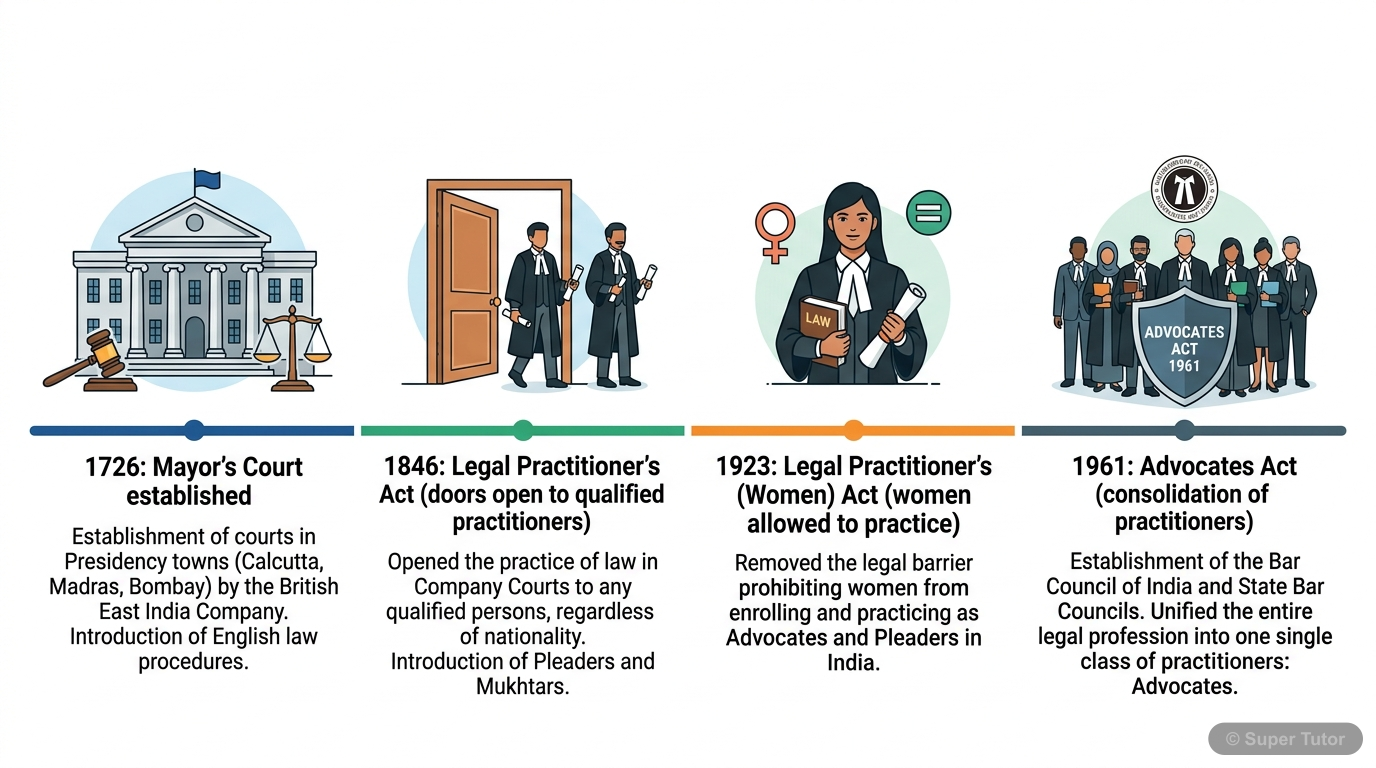
- Mayor's courts established in 1726 marked the beginning of modern legal practice
- Legal Practitioner's Act 1846 opened profession to qualified practitioners regardless of nationality/religion
- Women gained entry through Legal Practitioner's (Women) Act 1923
- Unified all practitioner categories into single 'Advocate' designation
- Created Senior Advocate designation for exceptional practitioners
- Established Advocate-on-Record system for Supreme Court practice
- Two-tier structure: State Bar Councils and Bar Council of India
- State Bar Councils handle enrollment, rolls maintenance, and local discipline
- Bar Council of India sets national standards and regulates legal education
Common Mistakes to Avoid
All lawyers in India can practice in any court including the Supreme Court without any special requirements
Senior Advocates and Advocates-on-Record are the same thing with just different names
The Bar Council of India directly enrolls advocates and maintains the roll of all advocates in India
Memory Tips
Legal Practitioner's Act 1846 - First law opening legal profession to qualified practitioners
Legal Practitioner's Women Act 1923 - Allowed women to practice law
Advocates Act 1961 - Created single category of 'Advocates'
Requirements to be an Advocate: Citizen of India, 21+ years, LLB degree, All India Bar Exam
Want a personalised study plan?
Super Tutor builds a day-by-day plan for CBSE Class 12 Legal Studies that fits your exam date and pace.
Create My Study PlanFrequently Asked Questions
What are the important topics in Legal Profession in India for CBSE Class 12 Legal Studies?
Sources & Official References
- NCERT Official — ncert.nic.in
- CBSE Academic — cbseacademic.nic.in
- CBSE Official — cbse.gov.in
- National Education Policy 2020 — education.gov.in
Content is aligned to the official syllabus. Refer to the board website for the latest curriculum.
More resources for Legal Profession in India
For serious students
Get the full Legal Profession in India chapter — start free.
Quizzes, flashcards, an AI doubt solver and a study plan for CBSE Class 12 Legal Studies. Free to start, no card needed.