Legal Profession in India
CBSE · Class 12 · Legal Studies
NCERT Solutions for Legal Profession in India — CBSE Class 12 Legal Studies.
Interactive on Super Tutor
Studying Legal Profession in India? Get the full interactive chapter.
Quizzes, flashcards, AI doubt-solver and a step-by-step study plan — built for ncert solutions and more.
1,000+ Class 12 students started this chapter today

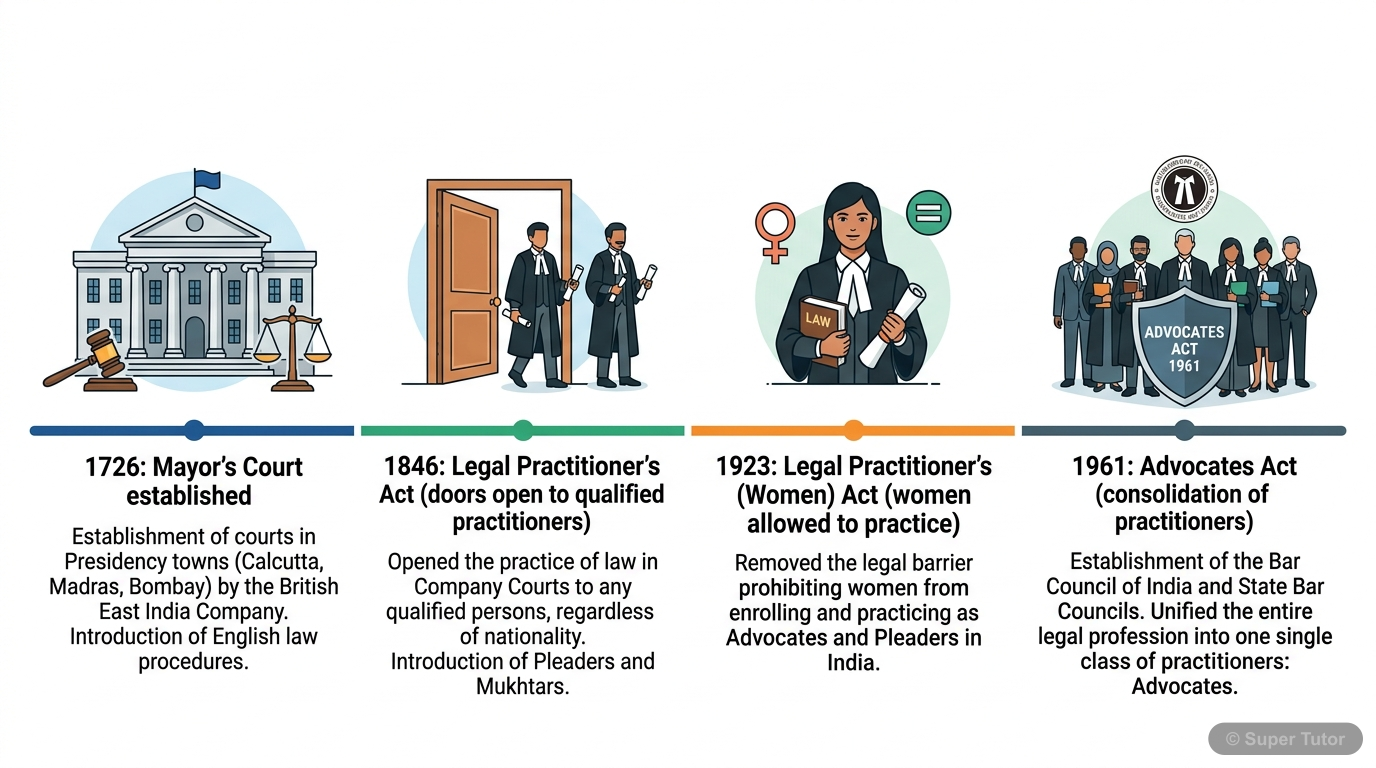
Super Tutor has 14+ illustrations like this for Legal Profession in India alone — flashcards, concept maps, and step-by-step visuals.
See them allExercises — Legal Profession in India (Class 12 Legal Studies)
1aWrite short notes on: Women and the Legal ProfessionShow solution
Given/Context: The role and status of women in the Indian legal profession over time.
Answer:
Historical Background:
For a long time, women were excluded from the legal profession in India. The legal system was largely male-dominated and women faced significant social and institutional barriers.
Key Milestones:
- Regina Guha (1916): She was one of the first women to seek enrolment as a pleader in India, but her application was rejected on the ground that women were not 'persons' entitled to be enrolled under the Legal Practitioners Act.
- Cornelia Sorabji was the first woman to study law at Oxford and is considered a pioneer for women in the Indian legal profession. She practised as a legal adviser before formal enrolment was permitted.
- The Legal Practitioners (Women) Act, 1923: This landmark legislation allowed women to be enrolled as legal practitioners in India, removing the earlier bar against them.
- Post-Independence: After independence, the Constitution of India guaranteed equality before law (Article 14) and prohibited discrimination on the basis of sex (Article 15), which opened all professions, including law, to women.
- The Advocates Act, 1961 made no distinction between men and women advocates, providing a uniform framework for enrolment.
Current Scenario:
- Women today practise as advocates, judges (including in the Supreme Court and High Courts), public prosecutors, legal advisers, and law officers.
- Despite progress, women remain under-represented, especially at senior levels of the Bar and the Bench.
- Issues such as the 'old boys' network', lack of mentorship, work-life balance challenges, and gender bias in briefing patterns continue to affect women lawyers.
- Several Bar Councils and the Supreme Court have taken steps to encourage greater participation of women in the profession.
Conclusion: While significant progress has been made, achieving true gender parity in the legal profession remains an ongoing challenge requiring structural and attitudinal changes.
1bWrite short notes on: Professional Ethics for lawyersShow solution
Given/Context: The standards of conduct expected of advocates in India.
Answer:
Meaning:
Professional ethics refers to the code of conduct and moral principles that govern the behaviour of lawyers in their professional capacity. It ensures that advocates discharge their duties with integrity, competence, and fairness.
Statutory Basis:
The Advocates Act, 1961 and the Bar Council of India Rules (particularly Chapter II — Standards of Professional Conduct and Etiquette) lay down the ethical obligations of advocates in India.
Key Ethical Duties of an Advocate:
1. Duty to the Court:
- An advocate must act with utmost honesty and integrity before the court.
- He/she must not mislead the court by making false statements or suppressing material facts.
- An advocate must maintain respectful conduct towards the court at all times.
2. Duty to the Client:
- An advocate must protect the interests of the client faithfully and to the best of his/her ability.
- He/she must maintain confidentiality of information shared by the client.
- An advocate must not charge excessive or unreasonable fees.
- He/she must not withdraw from a case without reasonable cause and without giving adequate notice to the client.
3. Duty to the Opponent:
- An advocate must not communicate with the opposing party directly without the knowledge of the opposing counsel.
- He/she must not use unfair or improper means against the opponent.
4. Duty to Colleagues:
- An advocate must treat fellow advocates with courtesy and fairness.
- He/she must not solicit work or advertise services in an improper manner.
5. Duty to Society:
- An advocate must uphold the rule of law and the Constitution.
- He/she must render legal aid to the poor and needy.
Prohibition on Advertising:
The Bar Council of India Rules prohibit advocates from advertising their services directly or indirectly, as law is considered a noble profession and not a trade.
Conclusion: Professional ethics are the backbone of the legal profession. They ensure that advocates serve justice rather than merely personal or commercial interests, thereby maintaining public trust in the legal system.
1cWrite short notes on: Eligibility and qualification to practice as an Advocate in IndiaShow solution
Given/Context: The legal requirements for enrolment and practice as an advocate under the Advocates Act, 1961.
Answer:
Governing Law:
The Advocates Act, 1961 is the primary legislation that governs the qualifications, enrolment, and practice of advocates in India. The Bar Council of India and State Bar Councils regulate enrolment.
Eligibility Criteria (Section 24 of the Advocates Act, 1961):
A person is entitled to be enrolled as an advocate if he/she:
1. Is a citizen of India. (Foreign nationals may be enrolled only if citizens of India are permitted to practise law in their country — principle of reciprocity.)
2. Has attained the age of 21 years.
3. Has obtained a law degree from a university recognised by the Bar Council of India:
- An LLB degree (3-year programme after graduation) or
- An integrated 5-year BA LLB / BBA LLB / B.Com LLB degree after Class 12.
4. Has paid the prescribed enrolment fee to the State Bar Council.
5. Fulfils the character requirements — he/she must not have been convicted of an offence involving moral turpitude.
All India Bar Examination (AIBE):
- Introduced by the Bar Council of India, the AIBE is a test that newly enrolled advocates must pass to obtain a Certificate of Practice.
- It tests basic knowledge of law and is an open-book examination.
- Passing the AIBE is now mandatory to practise as an advocate.
Disqualifications (Section 24A):
A person shall not be enrolled if:
- He/she has been convicted of an offence involving moral turpitude.
- He/she has been dismissed from government service for moral turpitude.
- He/she is already employed in any other profession or service (subject to exceptions).
Enrolment Process:
- Application is made to the State Bar Council of the state where the person intends to practise.
- Upon approval, the person is enrolled on the State Roll and is entitled to practise throughout India.
Conclusion: The eligibility framework ensures that only qualified, competent, and morally fit individuals enter the legal profession, thereby maintaining the standards and integrity of the Bar.
1dWrite short notes on: Legal Education in IndiaShow solution
Given/Context: The development, structure, and regulation of legal education in India.
Answer:
Introduction:
Legal education in India has evolved significantly since independence. It is regulated by the Bar Council of India (BCI) under the Advocates Act, 1961, which empowers the BCI to prescribe standards for legal education and recognise law degrees.
Historical Development:
- During the colonial period, legal education was largely unstructured. The first law schools were established in Calcutta, Bombay, and Madras in the 19th century.
- After independence, the Law Commission of India (14th Report, 1958) highlighted the poor state of legal education and recommended reforms.
- The Advocates Act, 1961 gave the Bar Council of India the authority to lay down standards of legal education.
- A landmark development was the establishment of the National Law School of India University (NLSIU), Bangalore in 1987, which introduced the 5-year integrated BA LLB programme and transformed legal education in India.
- This led to the establishment of a chain of National Law Universities (NLUs) across the country.
Structure of Legal Education:
1. 3-Year LLB Programme: For graduates who wish to pursue law after completing a bachelor's degree in any discipline.
2. 5-Year Integrated Programme (BA LLB / BBA LLB / B.Com LLB): For students who join law directly after Class 12 (10+2).
3. Postgraduate Programmes: LLM (Master of Laws) for specialisation in specific areas of law.
4. PhD in Law: For research and academic careers.
Admission:
- Admission to NLUs is through the Common Law Admission Test (CLAT), a centralised national entrance examination.
- Other universities conduct their own entrance tests.
Regulatory Framework:
- The Bar Council of India prescribes the minimum curriculum, infrastructure requirements, and standards for law schools.
- Law schools must obtain recognition from the BCI to award degrees that qualify graduates for enrolment as advocates.
Challenges:
- Uneven quality of legal education across institutions.
- Outdated curriculum in many universities.
- Lack of clinical legal education and practical training.
- Large number of unrecognised or sub-standard law colleges.
Recent Reforms:
- The BCI has introduced stricter inspection norms for law colleges.
- Emphasis on clinical legal education, moot courts, and internships.
- Introduction of the All India Bar Examination (AIBE) to ensure minimum competence.
Conclusion: Legal education in India is at a crossroads — while premier institutions like NLUs produce world-class lawyers, the overall quality needs significant improvement to meet the demands of a rapidly evolving legal landscape.
2What changes did the Advocates' Act bring about in India?Show solution
Given: The Advocates Act, 1961 is the central legislation governing the legal profession in India.
Introduction:
Before the Advocates Act, 1961, the legal profession in India was governed by a patchwork of colonial-era laws — the Legal Practitioners Act, 1879, the Bombay Pleaders Act, 1920, and various High Court rules. There were multiple categories of legal practitioners (barristers, advocates, vakils, pleaders, mukhtars, revenue agents) with different qualifications and privileges. The Advocates Act, 1961 brought about a comprehensive and uniform reform.
Key Changes Introduced by the Advocates Act, 1961:
1. Unified Class of Legal Practitioners:
- The Act abolished all previous distinctions between barristers, advocates, vakils, pleaders, etc.
- It created a single unified class of legal practitioners called 'Advocates'.
- This ended the hierarchical and discriminatory structure inherited from the colonial period.
2. Establishment of the Bar Council of India (BCI):
- The Act established the Bar Council of India as the apex regulatory body for the legal profession at the national level.
- The BCI was given powers to lay down standards of professional conduct, prescribe qualifications for enrolment, and promote legal education.
3. Establishment of State Bar Councils:
- The Act provided for the creation of State Bar Councils in each state.
- State Bar Councils are responsible for enrolling advocates, maintaining the State Roll, and disciplining advocates within their jurisdiction.
4. Uniform Qualifications for Enrolment:
- The Act prescribed uniform eligibility criteria for enrolment as an advocate throughout India (Section 24).
- A recognised law degree became the standard qualification, replacing the earlier varied requirements.
5. Right to Practise Throughout India:
- An advocate enrolled with any State Bar Council has the right to practise in any court or tribunal throughout India, including the Supreme Court (subject to the distinction between Senior Advocates and Advocates on Record).
- This removed the earlier restriction of practising only in the jurisdiction where one was enrolled.
6. Disciplinary Proceedings:
- The Act established a clear mechanism for disciplinary proceedings against advocates through Disciplinary Committees of State Bar Councils and the Bar Council of India.
- Advocates found guilty of professional misconduct can be suspended or disbarred.
7. Senior Advocates:
- The Act introduced the concept of Senior Advocates — advocates of standing and ability who are designated as Senior Advocates by the Supreme Court or a High Court.
- Senior Advocates have certain restrictions (e.g., they cannot directly accept briefs from clients) and certain privileges.
8. Advocates on Record:
- The Act recognised the category of Advocates on Record for the Supreme Court — advocates who are entitled to file documents and appear on behalf of parties in the Supreme Court.
9. Legal Education:
- The BCI was empowered to prescribe standards of legal education and to recognise universities whose law degrees qualify for enrolment.
10. Repeal of Earlier Laws:
- The Act repealed the Legal Practitioners Act, 1879, the Bombay Pleaders Act, 1920, and other related legislation, replacing them with a single comprehensive statute.
Conclusion:
The Advocates Act, 1961 was a transformative piece of legislation. It unified the legal profession, democratised access to it, established self-regulatory bodies, and created a framework that continues to govern the legal profession in India to this day.
3Discuss the main points of difference between Senior Advocate and Advocate on Record.Show solution
Given: Both Senior Advocate and Advocate on Record are special categories of advocates recognised under the Advocates Act, 1961 and the Supreme Court Rules.
Introduction:
While all enrolled advocates have the right to practise, the Advocates Act, 1961 and the Supreme Court Rules create two special categories — Senior Advocates and Advocates on Record (AoR) — each with distinct qualifications, privileges, and restrictions.
Points of Difference:
| Basis | Senior Advocate | Advocate on Record (AoR) |
|---|---|---|
| Definition | An advocate who is designated as 'Senior Advocate' by the Supreme Court or a High Court on account of his/her ability and standing at the Bar. | An advocate who is registered with the Supreme Court and is entitled to file documents, appear, and act on behalf of parties in the Supreme Court. |
| Governing Law | Section 16 of the Advocates Act, 1961; Supreme Court Rules. | Supreme Court Rules, 2013 (Order IV). |
| How Designated/Registered | Designated by the Supreme Court or a High Court on its own motion or on the application of the advocate. The Full Court considers the advocate's ability, experience, and standing. | Must pass the Advocates on Record Examination conducted by the Supreme Court. Must also complete one year of training under a registered AoR. |
| Qualification | No separate examination; based on merit, seniority, and recognition by the court. | Must pass a written examination covering practice and procedure of the Supreme Court, drafting, and professional ethics. |
| Right to File Documents | A Senior Advocate cannot directly file vakalatnamas or documents in the Supreme Court. He/she must be instructed by an AoR. | An AoR can file vakalatnamas, petitions, and other documents directly in the Supreme Court on behalf of clients. |
| Direct Client Contact | A Senior Advocate cannot directly accept briefs from clients. He/she must be briefed through an AoR or junior advocate. | An AoR can directly accept instructions from clients and maintain a direct relationship with them. |
| Dress Code | Wears a distinctive gown with a different style to indicate seniority. | Wears the standard advocate's gown. |
| Scope | Designation is by the Supreme Court (for practice in the Supreme Court) or by a High Court (for practice in that High Court). | Registration as AoR is specific to the Supreme Court of India only. |
| Role in Court | Primarily appears and argues cases; acts as a leading counsel. | Primarily responsible for filing, procedural compliance, and instructing Senior Advocates. |
| Number | Limited in number; designation is a mark of honour and distinction. | A specific category for Supreme Court practice; not all advocates practising in the Supreme Court are AoRs. |
Conclusion:
In essence, a Senior Advocate is a mark of distinction for an experienced and eminent lawyer, while an Advocate on Record is a functional category that enables an advocate to formally represent clients before the Supreme Court. Both categories serve complementary roles — the AoR manages the procedural and filing aspects, while the Senior Advocate focuses on advocacy and argumentation.
4Compare the rules regarding advertising by legal professionals in India and other countries.Show solution
Given: Advertising by lawyers raises questions about the balance between professional ethics and the right to information.
Introduction:
The rules on advertising by legal professionals vary significantly across countries. While some countries maintain strict prohibitions, others have liberalised their rules to allow lawyers to market their services, recognising the public's right to information about legal services.
---
I. Rules in India:
Prohibition on Advertising:
- In India, the Bar Council of India Rules (Chapter II, Part VI — Rules on Standards of Professional Conduct and Etiquette) strictly prohibit advocates from advertising their services.
- Rule 36 of the BCI Rules states that an advocate shall not solicit work or advertise, either directly or indirectly, whether by circulars, advertisements, touts, personal communications, interviews not warranted by personal relations, furnishing or inspiring newspaper comments, or producing photographs to be published in connection with cases in which he has been engaged or concerned.
- The rationale is that law is a noble profession and not a trade or business. Advertising is seen as undignified and inconsistent with the professional character of an advocate.
Limited Exceptions:
- An advocate may have a nameplate or signboard at his/her office, but it must be of a reasonable size and must not indicate that he/she is or has been President or Member of a Bar Council or of any association, or that he/she has been associated with any person or organisation.
- An advocate may list his/her name in legal directories (e.g., Martindale-Hubbell) but cannot pay for special listings.
- Advocates may have a website but it must be informational and not promotional or soliciting in nature.
Recent Developments:
- There have been debates in India about liberalising advertising rules, especially with the growth of law firms and the need to compete globally.
- The Supreme Court has also examined this issue in the context of the right to information and freedom of speech.
---
II. Rules in the United States:
- In the USA, the rules on lawyer advertising are governed by the American Bar Association (ABA) Model Rules of Professional Conduct and individual state bar rules.
- The US Supreme Court in Bates v. State Bar of Arizona (1977) held that lawyer advertising is protected under the First Amendment (freedom of speech) and that a blanket prohibition on lawyer advertising is unconstitutional.
- As a result, lawyers in the USA are permitted to advertise their services, subject to certain restrictions:
- Advertisements must not be false, misleading, or deceptive.
- Advertisements must not make unjustified comparisons with other lawyers.
- Direct solicitation (approaching potential clients directly, especially accident victims) is restricted to prevent 'ambulance chasing'.
- Lawyers in the USA widely use television, radio, internet, and print media to advertise their services.
---
III. Rules in the United Kingdom:
- In the UK, the rules are governed by the Solicitors Regulation Authority (SRA) for solicitors and the Bar Standards Board (BSB) for barristers.
- Solicitors in the UK are permitted to advertise their services, provided the advertising is not misleading, inaccurate, or likely to diminish public confidence in the legal profession.
- Barristers have traditionally been more restricted, but the BSB has also liberalised its rules. Barristers may now advertise, subject to the requirement that the advertising is not misleading.
- The UK approach is more liberal than India but more regulated than the USA.
---
IV. Rules in Australia:
- Australian lawyers are permitted to advertise, but advertising must not be false, misleading, or deceptive under the Australian Consumer Law.
- The Legal Profession Uniform Law governs advertising by lawyers in New South Wales and Victoria.
- Advertising of speculative fees (no-win, no-fee arrangements) is permitted but subject to strict disclosure requirements.
---
Comparative Summary:
| Country | Advertising Permitted? | Key Restrictions |
|---|---|---|
| India | No (strictly prohibited) | Only nameplate/signboard allowed; no media advertising |
| USA | Yes (broadly permitted) | Must not be false/misleading; no direct solicitation |
| UK | Yes (permitted) | Must not be misleading; professional standards apply |
| Australia | Yes (permitted) | Must comply with consumer law; disclosure requirements |
Conclusion:
India's approach to lawyer advertising is among the most restrictive in the world. While the prohibition is rooted in the idea of law as a noble profession, there is growing pressure to liberalise these rules to improve access to legal services and allow the legal profession to compete in a globalised world. The experience of the USA and UK shows that advertising can be permitted with appropriate safeguards against misleading or unethical conduct.
5How is the Bar Council of India organized? What are its roles and functions? Trace the history of the Bar Council.Show solution
Given: The Bar Council of India (BCI) is the apex regulatory body for the legal profession in India, established under the Advocates Act, 1961.
---
I. History of the Bar Council:
Colonial Period:
- During British rule, there was no unified regulatory body for the legal profession. The legal profession was governed by the Legal Practitioners Act, 1879 and various High Court rules.
- The Indian Bar Councils Act, 1926 was the first legislation to establish Bar Councils in India. Under this Act, Bar Councils were established for each High Court. However, these councils had limited powers and were largely advisory.
- The legal profession remained fragmented with multiple categories of practitioners (barristers, advocates, vakils, pleaders, mukhtars) with different qualifications and privileges.
Post-Independence Reforms:
- After independence, there was a strong demand for a unified and self-governing legal profession.
- The All India Bar Committee (1951), chaired by Justice S.R. Das, recommended the creation of an All India Bar and a unified class of advocates.
- The Law Commission of India (14th Report, 1958) also recommended comprehensive reforms in legal education and the legal profession.
- Based on these recommendations, the Advocates Act, 1961 was enacted, which established the Bar Council of India as the apex regulatory body and replaced all earlier legislation.
---
II. Organisation of the Bar Council of India:
Composition (Section 4 of the Advocates Act, 1961):
The Bar Council of India consists of:
1. The Attorney General of India — ex-officio member.
2. The Solicitor General of India — ex-officio member.
3. One member elected by each State Bar Council from amongst its members — i.e., one elected representative from each of the State Bar Councils.
Currently, since there are State Bar Councils for each state and union territory (grouped), the BCI has members elected from each of them.
Term of Office:
- Elected members hold office for a term of 5 years.
Office Bearers:
- The BCI elects a Chairman and a Vice-Chairman from amongst its members.
Committees:
The BCI functions through various committees, including:
- Executive Committee — manages the day-to-day affairs of the BCI.
- Legal Education Committee — deals with matters relating to legal education.
- Disciplinary Committee — hears appeals from State Bar Council disciplinary decisions.
- Enrolment Committee — deals with enrolment matters.
---
III. Roles and Functions of the Bar Council of India:
1. Regulatory Functions:
- To lay down standards of professional conduct and etiquette for advocates.
- To prescribe conditions subject to which an advocate shall have the right to practise.
- To recognise universities whose law degree shall be a qualification for enrolment as an advocate.
- To prescribe standards of legal education to be observed by universities.
2. Disciplinary Functions:
- To hear and decide appeals against orders of State Bar Councils in disciplinary proceedings.
- To exercise general supervision and control over State Bar Councils.
- To withdraw a disciplinary proceeding from a State Bar Council and dispose of it itself, if necessary.
3. Enrolment Functions:
- To prepare and maintain a common roll of Senior Advocates.
- To deal with matters relating to the enrolment of advocates and to ensure uniformity in enrolment standards.
4. Legal Education Functions:
- To visit and inspect universities for the purpose of prescribing standards of legal education.
- To promote legal education and lay down the curriculum for law courses.
- To conduct the All India Bar Examination (AIBE) to test the competence of newly enrolled advocates.
5. Welfare Functions:
- To manage and invest funds of the Bar Council.
- To provide for the welfare of advocates and their dependants.
- To organise legal aid to the poor.
6. Representational Functions:
- To represent the Bar before the government, Parliament, and other authorities on matters concerning the legal profession.
- To safeguard the rights, privileges, and interests of advocates.
7. Other Functions:
- To promote law reform and make recommendations to the government.
- To conduct seminars and publish journals on legal matters.
- To elect members to the International Bar Association and other international bodies.
---
Conclusion:
The Bar Council of India plays a pivotal role in maintaining the standards, integrity, and independence of the legal profession in India. From its origins in the colonial-era Bar Councils Act of 1926 to its current form under the Advocates Act, 1961, the BCI has evolved into a powerful self-regulatory body that balances the interests of the profession with the demands of justice and public service.
6Compare the rules regarding entry of foreign lawyers in the United States and the UK.Show solution
Given: Globalisation has led to increasing demand for cross-border legal services, making the rules on entry of foreign lawyers an important issue.
Introduction:
As legal services become increasingly globalised, countries have developed different frameworks for allowing foreign lawyers to practise within their jurisdictions. The USA and the UK represent two distinct models.
---
I. Rules in the United States:
Regulatory Framework:
- In the USA, the legal profession is regulated at the state level. Each state has its own bar and its own rules for admission to practise.
- The American Bar Association (ABA) Model Rules provide guidance, but individual states are free to adopt their own rules.
Categories of Foreign Lawyer Practice:
1. Foreign Legal Consultant (FLC):
- Most US states allow foreign lawyers to register as Foreign Legal Consultants.
- An FLC can advise clients on the law of the country in which he/she is qualified, but cannot practise US law.
- Requirements typically include: a certain number of years of practice in the home country (usually 3–5 years), good standing in the home bar, and registration with the state bar.
2. Admission to the State Bar:
- A foreign lawyer who wishes to practise US law must generally pass the state bar examination.
- Some states (e.g., New York, California) allow foreign lawyers with a common law background to sit for the bar exam directly, or after completing an LLM degree from a US law school.
- Other states require foreign lawyers to complete a full US law degree (JD) before sitting for the bar exam.
- New York is considered the most accessible state for foreign lawyers — it allows foreign lawyers with a law degree from a common law country (or an LLM from a US law school) to sit for the New York Bar Examination.
3. Temporary Practice:
- Under ABA Model Rule 5.5, a foreign lawyer may provide legal services on a temporary basis in a US state if:
- The services are in association with a US lawyer who is admitted in that state, or
- The services are related to an international arbitration or mediation proceeding.
Restrictions:
- Foreign lawyers cannot represent clients in US courts unless admitted to the state bar.
- They cannot give advice on US law unless admitted.
- The rules vary significantly from state to state.
---
II. Rules in the United Kingdom:
Regulatory Framework:
- In the UK, the legal profession is divided into solicitors (regulated by the Solicitors Regulation Authority — SRA) and barristers (regulated by the Bar Standards Board — BSB).
- The rules for foreign lawyers differ for each category.
Categories of Foreign Lawyer Practice:
1. Registered European Lawyers (REL) — Pre-Brexit:
- Before Brexit, lawyers from EU member states could register as Registered European Lawyers (RELs) in England and Wales and practise under their home country title.
- After Brexit (2021), this route is no longer available to EU lawyers.
2. Registered Foreign Lawyers (RFL):
- Foreign lawyers (from non-EU countries) can register as Registered Foreign Lawyers (RFLs) with the SRA.
- An RFL can be a partner or director in a law firm in England and Wales but cannot practise as a solicitor.
- An RFL can advise on the law of their home country.
3. Qualification as a Solicitor:
- A foreign lawyer who wishes to qualify as a solicitor in England and Wales must pass the Solicitors Qualifying Examination (SQE), introduced in 2021.
- The SQE replaced the earlier Qualified Lawyers Transfer Scheme (QLTS).
- The SQE consists of two stages (SQE1 and SQE2) and requires 2 years of qualifying work experience.
- This route is open to foreign lawyers regardless of their country of qualification.
4. Qualification as a Barrister:
- Foreign lawyers wishing to qualify as barristers must pass the Bar Transfer Test (BTT) administered by the BSB.
- The BTT assesses knowledge of English law and procedure.
5. Temporary Practice:
- Foreign lawyers may advise on international matters and appear in international arbitrations in the UK without being qualified as solicitors or barristers.
Post-Brexit Changes:
- Brexit has significantly affected the rules for EU lawyers practising in the UK. The mutual recognition of qualifications between the UK and EU no longer applies automatically.
- The UK and EU are negotiating new arrangements for mutual recognition of professional qualifications.
---
Comparative Summary:
| Basis | United States | United Kingdom |
|---|---|---|
| Regulatory Body | State Bar Associations (state-level) | SRA (solicitors), BSB (barristers) |
| Foreign Legal Consultant | Permitted in most states; can advise on home country law | RFL status available; can advise on home country law |
| Full Qualification | Must pass state bar exam (some states allow foreign lawyers after LLM) | Must pass SQE (solicitors) or BTT (barristers) |
| Temporary Practice | Permitted in limited circumstances (ABA Model Rule 5.5) | Permitted for international arbitration and advisory work |
| Impact of International Agreements | Limited; state-by-state rules dominate | Post-Brexit, EU mutual recognition no longer applies |
| Accessibility | New York is most accessible; other states more restrictive | SQE has made the route more uniform and accessible |
Conclusion:
Both the USA and the UK have developed structured frameworks for the entry of foreign lawyers, balancing the need for global legal services with the protection of domestic professional standards. The UK's introduction of the SQE has created a more uniform and transparent pathway for foreign lawyers, while the USA's state-by-state system remains more fragmented but offers accessible routes in key states like New York. Both systems allow foreign lawyers to advise on their home country law without full qualification, while requiring additional steps for full admission to domestic practice.
Stuck on a step?
Ask Super Tutor AI to explain any solution on this page in a simpler way — free, 24x7.
Ask a Doubt FreeFrequently Asked Questions
What are the important topics in Legal Profession in India for CBSE Class 12 Legal Studies?
How to score full marks in Legal Profession in India — CBSE Class 12 Legal Studies?
Where can I get free NCERT Solutions for Legal Profession in India Class 12 Legal Studies?
Sources & Official References
- NCERT Official — ncert.nic.in
- CBSE Academic — cbseacademic.nic.in
- CBSE Official — cbse.gov.in
- National Education Policy 2020 — education.gov.in
Content is aligned to the official syllabus. Refer to the board website for the latest curriculum.
More resources for Legal Profession in India
Important Questions
Practice with board exam-style questions
Syllabus
What topics to cover
Revision Notes
Key points for last-minute revision
Study Plan
Step-by-step plan to ace this chapter
Flashcards
Quick-fire cards for active recall
Formula Sheet
All formulas in one place
Chapter Summary
Understand the chapter at a glance
Practice Quiz
Test yourself with a quick quiz
Concept Maps
See how topics connect visually
For serious students
Get the full Legal Profession in India chapter — for free.
Quizzes, flashcards, AI doubt-solver and a step-by-step study plan for CBSE Class 12 Legal Studies.