Arithmetic Progressions — Chapter Summary
Gujarat Board · Class 10 · Mathematics
Summary of Arithmetic Progressions for Gujarat Board Class 10 Mathematics. Part of the Gujarat Board Class 10 Mathematics syllabus.
Interactive on Super Tutor
Studying Arithmetic Progressions? Get the full interactive chapter.
Quizzes, flashcards, AI doubt-solver and a step-by-step study plan — built for chapter summary and more.
Free trial, no card needed.
Learn better with visuals Super Tutor pairs illustrations like this with notes and quizzes for Arithmetic Progressions.
Overview
Arithmetic Progressions (AP) are sequences of numbers that follow a specific pattern found everywhere in nature and daily life. From salary increments to ladder rungs, from savings schemes to building arrangements, APs help us understand and predict patterns mathematically. In this chapter, we learn
Key Concepts
An arithmetic progression is a sequence
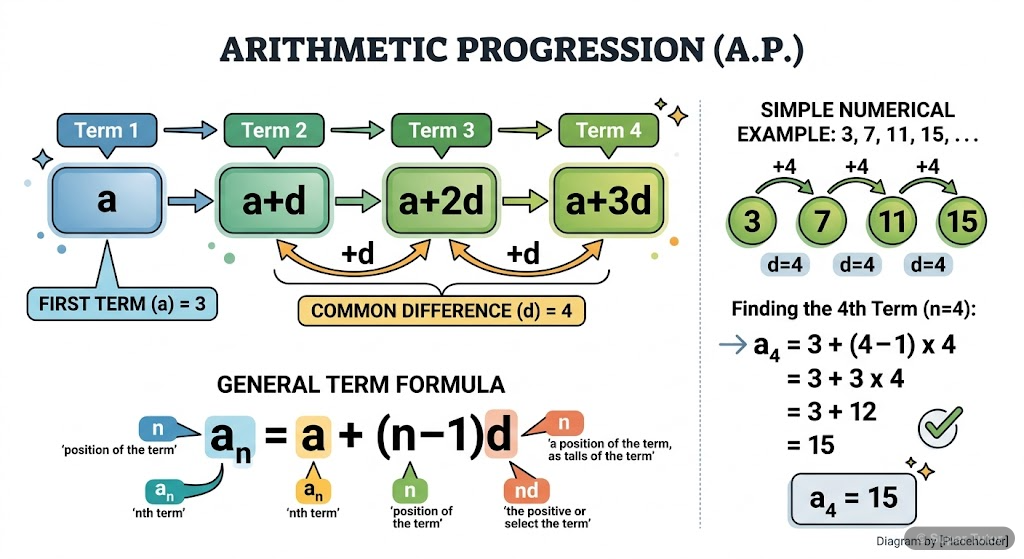
An arithmetic progression is a sequence of numbers where each term (except the first) is obtained by adding a fixed number to the previous term. For e
The common difference is the fixed
The common difference is the fixed number that we add to each term to get the next term. It is calculated as d = a_{k+1} - a_k (the difference between
The first term 'a' is
The first term 'a' is the starting number of the AP. We denote terms as a_1 (first term), a_2 (second term), a_3 (third term), and a_n (nth term). To
This formula allows us to find
This formula allows us to find any term in the AP without listing all previous terms. For the nth term: we start with the first term 'a' and add (n-1)
To find the sum of
To find the sum of the first n terms of an AP, we use S_n = n/2[2a + (n-1)d], where n is the number of terms, a is the first term, and d is the common
Learning Objectives
- Understand what an Arithmetic Progression is and identify APs from lists of numbers
- Calculate the common difference (d) in an AP and determine if a sequence is an AP
- Find the nth term of an AP using the formula a_n = a + (n-1)d
- Calculate the sum of the first n terms of an AP using summation formulas
- Apply AP concepts to solve real-life problems involving regular patterns
Frequently Asked Questions
What are the important topics in Arithmetic Progressions for Gujarat Board Class 10 Mathematics?
How should I revise Arithmetic Progressions for the Gujarat Board Class 10 board exam?
Sources & Official References
Content is aligned to the official syllabus. Refer to the board website for the latest curriculum.
More resources for Arithmetic Progressions
For serious students
Get the full Arithmetic Progressions chapter — start free.
Quizzes, flashcards, an AI doubt solver and a study plan for Gujarat Board Class 10 Mathematics. Free to start, no card needed.