Arithmetic Progressions — Flashcards
Gujarat Board · Class 10 · Mathematics
22 flashcards for Arithmetic Progressions (Gujarat Board Class 10 Mathematics) to test yourself on key terms and facts.
Interactive on Super Tutor
Studying Arithmetic Progressions? Get the full interactive chapter.
Quizzes, flashcards, AI doubt-solver and a step-by-step study plan — built for flashcards and more.
Free trial, no card needed.
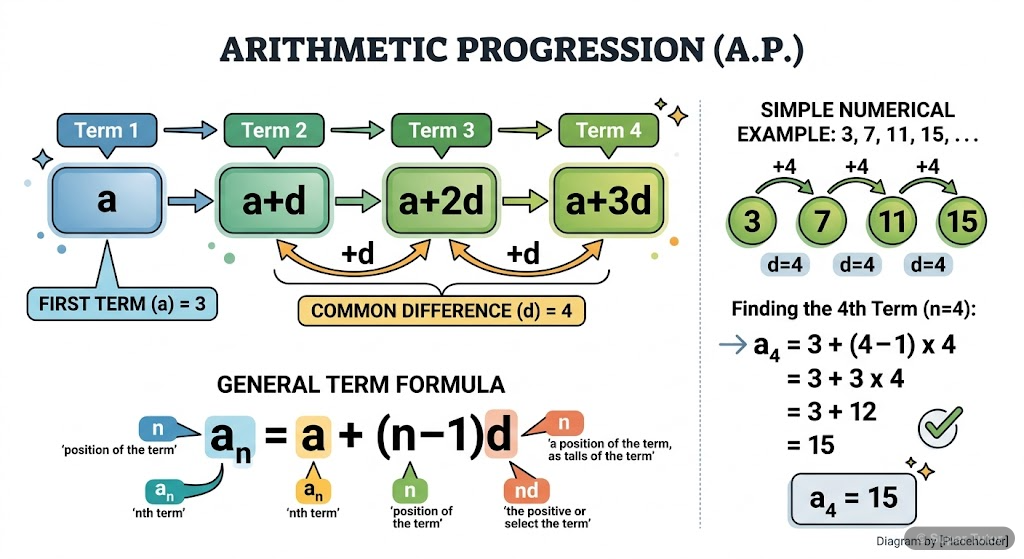
Learn better with visuals Super Tutor pairs illustrations like this with notes and quizzes for Arithmetic Progressions.
Check if the following list forms an AP: 5, 10, 15, 20, 25, ... If yes, find the first term and common difference.
Answer
Step 1: Check differences between consecutive terms. - a₂ - a₁ = 10 - 5 = 5 - a₃ - a₂ = 15 - 10 = 5 - a₄ - a₃ = 20 - 15 = 5 - a₅ - a₄ = 25 - 20 = 5 Step 2: Since all differences equal 5, this IS an A…
Check if 2, 4, 8, 16, 32, ... forms an AP. Explain why or why not.
Answer
Step 1: Calculate differences between consecutive terms. - a₂ - a₁ = 4 - 2 = 2 - a₃ - a₂ = 8 - 4 = 4 - a₄ - a₃ = 16 - 8 = 8 - a₅ - a₄ = 32 - 16 = 16 Step 2: The differences are 2, 4, 8, 16, ... (not …
Reena gets a starting salary of ₹8000 with an annual increment of ₹500. Write the AP for her salary for the first 5 years and find the common difference.
Answer
Step 1: First year salary = ₹8000 Second year salary = ₹8000 + ₹500 = ₹8500 Third year salary = ₹8500 + ₹500 = ₹9000 Fourth year salary = ₹9000 + ₹500 = ₹9500 Fifth year salary = ₹9500 + ₹500 = ₹10000…
Formula for nth term of an AP: Write the formula and explain what each symbol means.
Answer
Formula: aₙ = a + (n - 1)d Where: - aₙ = the nth term (general term) - a = first term of the AP - d = common difference - n = position of the term in the sequence Example: In AP 3, 7, 11, 15, ... a …
Find the 10th term of the AP: 2, 5, 8, 11, ...
Answer
Step 1: Identify the values. a (first term) = 2 d (common difference) = 5 - 2 = 3 n = 10 Step 2: Apply formula aₙ = a + (n - 1)d a₁₀ = 2 + (10 - 1)×3 a₁₀ = 2 + 9×3 a₁₀ = 2 + 27 a₁₀ = 29 Answer: The …
Find the 15th term of the AP: 100, 70, 40, 10, ...
Answer
Step 1: Identify the values. a (first term) = 100 d (common difference) = 70 - 100 = -30 n = 15 Step 2: Apply formula aₙ = a + (n - 1)d a₁₅ = 100 + (15 - 1)×(-30) a₁₅ = 100 + 14×(-30) a₁₅ = 100 - 420…
In an AP, if a = 3, d = 2, and aₙ = 23, find n (which term is 23?).
Answer
Step 1: Use formula aₙ = a + (n - 1)d 23 = 3 + (n - 1)×2 Step 2: Solve for n. 23 = 3 + 2n - 2 23 = 1 + 2n 22 = 2n n = 11 Step 3: Verify. a₁₁ = 3 + (11 - 1)×2 = 3 + 20 = 23 ✓ Answer: n = 11 (23 is t…
Formula for sum of first n terms of an AP: Write both forms and explain when to use each.
Answer
Formula 1: S = n/2 [2a + (n - 1)d] Where: - S = sum of first n terms - a = first term - d = common difference - n = number of terms Use when: You know a, d, and n Formula 2: S = n/2 (a + l) Where:…
+14 more flashcards
Practise AllFrequently Asked Questions
What are the important topics in Arithmetic Progressions for Gujarat Board Class 10 Mathematics?
How many flashcards are available for Arithmetic Progressions?
How should I revise Arithmetic Progressions for the Gujarat Board Class 10 board exam?
Sources & Official References
Content is aligned to the official syllabus. Refer to the board website for the latest curriculum.
More resources for Arithmetic Progressions
Practice Quiz
Test yourself with a quick quiz
Important Questions
Exam-style questions with answers
Revision Notes
Key points for last-minute revision
Formula Sheet
The chapter's formulas in one place
Chapter Summary
Understand the chapter at a glance
Concept Maps
See how topics connect
Syllabus
What topics to cover
For serious students
Get the full Arithmetic Progressions chapter — start free.
Quizzes, flashcards, an AI doubt solver and a study plan for Gujarat Board Class 10 Mathematics. Free to start, no card needed.