Chemical Reactions and Equations — Practice Quiz
Gujarat Board · Class 10 · Science
Try a 4-question quiz on Chemical Reactions and Equations for Gujarat Board Class 10 Science: tap an answer to check it and see why.
Interactive on Super Tutor
Studying Chemical Reactions and Equations? Get the full interactive chapter.
Quizzes, flashcards, AI doubt-solver and a step-by-step study plan — built for practice quiz and more.
Free trial, no card needed.
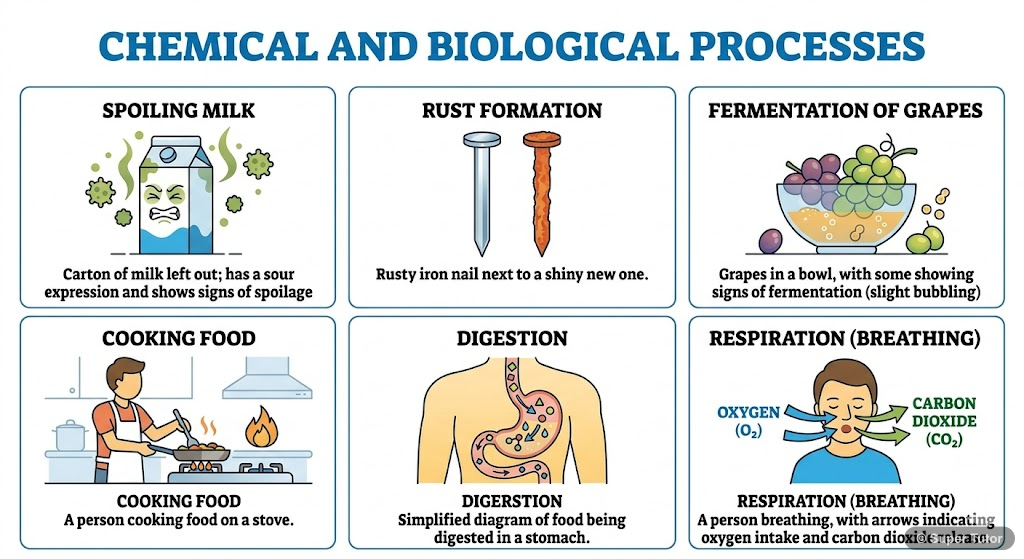
One of 23 illustrations for Chemical Reactions and Equations in Super Tutor — alongside flashcards, concept maps and practice questions.
Quick Quiz: Chemical Reactions and Equations
0/4Tap an answer to check it instantly. No sign-up needed for these 4.
What is the correct balanced equation for the combustion of magnesium in air?
The reaction CaO + H₂O → Ca(OH)₂ + Heat is an example of which type of reaction?
In the reaction Fe + CuSO₄ → FeSO₄ + Cu, which element is displaced?
What type of reaction occurs when silver chloride is exposed to sunlight?
Sample Questions
Which of the following are characteristics that indicate a chemical reaction has taken place?
Show answer
Change in color, Evolution of gas, Change in temperature, Change in state
Chemical reactions can be identified by observing changes in color, evolution of gas, temperature changes, and changes in state. These indicate that the chemical composition has changed. A mere change in shape without other indicators is usually a physical change.
Which of the following reactions are decomposition reactions?
Show answer
2FeSO₄ → Fe₂O₃ + SO₂ + SO₃, CaCO₃ → CaO + CO₂, 2H₂O → 2H₂ + O₂
Decomposition reactions involve a single reactant breaking down into two or more products. The first three options show this pattern. The last two are combination and displacement reactions respectively.
The process of respiration is an exothermic reaction.
Show answer
True
Respiration is indeed an exothermic reaction. During respiration, glucose combines with oxygen to produce carbon dioxide, water, and energy. The energy released is used by our body for various life processes.
Which symbols are used to represent different physical states in chemical equations?
Show answer
(s) for solid, (l) for liquid, (g) for gas, (aq) for aqueous solution
The standard symbols for physical states are (s) for solid, (l) for liquid, (g) for gas, and (aq) for aqueous solution (dissolved in water). There is no standard symbol (p) for powder.
+55 more questions on Chemical Reactions and Equations (Gujarat Board Class 10 Science)
Practise AllFrequently Asked Questions
What are the important topics in Chemical Reactions and Equations for Gujarat Board Class 10 Science?
How many practice questions are there for Chemical Reactions and Equations?
Sources & Official References
Content is aligned to the official syllabus. Refer to the board website for the latest curriculum.
More resources for Chemical Reactions and Equations
For serious students
Get the full Chemical Reactions and Equations chapter — start free.
Quizzes, flashcards, an AI doubt solver and a study plan for Gujarat Board Class 10 Science. Free to start, no card needed.