Metals and Non-metals — Practice Quiz
Gujarat Board · Class 10 · Science
Try a 4-question quiz on Metals and Non-metals for Gujarat Board Class 10 Science: tap an answer to check it and see why.
Interactive on Super Tutor
Studying Metals and Non-metals? Get the full interactive chapter.
Quizzes, flashcards, AI doubt-solver and a step-by-step study plan — built for practice quiz and more.
Free trial, no card needed.
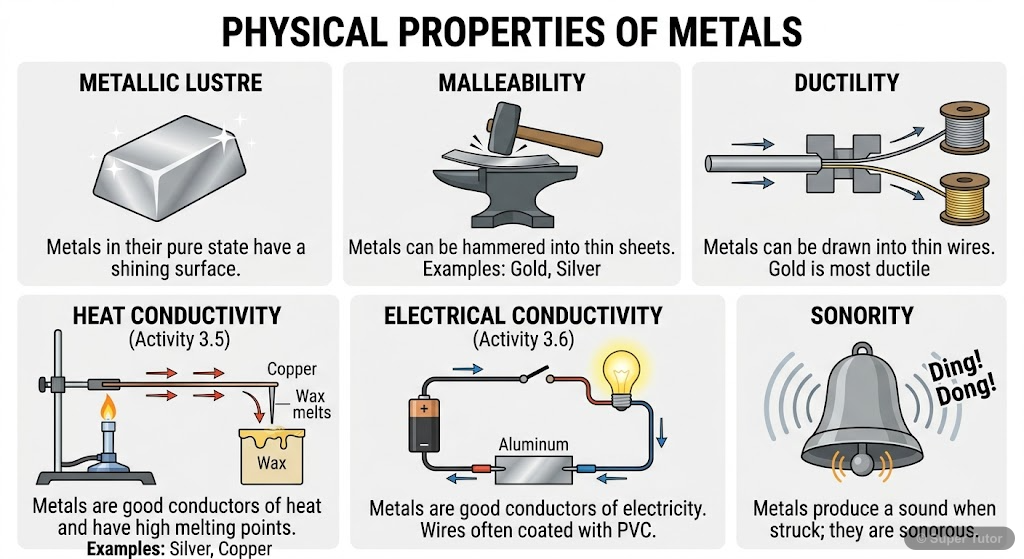
One of 16 illustrations for Metals and Non-metals in Super Tutor — alongside flashcards, concept maps and practice questions.
Quick Quiz: Metals and Non-metals
0/4Tap an answer to check it instantly. No sign-up needed for these 4.
Which of the following is a characteristic property of metals?
Which of the following metals can be cut with a knife?
What type of oxide is formed when metals burn in oxygen?
Which gas is produced when metals react with dilute acids?
Sample Questions
Which of the following properties are exhibited by non-metals? (Select all correct answers)
Show answer
Brittleness, Poor conductivity of electricity, Dull appearance
Non-metals are typically brittle (break into pieces when force is applied), poor conductors of electricity (except graphite), and have a dull appearance. Malleability and ductility are properties of metals.
Mercury is liquid at room temperature.
Show answer
True
Mercury is the only metal that exists as a liquid at room temperature. All other metals are solids at room temperature, though gallium and caesium have very low melting points.
Arrange the following metals in decreasing order of reactivity: Iron, Sodium, Copper, Zinc
Show answer
Sodium > Iron > Zinc > Copper
According to the reactivity series, sodium is highly reactive (stored in kerosene), followed by iron, then zinc, and copper is least reactive among these. The reactivity series helps predict which metals can displace others from their salt solutions.
Why is sodium kept immersed in kerosene oil?
Show answer
To prevent it from reacting with oxygen and moisture
Sodium is highly reactive and reacts vigorously with oxygen and moisture in air. It can even catch fire. To prevent accidental fires and oxidation, sodium is stored under kerosene oil, which prevents contact with air and moisture.
+41 more questions on Metals and Non-metals (Gujarat Board Class 10 Science)
Practise AllFrequently Asked Questions
What are the important topics in Metals and Non-metals for Gujarat Board Class 10 Science?
How many practice questions are there for Metals and Non-metals?
Sources & Official References
Content is aligned to the official syllabus. Refer to the board website for the latest curriculum.
More resources for Metals and Non-metals
Important Questions
Exam-style questions with answers
Revision Notes
Key points for last-minute revision
Formula Sheet
The chapter's formulas in one place
Chapter Summary
Understand the chapter at a glance
Concept Maps
See how topics connect
Flashcards
Quick-fire cards for active recall
Syllabus
What topics to cover
For serious students
Get the full Metals and Non-metals chapter — start free.
Quizzes, flashcards, an AI doubt solver and a study plan for Gujarat Board Class 10 Science. Free to start, no card needed.