Nutrition in Plants
Gujarat Board · Class 7 · Science
Most important questions from Nutrition in Plants for Gujarat Board Class 7 Science board exam 2026. MCQs, short answer, and long answer questions with marks.
Interactive on Super Tutor
Studying Nutrition in Plants? Get the full interactive chapter.
Quizzes, flashcards, AI doubt-solver and a step-by-step study plan — built for important questions and more.
1,000+ Class 7 students started this chapter today
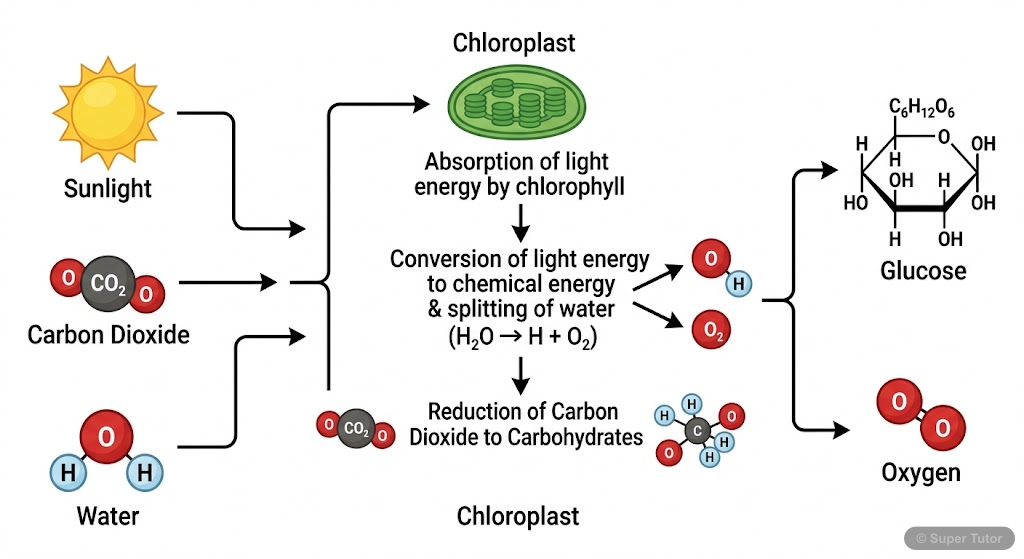
This is just one of 5+ visuals inside Super Tutor's Nutrition in Plants chapter
Explore the full setSample Questions
Which of the following is the food factory of a plant?
Show answer
Leaf
Step 1: For photosynthesis to happen, a plant needs chlorophyll, sunlight, water, and carbon dioxide. Step 2: Leaves contain the most chlorophyll and have a flat, broad shape to capture maximum sunlight. Step 3: Leaves also have stomata for gas exchange and veins that supply water and minerals. Step 4: This is why leaves are called the 'food factories' of plants. Roots absorb water, stems provide support and transport, and flowers help in reproduction.
What is the product of photosynthesis that plants store as food?
Show answer
Carbohydrate (Starch)
Step 1: When plants perform photosynthesis, they combine carbon dioxide and water using sunlight energy. Step 2: This produces carbohydrates, specifically in the form of sugars, which are then stored as starch. Step 3: We can test for the presence of starch in leaves using iodine solution – it turns blue-black if starch is present. Step 4: Proteins, fats, and vitamins are other nutrients but are NOT the direct products of photosynthesis.
Cuscuta (Amarbel) is a plant that grows on other plants and takes food from them. What type of nutrition does it show?
Show answer
Parasitic nutrition
Step 1: Cuscuta (Amarbel) is a yellow, wiry plant that twines around other plants. Step 2: It does not have chlorophyll, so it cannot make its own food. Step 3: It takes readymade food from the plant it grows on (called the host), harming the host plant. Step 4: Since Cuscuta depends on and harms another organism (host) for food, it is called a parasite and shows parasitic nutrition. Autotrophic means making own food, saprotrophic means feeding on dead matter, and symbiosis is a mutually beneficial relationship.
Which of the following organisms shows saprotrophic nutrition?
Show answer
Mushroom
Step 1: Saprotrophic nutrition means getting nutrients from dead and decaying organic matter. Step 2: Mushrooms are fungi that do not have chlorophyll, so they cannot make their own food. Step 3: They release digestive juices on dead or decaying material, break it down, and absorb the nutrients. Step 4: This is why mushrooms grow on rotting wood, moist soil, or decaying food. Cuscuta is a parasite, pitcher plant traps insects, and mango tree is an autotroph.
+41 more questions available
Practice AllFrequently Asked Questions
What are the important topics in Nutrition in Plants for Gujarat Board Class 7 Science?
How to score full marks in Nutrition in Plants — Gujarat Board Class 7 Science?
How many important questions are there in Nutrition in Plants?
Sources & Official References
Content is aligned to the official syllabus. Refer to the board website for the latest curriculum.
More resources for Nutrition in Plants
Practice Quiz
Test yourself with a quick quiz
Revision Notes
Key points for last-minute revision
Formula Sheet
All formulas in one place
Chapter Summary
Understand the chapter at a glance
Concept Maps
See how topics connect visually
Study Plan
Step-by-step plan to ace this chapter
Flashcards
Quick-fire cards for active recall
Syllabus
What topics to cover
NCERT Solutions
Every textbook question solved step by step
For serious students
Get the full Nutrition in Plants chapter — for free.
Quizzes, flashcards, AI doubt-solver and a step-by-step study plan for Gujarat Board Class 7 Science.