Nutrition in Plants — Syllabus
Gujarat Board · Class 7 · Science
What Nutrition in Plants covers in Gujarat Board Class 7 Science: 4 topics, for the 2026-27 session. Part of the Gujarat Board Class 7 Science syllabus.
Interactive on Super Tutor
Studying Nutrition in Plants? Get the full interactive chapter.
Quizzes, flashcards, AI doubt-solver and a step-by-step study plan — built for syllabus and more.
Free trial, no card needed.
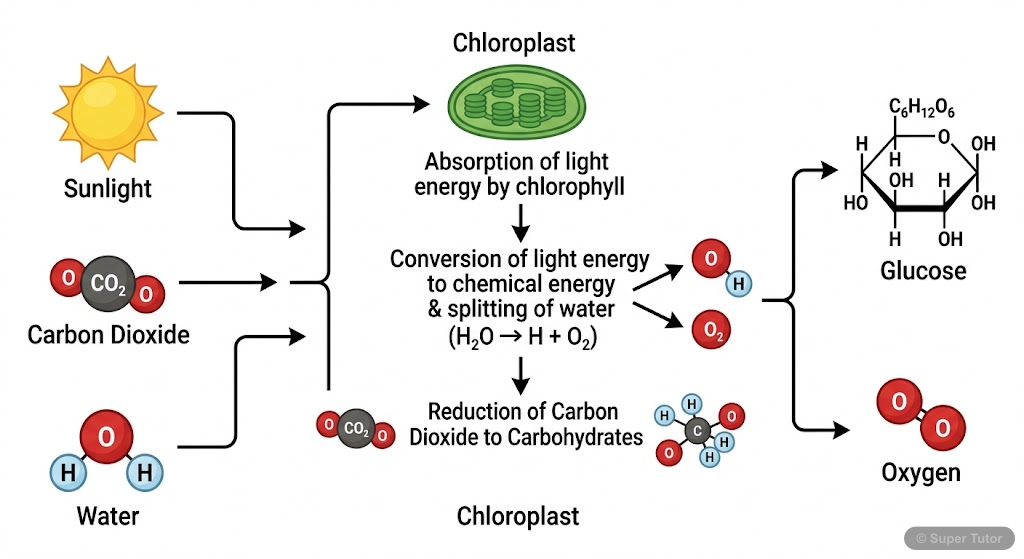
An illustration from Super Tutor's Nutrition in Plants chapter — alongside flashcards, concept maps and practice questions.
Topics in Nutrition in Plants
1. Nutrition and Its Types
- Nutrition is the mode of taking food by an organism and its utilisation by the body.
- Nutrients are the components of food (carbohydrates, proteins, fats, vitamins, minerals) that are necessary for the body.
- Autotrophic nutrition: Organisms make their own food from simple substances like CO₂, water, and minerals. Plants follow this mode.
2. Photosynthesis — The Food-Making Process in Plants
- Leaves are the food factories of plants.
- Chlorophyll is the green pigment present in leaves that captures sunlight energy.
- The four essential requirements for photosynthesis are: Chlorophyll, Sunlight, Carbon dioxide (CO₂), and Water.
3. Other Modes of Nutrition in Plants
- Not all plants have chlorophyll — some plants use heterotrophic modes of nutrition.
- PARASITIC NUTRITION: Some plants without chlorophyll take readymade food from other living plants (the host). Example: Cuscuta (Amarbel).
- Cuscuta is a yellow, wiry, branched plant that twines around the stem and branches of the host plant. It has no chlorophyll.
4. Saprotrophic Nutrition and Symbiosis
- SAPROTROPHIC NUTRITION: Organisms absorb nutrients from dead and decaying organic matter by secreting digestive juices onto the food and then absorbing it.
- Organisms using this mode are called SAPROTROPHS. Examples: Fungi (mushrooms, bread mould), some bacteria.
- Fungi do not have chlorophyll and cannot photosynthesise — they are heterotrophs.
Key Concepts
Work through every topic in Nutrition in Plants with notes and quizzes
Start This ChapterFrequently Asked Questions
What are the important topics in Nutrition in Plants for Gujarat Board Class 7 Science?
How should I revise Nutrition in Plants for Class 7 exams?
Sources & Official References
Content is aligned to the official syllabus. Refer to the board website for the latest curriculum.
More resources for Nutrition in Plants
For serious students
Get the full Nutrition in Plants chapter — start free.
Quizzes, flashcards, an AI doubt solver and a study plan for Gujarat Board Class 7 Science. Free to start, no card needed.