Physical and Chemical Changes
Gujarat Board · Class 7 · Science
Most important questions from Physical and Chemical Changes for Gujarat Board Class 7 Science board exam 2026. MCQs, short answer, and long answer questions with marks.
Interactive on Super Tutor
Studying Physical and Chemical Changes? Get the full interactive chapter.
Quizzes, flashcards, AI doubt-solver and a step-by-step study plan — built for important questions and more.
1,000+ Class 7 students started this chapter today
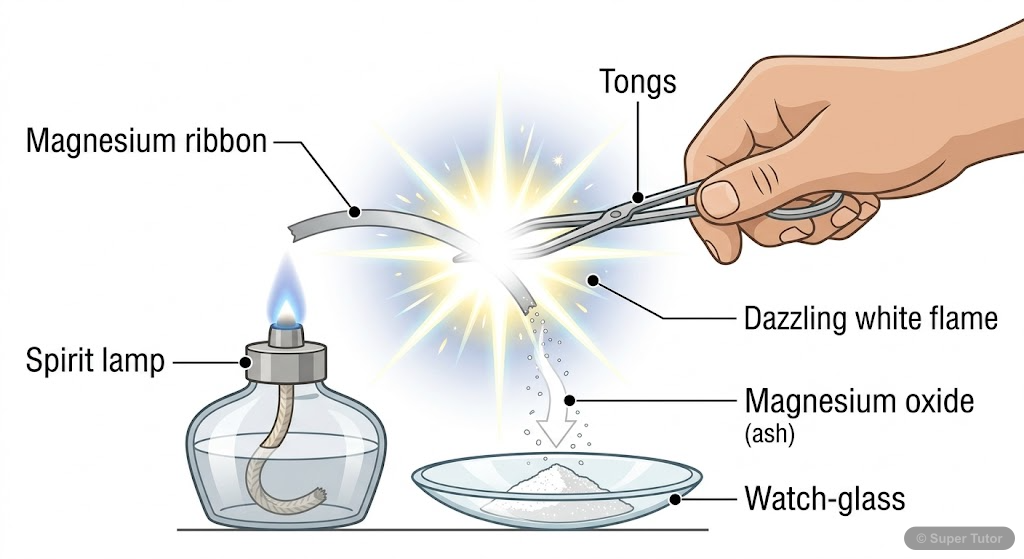
This is just one of 5+ visuals inside Super Tutor's Physical and Chemical Changes chapter
Explore the full setSample Questions
The chemical equation for rusting is: Fe + O₂ (from air) + H₂O → Fe₂O₃ (rust). A shopkeeper near the sea coast finds that iron tools rust much faster than those sold by a shopkeeper in a desert region. What is the MOST SCIENTIFIC reason for this?
Show answer
Sea air contains salt water moisture; salt increases the rate of rusting by acting as an electrolyte
Step 1: Rusting requires both oxygen (O₂) and water (H₂O). In coastal areas, humidity (moisture content in air) is much higher than in desert areas, so more water is available for rusting. Step 2: Additionally, sea air contains salt (sodium chloride) from ocean spray and sea breeze. Salt dissolved in water forms an electrolyte solution that significantly speeds up the rusting process. Step 3: Desert regions are very dry (low humidity), so very little water vapour is present in the air. Without sufficient water, rusting cannot occur rapidly even though oxygen is available. Step 4: Option A (sun
Galvanisation is a process used to prevent rusting of iron. Which of the following CORRECTLY describes galvanisation and explains how it prevents rusting?
Show answer
Coating iron with a layer of zinc; zinc prevents iron from coming into contact with oxygen and water
Step 1: Galvanisation specifically means depositing a thin layer of ZINC on iron. This is done by dipping iron in molten zinc or by electroplating. Step 2: Since rusting requires both oxygen (O₂) and water (H₂O) to contact the iron surface, the zinc coating acts as a physical barrier preventing both from reaching the iron. Step 3: Even if the zinc layer is scratched, zinc is more reactive than iron and preferentially reacts with oxygen and water, protecting the iron underneath. Step 4: Option A describes chromium coating (used in chrome plating), not galvanisation. Option C describes making st
In Activity 5.8, vinegar (acetic acid) is mixed with baking soda (sodium hydrogencarbonate). Bubbles are seen and a gas is produced. This gas turns lime water milky. Which of the following conclusions is MOST ACCURATE about this observation?
Show answer
The reaction is chemical because carbon dioxide (a new substance) is produced, which turns lime water milky
Step 1: The reaction is: Acetic acid + Sodium hydrogencarbonate → Carbon dioxide + other substances. CO₂ is a completely new substance not present in vinegar or baking soda. Step 2: This makes it a CHEMICAL change. The defining feature of a chemical change is the formation of new substances. Step 3: The gas produced (CO₂) turns lime water milky by forming calcium carbonate, which confirms it is CO₂ – a new substance. Step 4: Option A is wrong – the absence of a solid product does not make something a physical change. New gas = new substance = chemical change. Step 5: Option C is completely inc
A student performs four activities. Which activity among the following is an example of a PHYSICAL CHANGE where the original substance CAN be recovered?
Show answer
Dissolving copper sulphate crystals in water and then allowing the water to evaporate slowly to get crystals back
Step 1: A physical change is one where NO new substance is formed, and the change is often REVERSIBLE – meaning the original substance can be recovered. Step 2: When copper sulphate crystals dissolve in water, the copper sulphate is still present in solution. No chemical reaction occurs. By evaporating the water slowly (crystallisation), the original copper sulphate crystals can be recovered – confirming it is physical and reversible. Step 3: Burning paper produces ash and gases (CO₂, H₂O vapour). Paper cannot be recovered from ash. This is a chemical change. Step 4: Setting curd involves bact
+38 more questions available
Practice AllFrequently Asked Questions
What are the important topics in Physical and Chemical Changes for Gujarat Board Class 7 Science?
How to score full marks in Physical and Chemical Changes — Gujarat Board Class 7 Science?
How many important questions are there in Physical and Chemical Changes?
Sources & Official References
Content is aligned to the official syllabus. Refer to the board website for the latest curriculum.
More resources for Physical and Chemical Changes
Practice Quiz
Test yourself with a quick quiz
Revision Notes
Key points for last-minute revision
Formula Sheet
All formulas in one place
Chapter Summary
Understand the chapter at a glance
Concept Maps
See how topics connect visually
Study Plan
Step-by-step plan to ace this chapter
Flashcards
Quick-fire cards for active recall
Syllabus
What topics to cover
NCERT Solutions
Every textbook question solved step by step
For serious students
Get the full Physical and Chemical Changes chapter — for free.
Quizzes, flashcards, AI doubt-solver and a step-by-step study plan for Gujarat Board Class 7 Science.