Matter in our Surroundings — Practice Quiz
Gujarat Board · Class 9 · Science
Try a 4-question quiz on Matter in our Surroundings for Gujarat Board Class 9 Science: tap an answer to check it and see why.
Interactive on Super Tutor
Studying Matter in our Surroundings? Get the full interactive chapter.
Quizzes, flashcards, AI doubt-solver and a step-by-step study plan — built for practice quiz and more.
Free trial, no card needed.
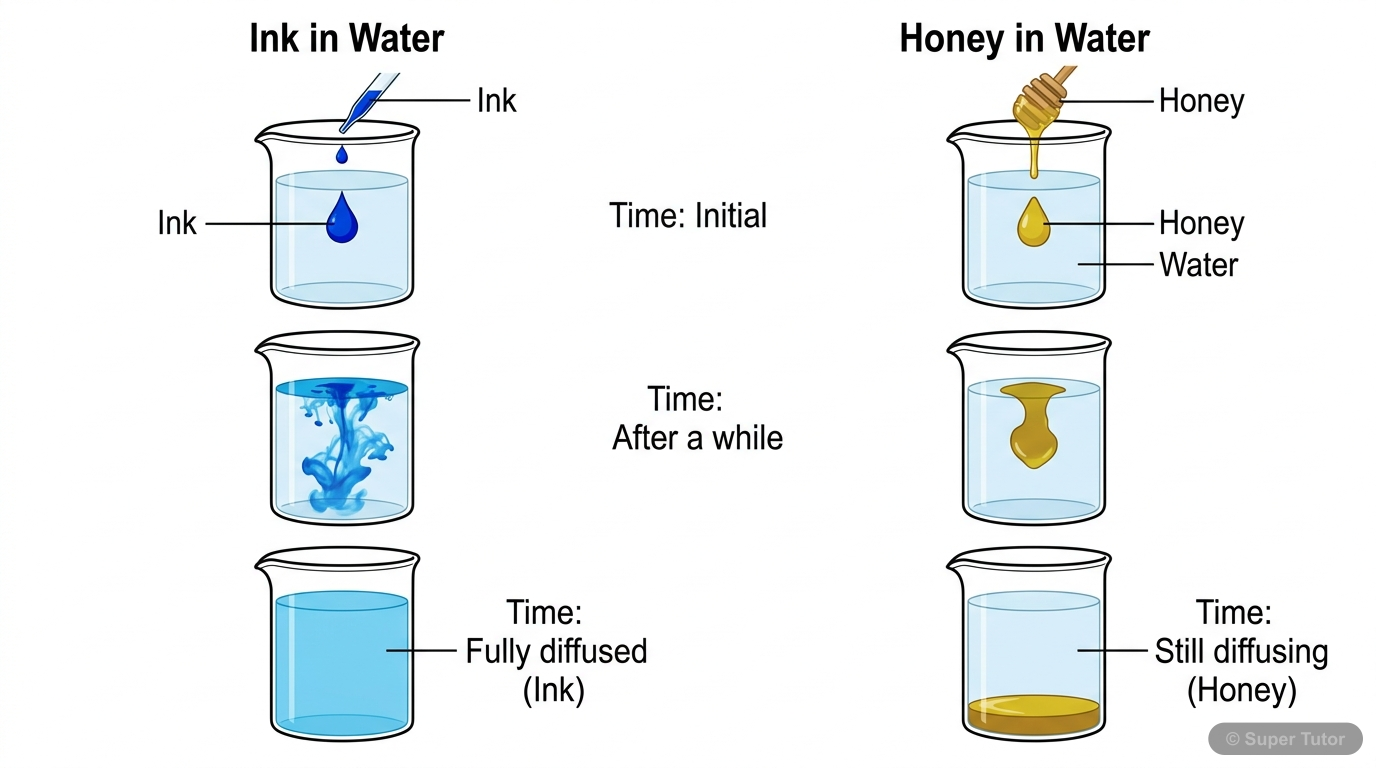
One of 2 illustrations for Matter in our Surroundings in Super Tutor — alongside flashcards, concept maps and practice questions.
Quick Quiz: Matter in our Surroundings
0/4Tap an answer to check it instantly. No sign-up needed for these 4.
Which of the following best describes matter?
What happens to the particles of matter when sugar dissolves in water?
The force of attraction between particles is maximum in:
The process of change from solid directly to gas is called:
Sample Questions
Which of the following demonstrate that particles of matter are in continuous motion?
Show answer
Smell of incense stick spreading in a room, Ink drop spreading in water, Diffusion of potassium permanganate in water, Steam rising from hot water
All these examples show diffusion - the mixing of particles on their own. This happens because particles are continuously moving. The book lying on a table does not demonstrate particle motion as it appears stationary at the macro level.
Which properties are characteristic of liquids?
Show answer
Fixed volume, Can flow, Take shape of container
Liquids have a fixed volume but no fixed shape. They take the shape of their container and can flow. Unlike gases, liquids are not highly compressible, and unlike solids, they don't have a fixed shape.
At which temperature does pure water boil at normal atmospheric pressure?
Show answer
100°C
Pure water boils at 100°C (or 373 K) at normal atmospheric pressure. This is the temperature at which liquid water changes to water vapor (steam).
Which factors affect the rate of evaporation?
Show answer
Surface area, Temperature, Wind speed, Humidity
Evaporation rate increases with larger surface area, higher temperature, higher wind speed, and lower humidity. The color of the container does not directly affect evaporation rate.
+41 more questions on Matter in our Surroundings (Gujarat Board Class 9 Science)
Practise AllFrequently Asked Questions
What are the important topics in Matter in our Surroundings for Gujarat Board Class 9 Science?
How many practice questions are there for Matter in our Surroundings?
Sources & Official References
Content is aligned to the official syllabus. Refer to the board website for the latest curriculum.
More resources for Matter in our Surroundings
For serious students
Get the full Matter in our Surroundings chapter — start free.
Quizzes, flashcards, an AI doubt solver and a study plan for Gujarat Board Class 9 Science. Free to start, no card needed.