Is Matter Around us Pure? — Practice Quiz
Gujarat Board · Class 9 · Science
Try a 4-question quiz on Is Matter Around us Pure? for Gujarat Board Class 9 Science: tap an answer to check it and see why.
Interactive on Super Tutor
Studying Is Matter Around us Pure?? Get the full interactive chapter.
Quizzes, flashcards, AI doubt-solver and a step-by-step study plan — built for practice quiz and more.
Free trial, no card needed.
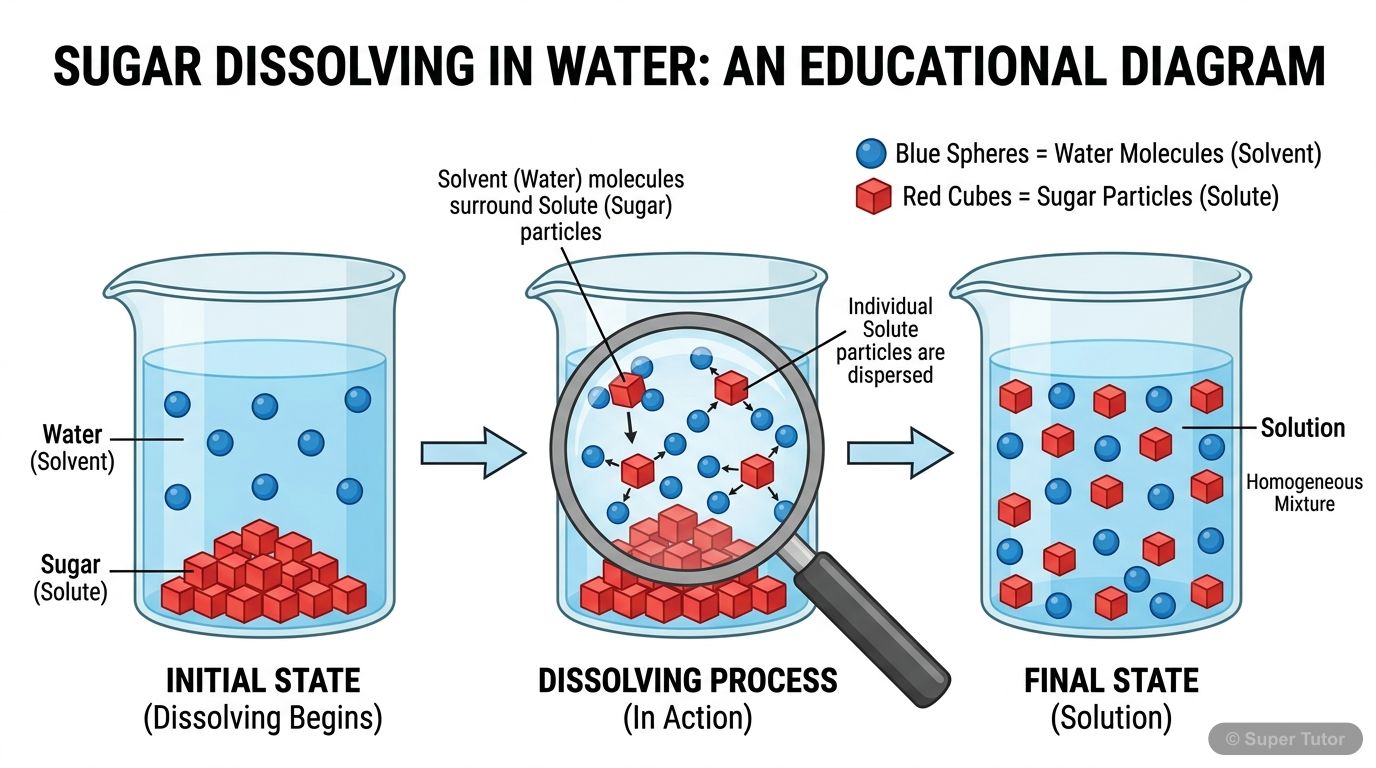
One of 2 illustrations for Is Matter Around us Pure? in Super Tutor — alongside flashcards, concept maps and practice questions.
Quick Quiz: Is Matter Around us Pure?
0/4Tap an answer to check it instantly. No sign-up needed for these 4.
Which of the following is an example of a homogeneous mixture?
What is the solute in a solution of salt dissolved in water?
A saturated solution is one in which:
The size of particles in a true solution is:
Sample Questions
Which of the following properties are shown by metals?
Show answer
They have lustre (shine), They conduct heat and electricity, They are malleable, They are ductile
Metals typically show several characteristic properties: they have lustre (shine), conduct heat and electricity well, are malleable (can be hammered into thin sheets), and are ductile (can be drawn into wires). They are also sonorous (make ringing sounds when hit). Poor conduction of electricity is a property of non-metals, not metals.
Which of the following mixtures will show the Tyndall effect?
Show answer
Milk, Starch solution, Fog
The Tyndall effect is shown by colloids because their particles are large enough to scatter light. Milk, starch solution, and fog are all colloids. Salt solution and sugar solution are true solutions with very small particles that don't scatter light, so they don't show the Tyndall effect.
Which of the following are examples of compounds?
Show answer
Water (H₂O), Carbon dioxide (CO₂), Sodium chloride (NaCl)
Compounds are substances composed of two or more elements chemically combined in fixed proportions. Water (H₂O), carbon dioxide (CO₂), and sodium chloride (NaCl) are all compounds. Iron and oxygen are elements, not compounds, as they consist of only one type of atom.
Which separation technique would you use to separate salt from salt water?
Show answer
Evaporation
Evaporation is used to separate salt from salt water because salt has a much higher boiling point than water. When heated, water evaporates leaving behind solid salt crystals. Filtration won't work as salt is dissolved, not suspended. Decantation and magnets are not suitable for this separation.
+53 more questions on Is Matter Around us Pure? (Gujarat Board Class 9 Science)
Practise AllFrequently Asked Questions
What are the important topics in Is Matter Around us Pure? for Gujarat Board Class 9 Science?
How many practice questions are there for Is Matter Around us Pure??
Sources & Official References
Content is aligned to the official syllabus. Refer to the board website for the latest curriculum.
More resources for Is Matter Around us Pure?
For serious students
Get the full Is Matter Around us Pure? chapter — start free.
Quizzes, flashcards, an AI doubt solver and a study plan for Gujarat Board Class 9 Science. Free to start, no card needed.