Matter in our Surroundings — Flashcards
Gujarat Board · Class 9 · Science
30 flashcards for Matter in our Surroundings (Gujarat Board Class 9 Science) to test yourself on key terms and facts.
Interactive on Super Tutor
Studying Matter in our Surroundings? Get the full interactive chapter.
Quizzes, flashcards, AI doubt-solver and a step-by-step study plan — built for flashcards and more.
Free trial, no card needed.
One of 2 illustrations for Matter in our Surroundings in Super Tutor — alongside flashcards, concept maps and practice questions.
What is matter? Give two key properties that define matter.
Answer
Matter is anything that occupies space and has mass. The two key properties are: (1) Mass - the amount of substance in an object, measured in kilograms (kg), and (2) Volume - the amount of space occup…
When salt is dissolved in water, the level of water does not change significantly. What does this observation tell us about the nature of matter?
Answer
This observation demonstrates that matter is made up of tiny particles. The salt particles spread throughout the water by fitting into the spaces between water particles. This proves that matter is no…
In Activity 1.2, a few crystals of potassium permanganate can colour a large volume of water (up to 1000 litres) even on repeated dilution. What does this tell us about the size of matter particles?
Answer
This demonstrates that particles of matter are incredibly tiny - far beyond our imagination! A single crystal contains millions upon millions of particles. When diluted repeatedly, the particles keep …
Why can we smell the aroma of food cooking in the kitchen from several metres away without entering the kitchen?
Answer
The smell of cooking food is due to gaseous particles (aroma molecules) being released. These particles move randomly at high speed and spread throughout the air by diffusing into the space between ai…
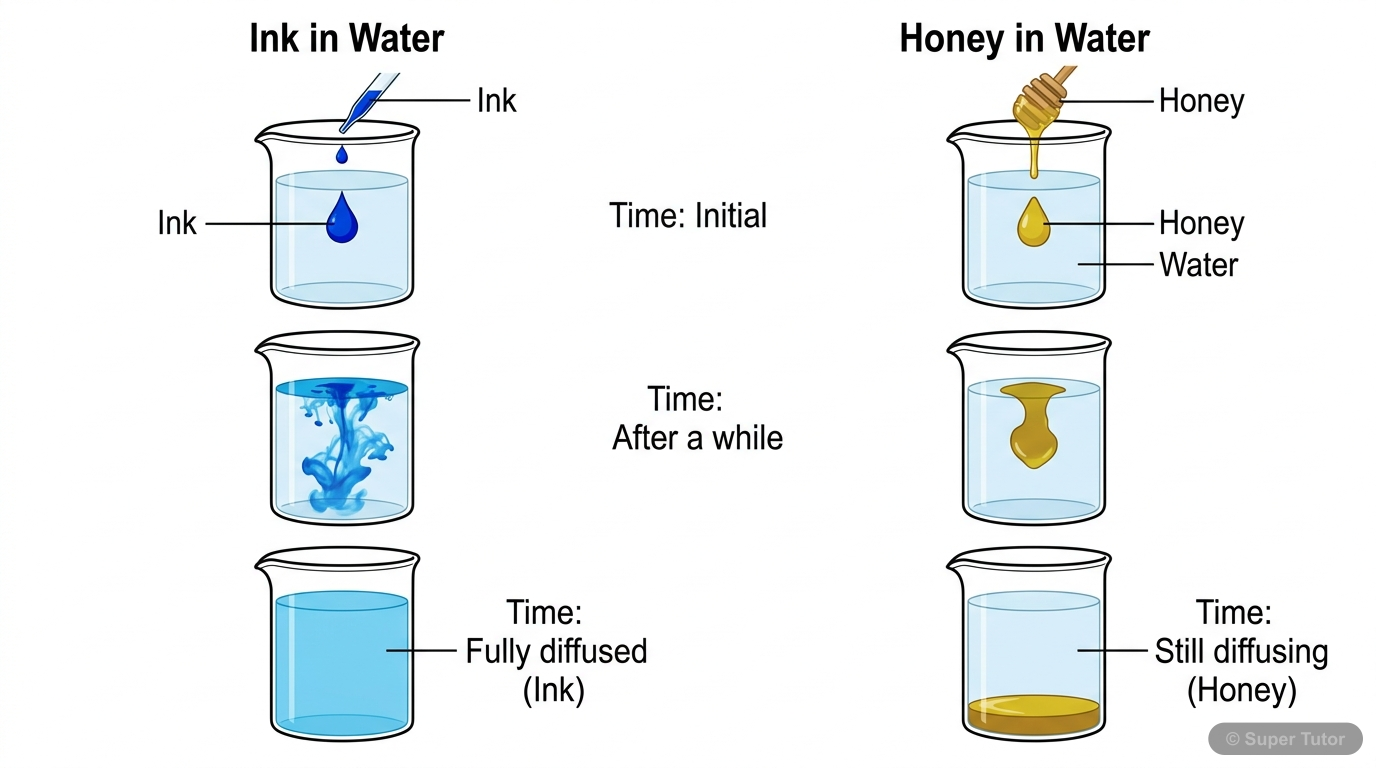
Compare the rate of spreading of blue ink in water at room temperature versus a drop of honey in the same container. Which spreads faster and why?
Answer
Blue ink spreads much faster than honey in water. This is because: (1) Ink particles move faster than honey particles at the same temperature, (2) Ink is a liquid with particles that move more freely …
When a crystal of copper sulphate is placed in hot water and cold water without stirring, the hot water becomes coloured faster. Explain why.
Answer
The hot water becomes coloured faster because particles move faster at higher temperatures. At higher temperature, particles have greater kinetic energy and move with higher speeds. This faster moveme…
In Activity 1.6 (human chain game), which group was easiest to break and what does this tell us about matter particles?
Answer
The group holding by fingertips (third group) was easiest to break because the forces holding them together were weakest. The group with locked arms (first group) was hardest to break because forces w…
Why can we easily cut through water with our fingers but cannot cut through a wooden table?
Answer
This difference is due to the strength of attractive forces between particles. In water (liquid), particles are farther apart and have weaker forces between them, so they can move apart easily when we…
+22 more flashcards
Practise AllFrequently Asked Questions
What are the important topics in Matter in our Surroundings for Gujarat Board Class 9 Science?
How many flashcards are available for Matter in our Surroundings?
How should I revise Matter in our Surroundings for Class 9 exams?
Sources & Official References
Content is aligned to the official syllabus. Refer to the board website for the latest curriculum.
More resources for Matter in our Surroundings
For serious students
Get the full Matter in our Surroundings chapter — start free.
Quizzes, flashcards, an AI doubt solver and a study plan for Gujarat Board Class 9 Science. Free to start, no card needed.