Matter in our Surroundings — Revision Notes
Gujarat Board · Class 9 · Science
Matter in our Surroundings revision notes for Gujarat Board Class 9 Science: 4 topics in quick points. Part of the Gujarat Board Class 9 Science syllabus.
Interactive on Super Tutor
Studying Matter in our Surroundings? Get the full interactive chapter.
Quizzes, flashcards, AI doubt-solver and a step-by-step study plan — built for revision notes and more.
Free trial, no card needed.
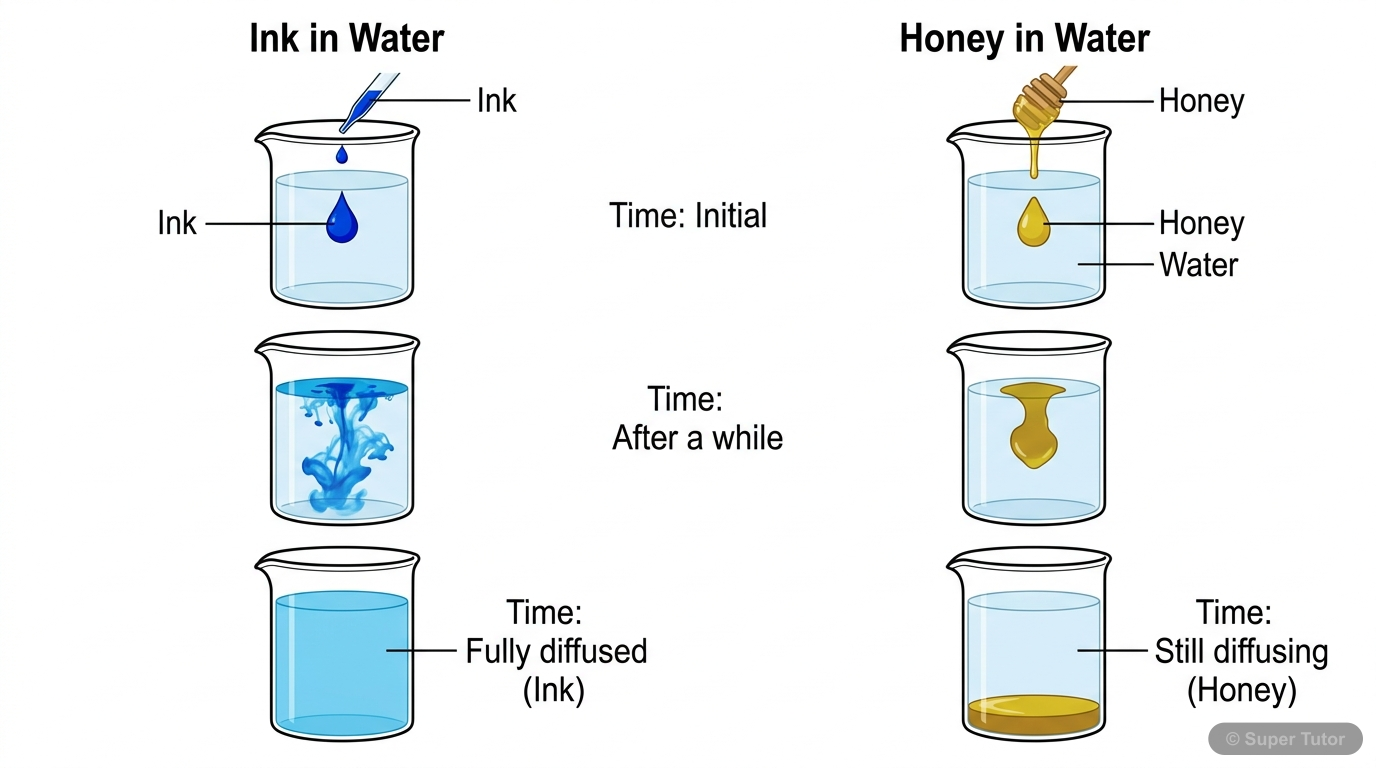
One of 2 illustrations for Matter in our Surroundings in Super Tutor — alongside flashcards, concept maps and practice questions.
Key Topics to Revise
Physical Nature of Matter
- Matter is made up of tiny particles that are too small to be seen with the naked eye.
- When salt or sugar is dissolved in water, the level of water does not rise significantly because the particles of salt/sugar fit into the spaces between water particles.
- Potassium permanganate experiment: A few crystals can colour millions of litres of water, proving particles are extremely small and present in very large numbers.
Characteristics of Particles of Matter
- Three key characteristics: (1) Particles have space between them, (2) Particles are continuously moving, (3) Particles attract each other.
- Space between particles: Salt/sugar dissolves in water because particles of solute fit into spaces between water particles.
- Continuous movement: Particles possess kinetic energy and are always in motion. As temperature rises, kinetic energy increases.
States of Matter
- Matter exists in three states: Solid, Liquid, and Gas.
- SOLID STATE: Definite shape, definite volume, negligible compressibility, rigid, particles are tightly packed with very little space, very strong intermolecular forces, very low kinetic energy.
- LIQUID STATE: No fixed shape (takes shape of container), definite volume, slightly compressible, can flow (fluid), particles have more space than solids, intermediate intermolecular forces, moderate k
Change of State of Matter
- State of matter can be changed by changing temperature or pressure.
- MELTING: Solid → Liquid (on heating). Temperature at which solid melts = Melting Point.
- Melting point of ice = 273 K (0°C).
Get complete notes with diagrams and examples
Full NotesKey Concepts
Frequently Asked Questions
What are the important topics in Matter in our Surroundings for Gujarat Board Class 9 Science?
How should I revise Matter in our Surroundings for Class 9 exams?
Sources & Official References
Content is aligned to the official syllabus. Refer to the board website for the latest curriculum.
More resources for Matter in our Surroundings
For serious students
Get the full Matter in our Surroundings chapter — start free.
Quizzes, flashcards, an AI doubt solver and a study plan for Gujarat Board Class 9 Science. Free to start, no card needed.