Public Revenue — Chapter Summary
ICSE · Class 10 · Economics
Summary of Public Revenue for ICSE Class 10 Economics. Key concepts: Public revenue means, Government revenue is divided and A tax is a compulsory payment.
Interactive on Super Tutor
Studying Public Revenue? Get the full interactive chapter.
Quizzes, flashcards, AI doubt-solver and a step-by-step study plan — built for chapter summary and more.
Free trial, no card needed.
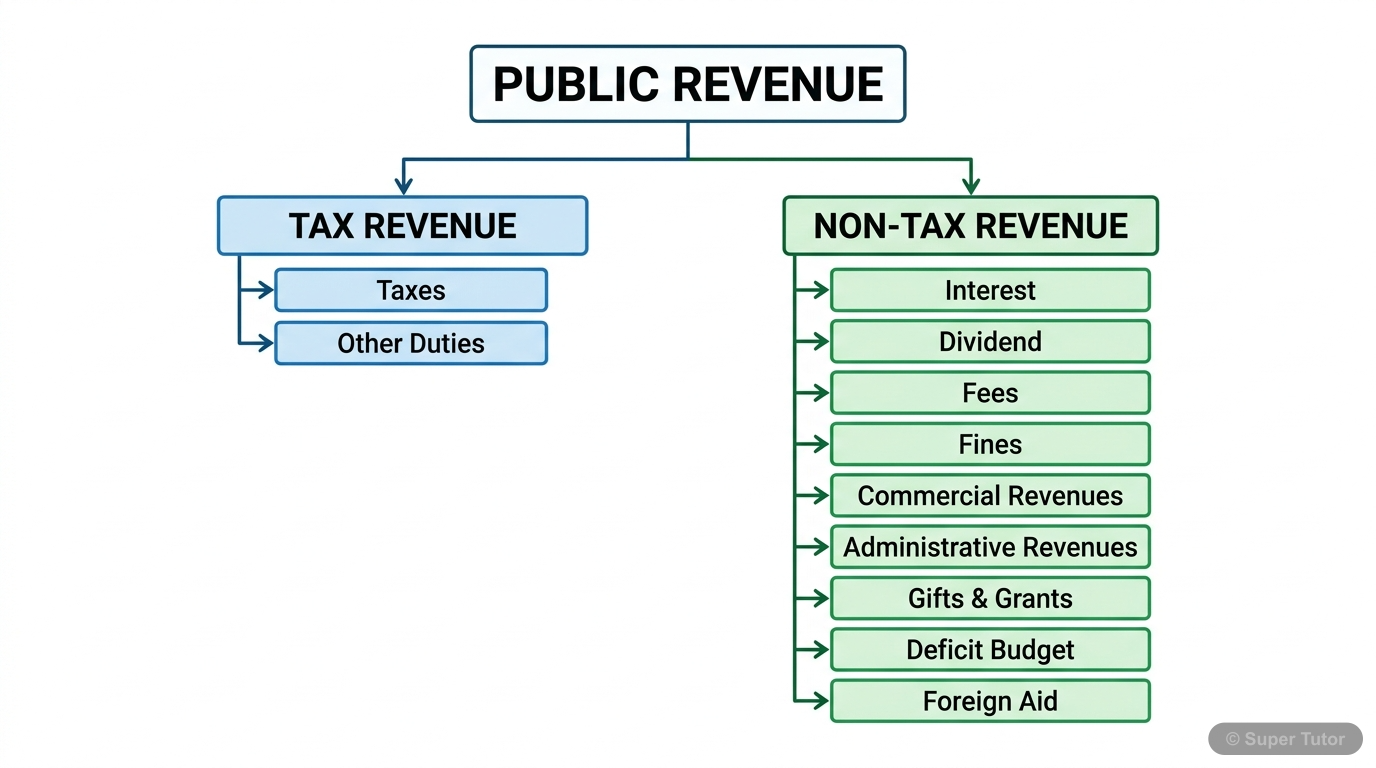
Learn better with visuals Super Tutor pairs illustrations like this with notes and quizzes for Public Revenue.
Get startedOverview
Public revenue is the income of the government from taxes, borrowings, fees, fines, donations, and similar sources. It is needed because modern governments perform many functions for the welfare of society. Public revenue is the means for public expenditure, just as production is the means for consu
Key Concepts
Public revenue means the income
Public revenue means the income of the government from all sources such as taxes, borrowings, fees, fines, donations, and other receipts. In the narro
Government revenue is divided into tax
Government revenue is divided into tax revenue and non-tax revenue. Tax revenue comes from taxes and other duties levied by the government. Non-tax re
A tax is a compulsory payment
A tax is a compulsory payment imposed by the government on persons or companies to meet expenditure for common benefits. It is legally collected, paid
A direct tax is paid by
A direct tax is paid by the same person on whom it is imposed, so the burden cannot be shifted. Examples include income tax, corporation tax, gift tax
An indirect tax is imposed on
An indirect tax is imposed on one person but the burden can be partly or wholly shifted to another person. Examples include excise duty, VAT, sales ta
Learning Objectives
- Understand the meaning of public revenue and public receipts
- Identify the main sources of government revenue
- Explain the meaning, characteristics, and importance of tax
- Distinguish between direct taxes and indirect taxes
- Describe the merits and demerits of direct and indirect taxes
Frequently Asked Questions
What are the important topics in Public Revenue for ICSE Class 10 Economics?
How should I revise Public Revenue for the ICSE Class 10 board exam?
Sources & Official References
Content is aligned to the official syllabus. Refer to the board website for the latest curriculum.
More resources for Public Revenue
For serious students
Get the full Public Revenue chapter — start free.
Quizzes, flashcards, an AI doubt solver and a study plan for ICSE Class 10 Economics. Free to start, no card needed.