Elasticity of Demand — Chapter Summary
ICSE · Class 10 · Economics
Summary of Elasticity of Demand for ICSE Class 10 Economics. Key concepts: Price elasticity of demand, The basic formula is Ed = and If Ed equals 1.
Interactive on Super Tutor
Studying Elasticity of Demand? Get the full interactive chapter.
Quizzes, flashcards, AI doubt-solver and a step-by-step study plan — built for chapter summary and more.
Free trial, no card needed.
One of 3 illustrations for Elasticity of Demand in Super Tutor — alongside flashcards, concept maps and practice questions.
See them allOverview
Elasticity of demand measures how much the quantity demanded of a commodity changes when its price changes. It shows the responsiveness or sensitivity of demand to price. Some goods show a large change in demand even when price changes a little, while some goods show only a small change. This differ
Key Concepts
Price elasticity of demand tells
Price elasticity of demand tells the amount of change in quantity demanded of a commodity in response to change in its price. It is measured using per
The basic formula is Ed =
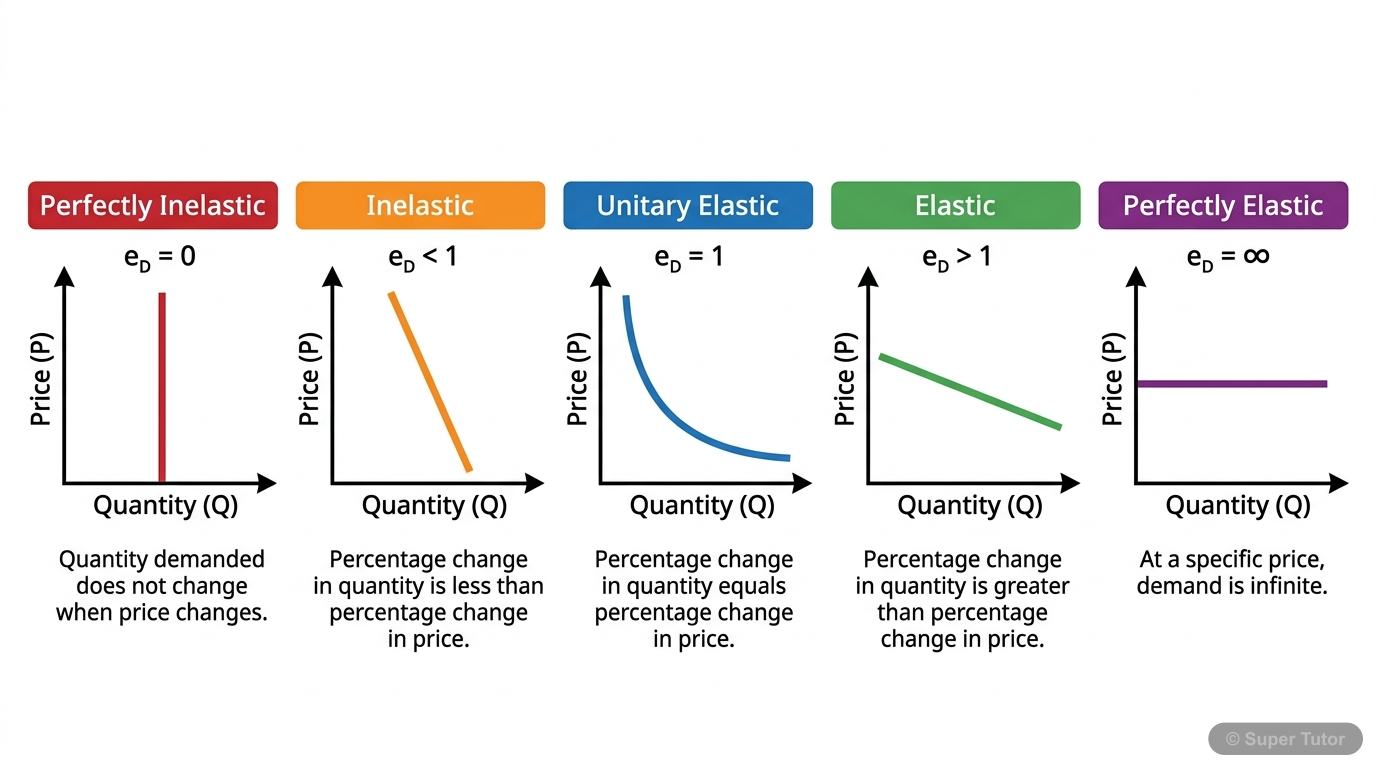
The basic formula is Ed = Percentage change in demand for the good / Percentage change in price of the good. The simplified form is Ed = ΔQ/ΔP × P/Q.
If Ed equals 1
If Ed equals 1, demand is unit elastic. According to Dr. Marshall, total expenditure remains the same even when the price changes. Rectangular hyperbo
If Ed is less than 1
If Ed is less than 1, demand is inelastic or less elastic. Quantity demanded changes less than the price change. Necessary goods often have inelastic
If Ed is greater than 1
If Ed is greater than 1, demand is elastic. Quantity demanded changes more than the price change. Luxury goods like jewellery and precious clothes hav
Learning Objectives
- Understand the meaning of elasticity of demand
- Learn the percentage method of measuring price elasticity of demand
- Identify the five degrees of price elasticity of demand
- Recognise the factors that affect price elasticity of demand
- Understand the three main types of elasticity of demand: price, income, and cross elasticity
Frequently Asked Questions
What are the important topics in Elasticity of Demand for ICSE Class 10 Economics?
How should I revise Elasticity of Demand for the ICSE Class 10 board exam?
Sources & Official References
Content is aligned to the official syllabus. Refer to the board website for the latest curriculum.
More resources for Elasticity of Demand
Practice Quiz
Test yourself with a quick quiz
Important Questions
Exam-style questions with answers
Revision Notes
Key points for last-minute revision
Formula Sheet
The chapter's formulas in one place
Concept Maps
See how topics connect
Study Plan
Step-by-step plan for this chapter
Flashcards
Quick-fire cards for active recall
Syllabus
What topics to cover
For serious students
Get the full Elasticity of Demand chapter — start free.
Quizzes, flashcards, an AI doubt solver and a study plan for ICSE Class 10 Economics. Free to start, no card needed.