Meaning and Functions of Money — Chapter Summary
ICSE · Class 10 · Economics
Summary of Meaning and Functions of Money for ICSE Class 10 Economics. Part of the ICSE Class 10 Economics syllabus.
Interactive on Super Tutor
Studying Meaning and Functions of Money? Get the full interactive chapter.
Quizzes, flashcards, AI doubt-solver and a step-by-step study plan — built for chapter summary and more.
Free trial, no card needed.
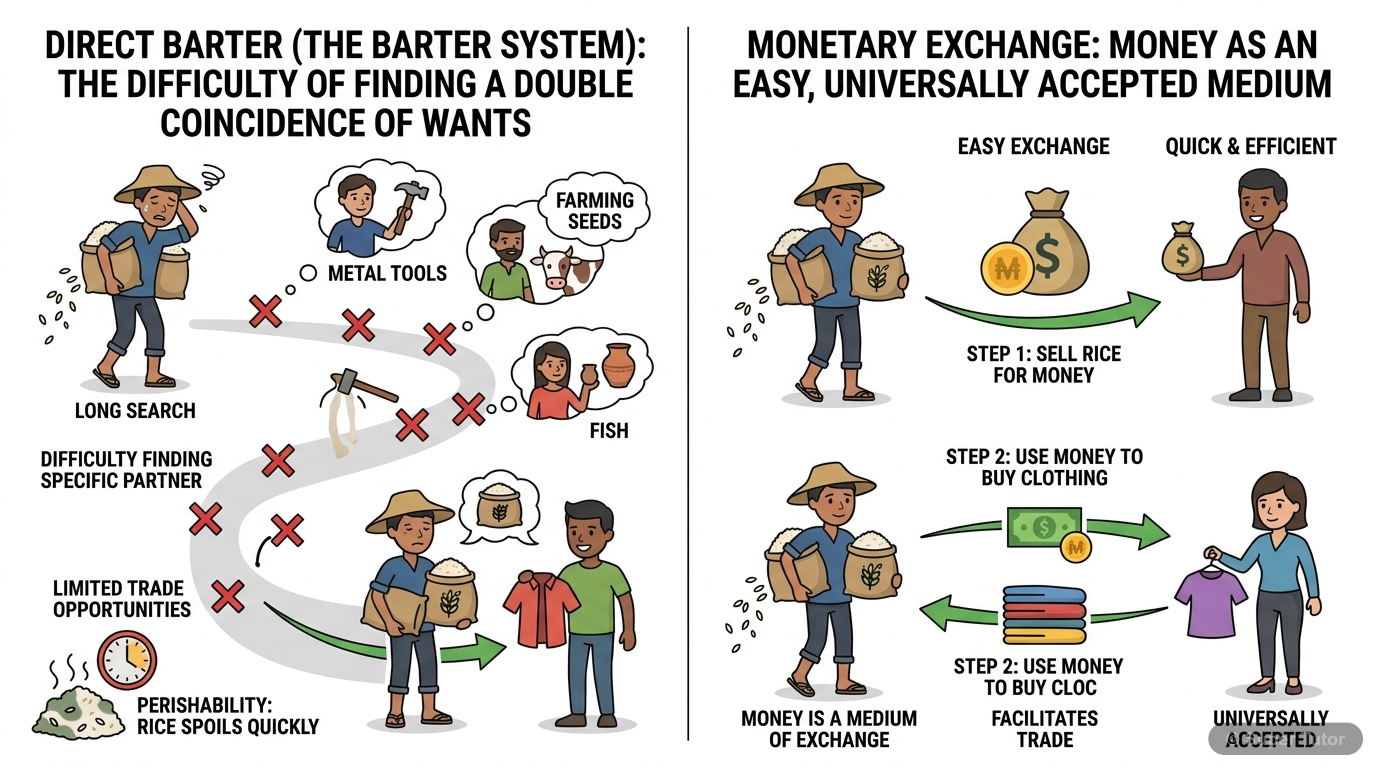
Learn better with visuals Super Tutor pairs illustrations like this with notes and quizzes for Meaning and Functions of Money.
Get startedOverview
Money is a central part of economic life because it makes exchange easier. In a barter system, goods are exchanged directly for goods, but this creates many problems. Money solves these problems by acting as a common medium of exchange, a measure of value, a standard of deferred payments, and a stor
Key Concepts
Barter is a system of exchange
Barter is a system of exchange in which goods and services are exchanged directly for other goods and services. It is also called C-C economy, where C
The barter system has five main
The barter system has five main difficulties: lack of double coincidence of wants, lack of common measure of value, lack of divisibility, problem of s
Money developed in five stages
Money developed in five stages: animal money, commodity money, metallic money, paper money, and bank money.
Money is anything generally accepted as
Money is anything generally accepted as a medium of exchange. It is also used to measure value and store value.
Crowther defined money as anything generally
Crowther defined money as anything generally acceptable as a medium of exchange and also acting as a measure and store of value. D.H. Robertson define
Learning Objectives
- Understand the meaning of barter and its difficulties
- Explain the evolution of money through five stages
- Learn the different definitions of money given by economists
- Identify the main forms of money such as full bodied money, fiat money, legal tender money, high powered money, bank money, and near money
- Understand the features of money
Frequently Asked Questions
What are the important topics in Meaning and Functions of Money for ICSE Class 10 Economics?
How should I revise Meaning and Functions of Money for the ICSE Class 10 board exam?
Sources & Official References
Content is aligned to the official syllabus. Refer to the board website for the latest curriculum.
More resources for Meaning and Functions of Money
For serious students
Get the full Meaning and Functions of Money chapter — start free.
Quizzes, flashcards, an AI doubt solver and a study plan for ICSE Class 10 Economics. Free to start, no card needed.