Elementary Theory of Demand — Chapter Summary
ICSE · Class 10 · Economics
Summary of Elementary Theory of Demand for ICSE Class 10 Economics. Part of the ICSE Class 10 Economics syllabus.
Interactive on Super Tutor
Studying Elementary Theory of Demand? Get the full interactive chapter.
Quizzes, flashcards, AI doubt-solver and a step-by-step study plan — built for chapter summary and more.
Free trial, no card needed.
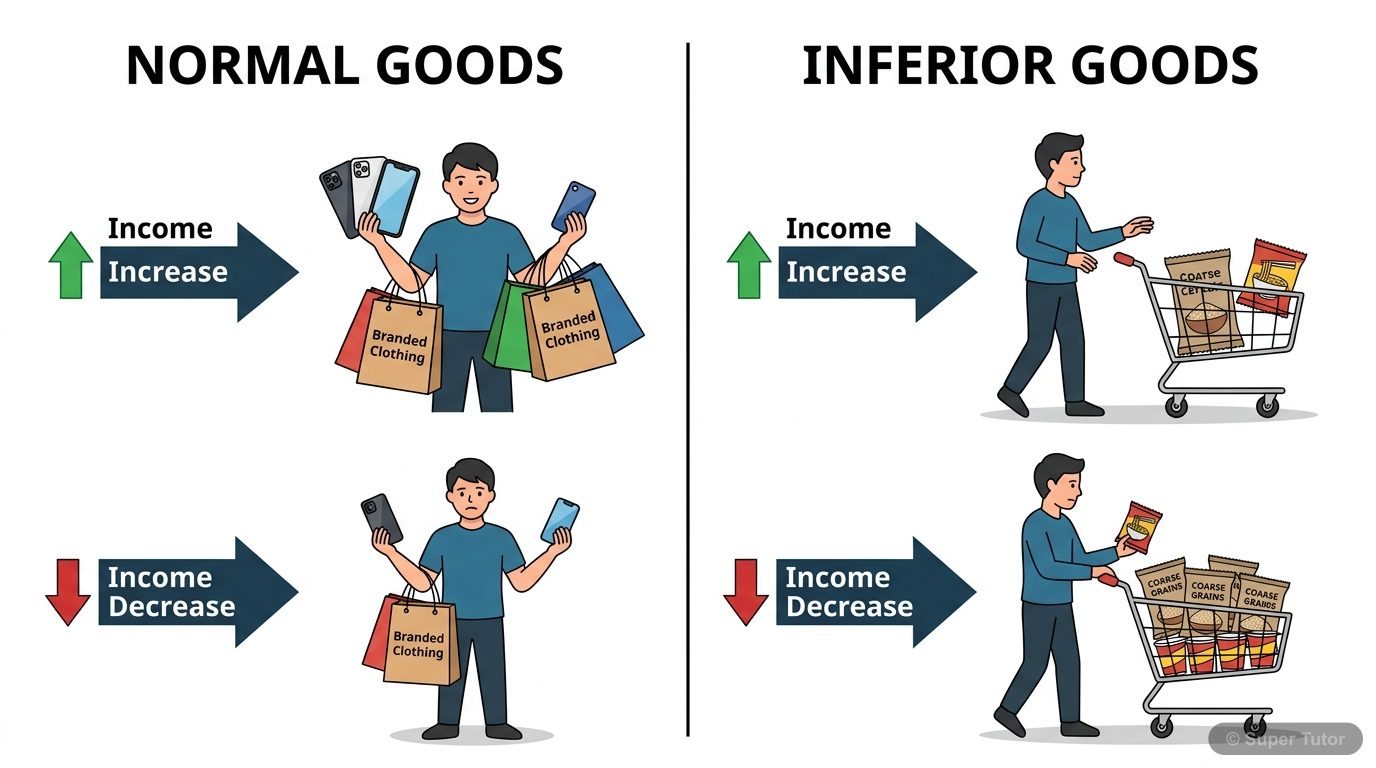
One of 8 illustrations for Elementary Theory of Demand in Super Tutor — alongside flashcards, concept maps and practice questions.
See them allOverview
Demand means effective desire for a commodity backed by ability to pay and willingness to pay. It is a relative concept because it is always linked with price and time. Demand is different from quantity demanded: demand refers to a schedule of quantities at different prices, while quantity demanded
Key Concepts
Demand means effective desire or want
Demand means effective desire or want for a commodity, backed by ability to pay and willingness to pay. Three conditions are necessary: desire, capaci
Demand refers to different quantities
Demand refers to different quantities of a good at different prices, while quantity demanded means the amount bought at one particular price and time.
Joint demand means goods are demanded
Joint demand means goods are demanded together, such as printer and ink. Composite demand means one good has several uses, such as milk. Direct demand
Individual demand is demand by one
Individual demand is demand by one consumer or household. Market demand is the total demand by all consumers in the market. Market demand is formed by
A demand schedule shows price
A demand schedule shows price-quantity combinations. A demand curve is the graphical form of a demand schedule. It slopes downward from left to right
Learning Objectives
- Understand the meaning of demand and the difference between demand and quantity demanded
- Identify major types of demand such as joint demand, composite demand, direct demand, derived demand, and competitive demand
- Explain individual demand and market demand through demand schedules and demand curves
- Understand the determinants of demand for an individual consumer and for the market
- State and explain the law of demand, its assumptions, and its causes
Frequently Asked Questions
What are the important topics in Elementary Theory of Demand for ICSE Class 10 Economics?
How should I revise Elementary Theory of Demand for the ICSE Class 10 board exam?
Sources & Official References
Content is aligned to the official syllabus. Refer to the board website for the latest curriculum.
More resources for Elementary Theory of Demand
Practice Quiz
Test yourself with a quick quiz
Important Questions
Exam-style questions with answers
Revision Notes
Key points for last-minute revision
Formula Sheet
The chapter's formulas in one place
Concept Maps
See how topics connect
Study Plan
Step-by-step plan for this chapter
Flashcards
Quick-fire cards for active recall
Syllabus
What topics to cover
For serious students
Get the full Elementary Theory of Demand chapter — start free.
Quizzes, flashcards, an AI doubt solver and a study plan for ICSE Class 10 Economics. Free to start, no card needed.